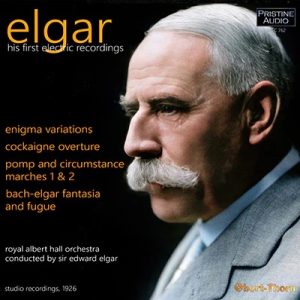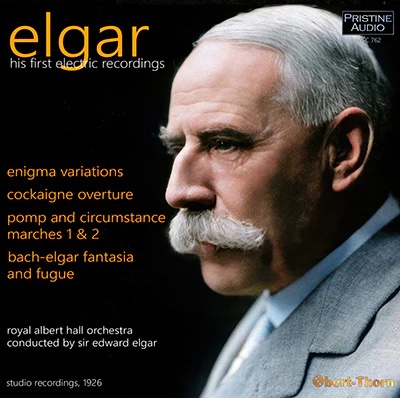
ELGAR: His First Electric Recordings – Pomp and Circumstances Marches, Bach-Elgar Fantasia and Fugue, Enigma Variations, Cockaigne Overture – Royal Albert Hall Orchestra/ Sir Edward Elgar – Pristine Audio PASC 762 (65:25, detailed contents listed below) [www.pristineclassical.com] ****:
Producer and Restoration Engineer Mark Obert-Thorn turns to the banner year 1926, when in Apil and August of that year Sir Edward Elgar took the podium of the Royal Albert Hall Orchestra to engage in what he celebrated as “the greatest discovery made up to that time in the history of the gramophone,” the electrical recording process. Collectors should both embrace this release from Pristine Audio and a companion disc from SOMM Recordings “Elgar from the Archives, Vol. I: Premiere Recordings Remastered” (Somm Ariadne 5046), which restores acoustic performances, 1919-1924, produced by Siva Oke and Lani Spahr. Together, we receive a firm accounting of Elgar’s earliest incursions into recorded posterity from him and those musicians he entrusted with preserving his legacy.
The program opens jingoistically enough with Elgar’s lively 1901 Cockaigne Overture (27 April 1926), an appreciation of the City of London, with its history as “the Land of Delights,” by way of 13th Century poet Rutebeuf. In one unbroken movement, the work subdivides into seven programmatic sections, the good cheer and bustle of London evolve into a “Lovers’ Romance” in E major and then into alternately militant and pious meditation, the military band and the church, respectively, and concluding “In the Streets.” The city-scape’s energy, brash timpani girded by the use of tubas as substitutes for string basses, has Elgar in full throttle, quite relishing his city in terms of open affection, literally nobilmente in the manner of Peter Breughel, the Elder, portraying even excess with endearment, the gift of “the lazy, luscious land.”
Of the Elgar transcription of Bach (28 April and 30 August 1926) Obert-Thorn notes that “a bit of scrappiness in the Fugue” may account for HMV’s limiting the performance to distribution only in France and Italy. The music of Bach helped console Elgar’s creative inertia after the death of his wife in 1920, and Bach’s late music may have provided – as posited by the late Carmine Arena – the impetus for the “Enigma” of the Op. 36 Variations. In conversation, Elgar encouraged Richard Strauss to orchestrate the Fugue; but Strauss’s having failed to proceed, Elgar completed the task in 1922 for the Gloucester Three Choirs Festival. Elgar deliberately utilizes a large ensemble, stating that “‘I wanted to show how gorgeous and great and brilliant [Bach] would have made himself sound if he had our means.” The triple time opening, with treading drumbeats, reminds some auditors of the St. Mathew Passion, but the mightier scoring appears in the Fugue, with brass prominent. The repeat of the exposition subject in a fugue signifies a rarity in Bach, who does not combine individual themes; but Bach scholar and organ virtuoso Albert Schweitzer sees in the da capo format a moral victory “of confident faith.”
Elgar’s duet for violin and piano, Chanson de Nuit (c. 1890), here orchestrated for strings, derives from the same session as Cockaigne, though its companion piece, Chanson de Matin, had been rejected, to be recorded again later, in 1928, with the LSO. The somber dignity of the piece evolves in majestic, nuanced procession, with tiny moments of portamento. The two Pomp and Circumstance marches (27 April 1926) emerge intact, with no cuts. Bold, athletic energy defines No. 1 in D Major, while No. 2 in A Minor projects a startled impetus, nervously and persistently aggressive. The Light of Life, Op. 29 (1896-1903) resembles a cantata, but Elgar preferred to call it an oratorio. Utilizing the leitmotif principle in Wagner, the “Meditation,” which opens the work, Elgar gives voice to themes associated with the Levites’ first chorus, the prayer of the blind man to whom Jesis restores sight, Christ as healer, and lastly, to the Light proper. The kinship in tone to Wagner’s Parsifal Prelude, Act I feels quite palpable.
We have Elgar’s remake of his eminent Enigma Variations (20 August 1926), his having recorded it earlier in 1920 and 1921 for the acoustic horn. Obert-Thorn contributes the epithet “boundless energy” to characterize Elgar’s performance. After a studied presentation of the Theme, rife with rubato and slides, Elgar has his ensemble strings dwell lavishly in the music’s evolution. Intimacy, even spirituality, becomes manifest in the C.A.E. variant, the composer’s wife. The succeeding variants move fleetly but emphatically conscious of the original motif. The most famous and luxurious of the lost, Nimrod, does not take residence in molasses. At key points in the narrative, as such, the influence of the Brahms bass line emerges. “Nimrod” (A.J. Jaeger) casts his own devotional aura, unhurried but mounting to an expressive grandeur that typically defines the Elgar style. Obert-Thorn comments on the labor pains required to revitalize the present incarnation, and his own words encapsulate the aggregate here documented: “affectionate portraits in a most authentic and heartfelt manner, culminating in a brilliant finale.”
—Gary Lemco
ELGAR: His First Electric Recordings
Cockaigne Overture (In London Town), Op. 40;
BACH-ELGAR: Fantasia and Fugue in C Minor, Op. 86;
Chanson de Nuit, Op. 15/1;
Pomp and Circumstances Marches, Op. 39: No. 1 in D; No. 2 in A Minor;
Meditation from The Light of Life, Op. 29;
Variations on an Original Theme, Op. 36 “Enigma” –
Royal Albert Hall Orchestra/ Sir Edward Elgar