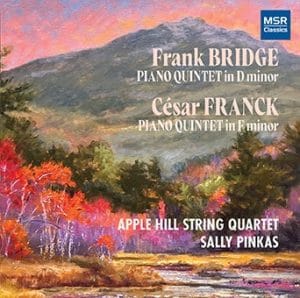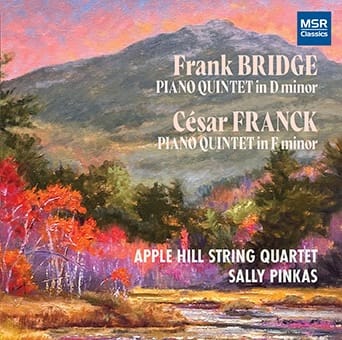
BRIDGE: Piano Quintet in D Minor; FRANCK: Piano Quintet in F Minor, Op. 14 – Apple Hill String Quartet/ Sally Pinkas, piano – MSR Classics MS 1815 (60:14) (1/25) [Distr. by Albany] *****
Composer Benjamin Britten spoke of his mentor and teacher Frank Bridge 1879-1941) that he evinced a “instinctive inclination towards the French tradition of skill, grace, and good workmanship.” The Bridge Piano Quintet (1905; rev. 1912) demonstrates the composer’s compulsion to the cyclic form established by Franck, Chausson, and D’Indy. As a practicing viola player, Bridge – a member of the English String Quartet – well knew the piano quintets of Schumann, Brahms, and Franck, and he compressed his original four-movement quintet of 1905 into a three-movement structure that would repeat and embellish motifs from the first movement throughout the whole. The 1879 Franck Quintet stands a feverish testament to his ardor for a mistress; and the work’s openly Wagnerian, sensuous sensibility, in all its Tristan ethos, infuriated the dedicatee, Camille Saint-Saens, to abhor it.
The Frank Bridge work has debts both to Brahms and Fauré, its opening Adagio – Allegro moderato employing the violin (Elise Kuder) and cello (Jacob MacKay) to introduce a soulful motif that the viola (Mike Kelley) accelerates into the Allegro moderato. The melody devolves into the kinds of sequences that Brahms relishes, although the full throbbing of the melody, when it erupts, suggests that British post-Romanticism has attained a fine peak. Hazy harmonies in French colors permeate the texture, which often assumes a liquid, lushly thick sensuousness, well in the style Franck’s imitations of Wagner. The piano part seems to muse introspectively, sometimes dipping into the nether bass regions for minor-key, chromatic identity. When the harmonic movement becomes suspended, the broad stasis and melodic fragments seem to borrow moments from Schoenberg’s Verklaerte Nacht.
The second movement, Adagio ma non troppo – Allegro con brio – Adagio ma non troppo – derives exactly from Bridge’s 1905 original, now extended by the composer’s utilizing an abbreviated form of the slow, evocative tune as an intrusive and witty scherzo, Allegro con brio. The musical texture reminds us of Dvorak’s use of the dumka as a device for tempo shifts. The ternary form manifests itself as the initial Adagio ma non troppo returns in order to effect an impressive climax.
A subordinate theme in movement one provides the fiery impetus for the Allegro energico last movement, here enunciated angrily by the keyboard after the initial string attack. Tumultuous emotion energizes the momentum of this music, with brief expressions of more placid recollection trying to stem the surges of yearning. A moment of chordal versus pizzicato color makes a poignant moment, before the keyboard assumes command of the more liquid expression. A sense of a huge tidal wave develops, much in the Franck/Wagnerian mode. The first movement theme recurs, typical of the cyclic gambit, once more colored by pizzicato gestures in the second violin (Jesse MacDonald) and the cello. The romantic impulse dominates as the music sweeps forward to a ravishing, potent coda.
The Franck Piano Quintet, permeated by frequent, obsessive modulations, marks the fin-de-siècle sensibility that for Schoenberg exhausted the limits of traditional tonality. Like Liszt, Franck practiced the art of thematic transformation, imposing a ground-theme that would recur in diverse permutations throughout his composition. The opening Molto moderato quasi lento – Allegro grips the listener from the strings’ outset, soon establishing a dialogue between first violin and piano, followed by vibrating strings for the secondary tune that relishes half steps of increasing intensity. At times, Pinkas’ keyboard part resembles an obsessive toccata; at other points, her part expresses a terrible languor in scalar motions. The persistence of erotic tension ceaselessly accumulates, a maelstrom of passionate torment, especially in the barrage of keyboard eighth notes. The sheer, symphonic breadth of the movement – brilliantly maintained by our ensemble – overwhelms the medium, as the music becomes a tone-poem luxuriant in its aggressive fervor. The three, grim piano chords that end the movement will quicky recall the Bridge work one just auditioned.
Franck has rarely executed as touching a moment as he realizes in the second movement, Lento con molto sentimento, initiated by the soft piano chords that closed movement one. Replacing the momentous fff directives come nuanced ppp indications of a reserved, revered intimacy. A series of sighing gestures, rife with the opening motifs of the first movement, now assume harmonic and textural variety. Franck asks the individual players to pair with one another in somber, emotionally agitated, duets. Pinkas reveals herself as master of hues, of an ever-shifting palette that often throbs in erotic transitions. The violin-piano episodes prove exemplary for sensitive articulation.
Eerie tremolos and buzzing ostinatos announce the last movement, Allegro non troppo ma con fuoco, a veritable moto perpetuo in bravura style. The dire keyboard part seems to thrive in martial, potentially explosive motifs. A sweeping, pendulum-style gesture carries us ineluctably forward, with hints of the first movement theme. At its last incarnation, Franck calls for Ritenuto un pocchetino il tempo – a restraint, a holding back, as if to recall the initial urgency of spiritual journey’s expansive trek through an expression of undying passion. This has been a recorded experience that warrants a live performance by these artists to verify their superb, cogent mastery of this medium.
—Gary Lemco