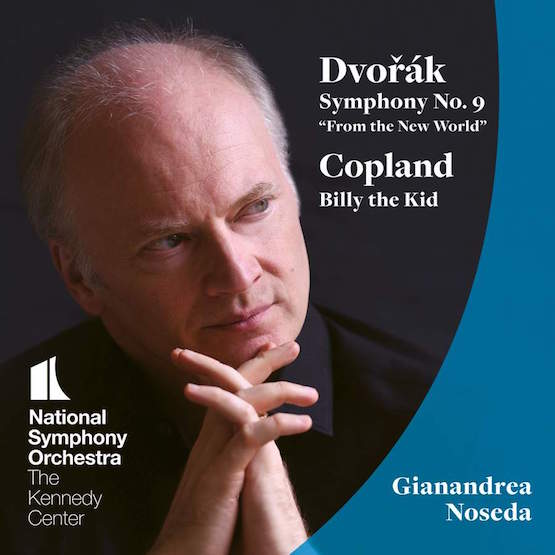
DVORAK: Symphony No. 9 in E minor, Op. 95 “From the New World”; COPLAND: Billy the Kid – Suite – National Symphony Orchestra/ Gianandrea Noseda – SACD NSO 00001, 62:30 (2/21/20) [nationalsymphony.org] ****
Audiophiles will doubtless be happy to discover this inaugural issue from the National Symphony Orchestra, The Kennedy Center’s own label (rec. 6-9 June 2019) that features two approaches to “Americana.” Lincoln Kirsten of the Ballet Caravan in 1938 suggested the story of outlaw Henry McCarty (Billy the Kid) to Aaron Copland, who dutifully, if not idiomatically, consulted cowboy songs of the period as a basis for thematic development, much as Antonin Dvorak had indicated American composers might do to evolve a national style. Eugene Loring chose to arrange the choreography for the new ballet.
The eight sections of the suite comprise some two-thirds of the ballet proper, beginning with the Introduction: The Open Prairie, whose parallel fifths invoke a sense of spatial landscape. In the ensuing movements, such as Street in a Frontier Town and Mexican Dance and Finale, we hear a combination of “Git Along Little Dogies” and “Bury Me Not on the Lone Prairie,” in brash, virile colors, courtesy Blanton Alspaugh, Recording Producer. The rhythms, already swaggering in infectious, Mexican and Southwest syncopations of a Jarabe, assume a canter we recall from El Salon Mexico. In the midst of the Mexican Dance we hear “Goodbye Old Paint, I’m Leavin’ Cheyenne.” The Card Game at Night enjoys a nocturnal serenity imbued with “Great Grand Dad.” Heavy tympani and percussion invoke the Gun Battle, from which follows Celebration of Billy’s Capture. The sad Billy’s Death laments the passing of a popular hero who had become a legend in his own time. French horns and powerful brass revisit The Open Prairie, which now assumes the power of a pageant, an apotheosis.
The Noseda approach to Dvorak’s 1893 From the New World, excepting Noseda’s decision to take the first movement repeat in the Adagio – Allegro molto, much resembles the streamlined, pointed conception from George Szell and the Cleveland Orchestra some two generations ago, and played with equal instrumental precision. Noseda loves to milk the melodic strings – in G Major – while his brass and tympani underline the dark tensions that pass below the flute, oboe, and clarinet. A real ferocity evolves in the development section, the seamless transition between themes constantly in rich focus. The sense of lyric nostalgia benefits from Noseda’s idiosyncratic rubato, though his realization has not the tragic color of the Fricsay recording with the Berlin Philharmonic. The last pages quite literally require an asbestos podium.
The composer’s own nostalgia his native Bohemia combined with his reading of The Song of Hiawatha to inspire the lovely Largo movement, opening in the home key of E minor but evolving into D-flat Major. The funeral of Minnehaha may provide a literary basis, but the intensely personal style of the music – featuring the English horn (Kathryn Meany Wilson) – transcends the medium by entering the realm of chamber music with a selected string ensemble. Brilliant fanfare thunders forth for the Scherzo: Molto vivace, a Bohemian furiant adjusted to Longfellow’s Indian Dance from Hiawatha. The thundering tympani might nod to the second movement of the Beethoven Ninth. Noseda imparts to the central Trio section more of a galloping, Viennese waltz than a Native American feast dance. The quality of the bassoon work (Sue Heineman, Principal) warrants close attention. The last movement, Allegro con fuoco, evolves in sonata-form, but Dvorak utilizes its development to proceed cyclically, re-engaging prior themes, particularly in the second movement. The dynamic aggression of Noseda’s National Symphony will remind auditors some of the fine renditions we have had from the likes of Toscanini, Kubelik, and Talich. Consistently, the character and quality of the woodwind and brass definition has proved superb. When Dvorak applies riffs that seem to arise from Wagner’s Venusberg, the transformation of Native American materials to Bavarian, empyrean regions seems complete. Prior to the exuberant coda, we have that “and so my children” rhetoric that informs all late Dvorak, especially in his symphonic poems, imparting to the narrative a timeless message, old as Aesop.
—Gary Lemco