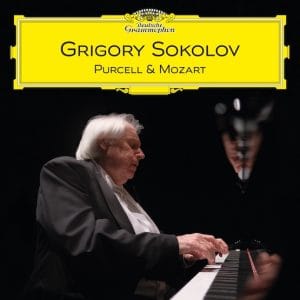
Grigory Sokolov – Keyboard works of Purcell, Mozart, Rameau, Chopin, Bach – DG 486 6263 (2 CDs: 37:29; 57:33, complete listing below) (8/17/24) [Distr. by Universal] ****:
I confess to having discovered Russian pianist Grigory Sokolov (b. 1950) rather by accident, my having unearthed the EMI/Melodiya recording of the Saint-Saens Piano Concerto No. 2 with him and Neeme Jarvi among the LPs amassed at WHRW-FM, SUNY Binghamton. The slick facility and applied nuance of the performance, coupled as it was with Schumann’s Carnaval, demanded I pay more attention.
Sokolov has come to demand that his performances be captured live rather than in the recording studio, so preserving his unique spontaneity and communication of the moment. He has reduced his programs to one per year, and this recital has its origin in Spain, from 16 and 18 August 2023. The posthumously published keyboard pieces of Henry Purcell (1659-1695) remain uncommon repertory for virtuoso pianists, since his familiar provender lies in string consort music and festive voluntaries. Sokolov’s nuanced control of staccato figures, infused with passing ornaments, delivers a modest, contrapuntal tapestry of exquisite charm from the onset, the Ground in Gamut. Much like Glenn Gould, Sokolov can convince us the modern Steinway might still be related to harpsichord ancestry. The four-movement Suite in G Minor benefits immediately by Sokolov’s shaping of the upper voice melody of the Prelude. The ensuing, slow Almand enjoys an archaic, delicately persuasive grace. The Corant plays with metric ambiguities, ornamentally expressive. The final Saraband exploits more ornaments, particularly mordents, virtually an emotional, florid extension of the previous pieces.
The more “typical” Purcell emerges in A New Irish Tune and A New Scotch Tune, instances of the robust folk spirit in the composer. The little Trumpet Tune “Cibell” rings with a pre-Handelian fervor. For the compressed Suite in A Minor, I once more attend to Sokolov’s lyrical Almand, in nuanced syncopation. If one detects the hint of passing bagpipes, the effect is likely intentional. Sokolov’s final movement, the Saraband, reminds us of its stately Spanish origins, poised and elegantly molded. The Round O found emblazoned immortality in Benjamin Britten’s adaptation for his Young Person’s Guide to the Orchestra.
After an equally intimate reading of Purcell’s Suite in D Minor, a work both spacious and rustic, at once, Sokolov addresses the much-admired Chaconne in G Minor, whose spunky trills and stately, voiced antiphons were a delight to Yehudi Menuhin in its string realization. The long-silent audience now erupts into applause.
Disc 2 offers monumental accounts of Mozart’s 1783 noble Sonata in B-flat Major, K. 333 from the composer’s move to Linz and then Vienna; and the late, highly expressive Adagio in B Minor, K. 540 of 1788 Vienna, whose 57 measures become greatly expanded when both of its repeats receive their due. The Adagio’s tragic, noble demeanor relents only at the finale, in the tonic major. Sokolov emphasizes Mozart’s exquisite, galant balances in the first movement of the Sonata, its gracefully ornate modulation from the central key to tis dominant F major. The sparkling, sonic image from Sokolov’s Steinway has been resonantly preserved by the DG engineers. Those influences from Haydn and J.C. Bach that Mozart had imbibed have now been assimilated into a seamless evolution of harmonic and melodic invention. The second movement, Andante cantabile, a theme and variations, offers Sokolov the opportunity to sing an aria of thoughtful, chromatic color. The utter simplicity and clarity of line reveals the purity in Sokolov’s poetic arsenal, often realized in music-box sonority. The finale, Allegro grazioso, proceeds as a graceful rondo, brisk and intricate, at once. The subtle modulations in their progression pass us by with several, poignant hints of their emotional depth of expression. As a lesson in compressed versatility of style, this performance shines in the annals of Sokolov artistry.
The intoxicated audience demands encores, of which Sokolov concedes five. Sokolov’s love for the French Baroque style comes to the fore in two pieces from Jean-Philippe Rameau, his Les Sauvages, in colorful array, rife with drone and accented figures. The playful Tambourin no less assaults us in drone effects in mock-martial procession. The two Chopin miniatures, if you will, counterbalance their relative brevity with a depth of romantic expression. The familiar “Raindrop” Prelude enjoys a grand leisure, the song’s menacingly proceeding into the dark regions of the soul before returning, without guile, to its childlike innocence. The Mazurka in F shudders with erotic mystery, an adumbration of what Scriabin most admired in the Polish Romantic. Sokolov closes his recital with the Siloti arrangement of Bach’s E minor Prelude now in B minor, a brief but sustained meditation that verges on a venerable hymn to music itself.
—Gary Lemco
GRIGORY SOKOLOV: PURCELL & MOZART =
PURCELL: A Ground in Gamut, Z 645; Suite in G Minor, Z 661; A New Irish Tune “Lilliburlero,” Z 655; A New Scotch Tune, Z 678; Trumpet Tune “Cibell,” ZT 678; Suite in A Minor, Z 663; Round O, ZT 684; Suite in D Minor, Z 668; Chaconne in G Minor, ZT 680;
MOZART: Piano Sonata No. 13 in B-flat Major, K 333; Adagio in B Minor, K. 540;
CHOPIN: Prelude in D-flat Major, Op. 28/15; Mazurka in F Minor, Op. 63/2;
RAMEAU: Les Sauvages; Tambourin from Suite in E Minor;
BACH (arr. Siloti): Prelude in E Minor, BWV 855
More information through Amazon