Hamilton Harty conducts SCHUBERT = Cello Concerto in A Minor, D. 821; Symphony No 9 in C Major “The Great,” D. 944 – Gaspar Cassado, cello/ Halle Orchestra/Sir Hamilton Harty – Pristine Audio PASC 282, 71:47 [avail. in various formats incl. hi-res at www.highdeftapetransfers.com] ****:
Sometimes referred to as “the Irish Toscanini,” Sir Hamilton Harty (1897-1941) commands respect for his prowess both as a composer and powerful interpreter, particularly noted for his work in the music of Berlioz. Producer and editor Mark Obert-Thorn resuscitates two potent Schubert inscriptions, the first of which is the arrangement by Spanish cellist Gaspar Cassado (1897-1966) of the 1824 Arpeggione Sonata in A Minor as a cello concerto (rec. 5 March 1929), performed with an unnamed pick-up British ensemble. Cassado’s tone resonates as both clear and sweet, his phrases arched with the same melodic contour for which his eminent teacher Pablo Casals gleaned fame. An excellent accompanist-conductor–recall Harty’s contribution to Szigeti’s fine 1928 Brahms Violin Concerto–Harty surrounds Cassado with loving harmonies, and the Adagio seems all too brief. The lovely segue to the Allegretto finale proves worth re-hearing, the movement itself a tender, if lumbering, dance of limpid beauty, especially as the woodwinds support Cassado. The original singing quality of the arpeggione (a bowed guitar) endures in this glowing rendition, in which the Allegretto’s middle section transition momentarily becomes a charming wind serenade.
The Schubert Ninth Symphony (14 January 1928) allows Harty his natural breadth and expansive vision as a committed interpreter of the Romantics. The initial series of first movement themes proceed a flexible linear fashion, a cross between Toscanini’s literalism and Mengelberg’s idiosyncratic rhythmic canter. Wonderful support in the Halle brass and lower strings aid in the steady acceleration of two distinct tempos over an unfaltering sense of pulse. The Halle woodwinds–scored mostly in thirds–consistently impress us with their tonal accuracy. Once the essential motion is fixed, Harty moves the Allegro impulses with fervent authority, a combination of flowery lyricism and explosive menace. What clearly emerges from the colossal amalgam of forces and stunning periods is the potent discipline of the Halle orchestra, certainly on a par with ensembles on the European continent, with Harty himself functioning on a sonic level with Albert Coates. The peroration simply glories in the aural splendor of Schubert’s plethora of ideas, with Harty’s deliberate slowing down of the coda to underline a gripping realization of unique power.
The sonics can occasionally sound thin and reedy in the A Minor Andante, but Harty’s resolute outer sections provide a grand contrast to the sublimely slow middle section, whose horn solo tolls a single note of metaphysical questioning. We do hear Harty’s recourse to portamento that aligns him more with Mengelberg than Toscanini, but the fervor of the reading never allows the drama to degenerate into less than noble sentiment.
The C Major Scherzo ushers in a series of visceral dance energies, the song a combination of laendler and ennobled courtly or dramatic tissue. Wonderful legato strings announce the main melody of puttering woodwinds. Harty’s tempos, quite brisk, urge the virtuosic impulse, a competitive vision akin to Mengelberg’s. The rustic character of the trio–given some frenetic alterations of the tempo– comes forth from a sonority that suggests the drone of a hurdy-gurdy. A Scherzo with “personality,” to be sure! The whirlwind Allegro vivace becomes a showpiece of orchestral discipline, given Harty’s idiosyncratic approach to the tempo, with his insistence of strong woodwind and string definition. The counter-theme receives the slowing-down that allows Harty to build up a fierce tension while Schubert expands the sonata-form to Herculean proportions. The transition to the coda–another miracle of measured rubato–testifies to Harty’s natural musicianship. Vitality and spontaneity of feeling mark every bar of this heroically epic movement, a monument to its composer and an immensely accomplished conductor.
— Gary Lemco
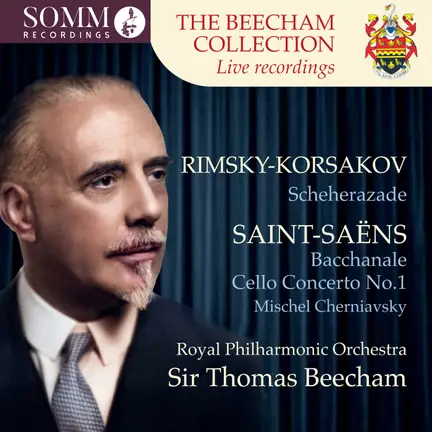
Sir Thomas Beecham conducts Rimsky Korsakov, Saint-Saëns – SOMM
Three mid-century concerts