JOHN CAGE: ‘108’ Symphony for large orchestra; ‘109’ (One8 and 108) cello orchestra; ’110’ (Two3 and 108) Double concerto for sho and conch shells – Soloists/Chance Philharmonic – OgreOgress Productions ASIN:B004HUX47A (DVD audio, 96kHz/24-bit stereo) 130:30 ***:
John Cage’s place in twentieth century music is that of the grand experimenter who sought to reinvent what is expected out of music and redefine the processes by which it is created. These works represent a prime example of his belief that music can create itself through live performance with little to none of the conventional “restrictions” in place, such as duration, tempo, volume and color. Each of these extended pieces is late Cage written during the last twenty years of his life and are of his “Number Pieces” series. This series, which includes much smaller works like his “Four” for string quartet also reflects some of the philosophy and aesthetic from his painting of the same era. (That is, in large extent, what makes Cage such a fascinating individual; his explorations into music, visual art and the spoken/written word all were flavored by his fascination with indeterminacy.)
The interesting thing about these three long multi-section works is that there are actually some elements of composition that are completely prescribed. In these cases, tone color is at least focused around a germ timbre, winds, cello, conch shells and sho (very Asian effects). What is even more prescribed is duration. In fact, the main reason, it seems, that this performance is recorded on the very unusual choice of audio DVD is to accommodate the massive length of the works, both individually as well as a set, that does not get interrupted with disc changing. For example, each piece is 43’30” which booklet annotator George Adams says is a likely analogy to Cage’s infamous “silent” performance piece 4’33” (1952). The extended silences between movements of these works, ranging in duration from 1’30” to 4’00 are a part of the piece and part of the experience. The listening, especially when contrasted to virtually any traditional form of Western music does require immense patience, having to hear the very subtle timbre changes and the very slowly-evolving – and spontaneous – harmonies. The scored silences are intended to provide space for reflection.
Sonically, the DVD is good, though certainly any CD or SACD will provide at least as much depth to the sound. I have not heard enough audio DVDs to know if this one is a particularly good example or not. [And most are surround…Ed.] The performances by the Chance Philharmonic are also just fine (I guess…) The ensemble does not play with a conductor in the traditional sense and it appears that OgreOgress specializes in music of a most unusual nature. According to their website they have other albums of Cage’s music – including more of the “number pieces” – as well as some Morton Feldman (which would interest me a great deal) There is a place for music of this type and it should be recorded, distributed and presented I admit that I have spent a lot of time studying Cage’s music and I always find at least the concept, and sometimes the aural effect, to be quite interesting. The thing about this release, though, is that the listener needs to be already aware of what listening to John Cage means or at least be prepared to be open and patient. No dashing off to get a beverage during those silences. That destroys the intent.
[This is the 17th in a series of OgreOgress DVD-As and CDs devoted to previously-unreleased works by well-known avant composers…Ed.]
— Daniel Coombs
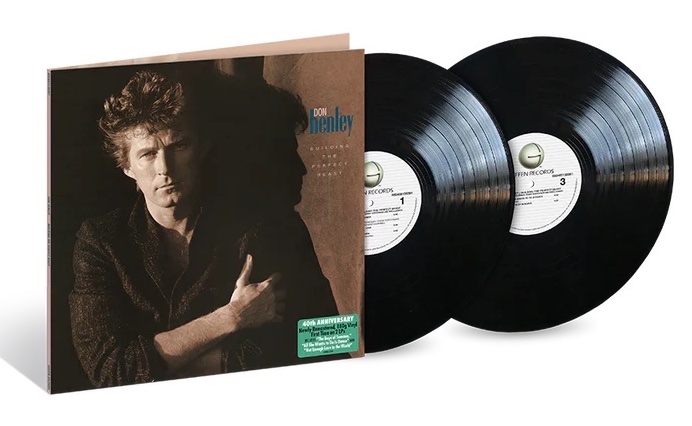
Don Henley – Building The Perfect Beast – Interscope Records
Interscope Records releases a vibrant re-mastered 180-gram double vinyl of Don Henley’s enduring solo album.