Josef Suk – The Early Recordings = DVORAK : Four Romantic Pieces, Op. 75; Sonatina in G, Op. 100; Sonata in F, Op. 57; SUK: Four Pieces, Op. 17; SMETANA: From the Homeland: 2 Pieces; MARTINU: Duos for Violin and Cello Nos. 1 and 2; JANACEK: Violin Sonata; JEZEK: BRAHMS: 3 Violin Sonatas; Valse in A, Op. 39, No. 15; GRIEG: Violin Sonata No. 3 in C Minor, Op. 45; RESPIGHI: Violin Sonata in B Minor; DEBUSSY: Violin Sonata in G Minor; Clair de Lune; Le plus que lente; POULENC: Violin Sonata; FRANCK: Violin Sonata in A Major; SCHUBERT: Sonatina, Op. 137; Duo in A Major, Op. 162; SCHUMANN: Evening Song, Op. 85, No. 12; MOZART: Duo for Violin and Viola, K 424; HONEGGER: Sonatina for Violin and Cello; KODALY: Duo for Violin and Cello, Op. 7 – Josef Suk, violin/ Andre Navarra, cello/ Milan Skampa, viola/ Josef Hala, piano/ Alfred Holecek, piano/ Jan Panenka, piano – Supraphon SU 4075 2, (6 CDs) 76:15; 73:14; 77:30; 72:40; 65:25; 60:11 [Distr. by Qualiton] *****:
Czech violinist Josef Suk (1929-2011) could rightly claim one of the most distinguished pedigrees in classical music, the grandson of composer of Josef Suk and the grand-grandson of Antonin Dvorak. The collection here offered via Supraphon includes inscriptions made 1956-1967, and they reveal Josef Suk as a finished artist of high caliber and lofty character, a student of the formidable violinist-pedagogue, Jaroslav Kocian (1883-1950). Upon Suk’s American debut at Carnegie Hall, in 1961, critics lauded his “velvety bow,” his “impeccable beauty of tone,” his “grand bearing,” his “pure and rhythmically bracing play,” testifying to the fact that none of his contemporaries “could offer a greater variety of timbres.” And we must add the fact that, even early in his career, Suk had the advantage of brilliant piano accompanists in Josef Hala (b. 1928), Jan Panenka (1922-1999), and Alfred Holecek (1917-1989), the last of whom had partnered with Jan Kubelik.
Rather than belabor Suk’s mastery in the traditional repertory from Brahms, Schubert, Dvorak, Janacek, and his own grandfather Joseph Suk, the canny collector does well to gravitate to the chamber music rarities, like the 1917 Respighi Sonata, in which Suk and Panenka must maintain a tricky, severely “classical” form in the last movement, a Passacaglia of intricate colors and metric shifts. The often inflated character of the writing keeps the piece outside the mainstream, although its keyboard part becomes demanding with Lisztian rhetorical devices. The Grieg C Minor Sonata (rec. 1956), a piece once favored by Fritz Kreisler, has a strong reading from Suk and Hala, the music rife with Norwegian rhythmic life and melodies that never seem far away from the magic of Peer Gynt.
A real rarity is the 1933 Sonata by Jaroslav Jezek (1906-1942), played by Suk and Panenka. Jezek, who had been a member of the Czech Group of Surrealists and a dear friend of actor George Voskovec, fled to New York City to escape Nazism, but he died from chronic kidney disease. Jezek’s moody twenty-minute Sonata is in four movements, plaintively dissonant and explosively agitated, hinting of both Stravinsky and Bartok, but uniquely, urgently lyrical in its own terms, which remain tonal. The two middle movements, Lento and Largo, respectively, make a strong case for a lyric gift under the sieges of the world as it existed in 1933. The last movement, Allegro, proceeds as a grotesque dance that sets the violin’s lyricism against the keyboard’s askew percussion. The writing becomes thickly obsessive, only “simplifying” in the latter part of the movement, although the modal harmonies suggest the influence of ironic Prokofiev as well as Bartok.
For the two Duos for Violin and Cello by Bohuslav Martinu, Suk has the grand athletic cello virtuosity of French phenomenon Andre Navarra (1911-1988) in recordings made 1964 and 1966. The Duo No. 1 consists of two movements, Preludium and Rondo. The musical blend between Suk and Navarra proves melting and luxurious in the opening movement, wiry and brilliant in the expansive second movement, marked Allegro con bio. Navarra himself enjoys a lengthy cadenza that testifies to a musical acuity and refined, melodic sensibility of uncommon power, one that conductor John Barbirolli exploited in their noted record of the Elgar Cello Concerto. The Duo No. 2 in three movements seems even more ardently nationalistic than the first while exercising the composer’s impressive capacity for counterpoint. A romantic strain infiltrates the opening Allegretto, an homage to the spirit of Dvorak or Smetana. The heart of the piece, an exalted Adagio, extends the lyric impulse, Navarra’s cello often serving as a lute or guitar to accompany a lachrymose serenade. The Poco allegro finale concedes to the composer’s polyphonic modernism, albeit still susceptible to melody of the highest order.
The all-French Disc V opens with a moving realization by Suk and Panenka of the Debussy Sonata and its tender but acerbic commentary on the sensibilities of 1915. Suk’s throaty violin tone enriches the sound dramatically, alternately caustic and acutely nostalgic. Even more compelling than the epic Franck Violin Sonata in A emerges the Violin Sonata of Francis Poulenc. Poulenc composed the work in 1942 for Ginette Neveu and the memory of poet Garcia Lorca, revising the last movement in 1949, in reaction to Neveu’s premature death in an airplane crash. Melodic but touched by the tragic Muse, the opening movement Allegro con fuoco takes its syntax from the Franck Sonata. The Intermezzo bears a Lorca quotation: “The guitar makes dreams weep,” and the music carries the ethos of Iberian folksong. The keyboard virtuosity, for power and persuasion, of Jan Panenka has rarely risen to the forefront with such authority. The last movement, Presto tragico, may suggest a contradiction, but the beat moves quickly, and the tone of the somewhat jazzy figures remains dark, even wistful in the manner of his Gloria. Suk and Panenka sell this elusive piece in a special realization worthy of repeated hearings.
Perhaps the most musically engaging of the reissues, Disc VI, opens with Mozart’s second of his two Duos for Violin and Viola, this the B-flat Major (rec. 1961), performed by Suk and Milan Skampa (b. 1928) of the Smetana String Quartet. The clear contrapuntal lines, richly intoned by these two sympathetic artists, rivals the inscription made by Joseph and Lillian Fuchs. By the end of this extraordinary duet, we are more than ready to hear them perform the Sinfonia Concertante in E-flat Major, K. 364.
Andre Navarra joins Suk twice more for the last two selections: the 1932 Sonatina for Violin and Cello by Arthur Honegger and the 1914 Duo, Op. 7 for Violin and Cello by Zoltan Kodaly. Honegger’s piece proves to be a serious moodily mercurial procession of emotions that introduces swaggering, broken phrases, harmonics, and a balanced sense of counterpoint, when deemed necessary. Some of the late chords in movement one, Allegro, remind us of Saint-Saens’ Danse macabre. The middle section of the Andante, marked Doppio movimento, offers some bittersweet writing that nods to Bartok; the whole movement casts an uneasy, hazy aura over the soul. The last movement, Allegro, enters a more playful territory, the bows bouncing and the strings plucked, bowed, or thumped in a gypsy style. Honegger’s employment of cross rhythms becomes infectious and virtuosic, especially in tremolandi. Navarra can soar and sing most lustily, and Suk plies his part with striking virtuosity.
Kodaly’s work, at least for Bartok, always embodies his faith in the spirit of the Hungarian folk soil and its people. Essentially vocal in character, seeking tonal and harmonic balance, Kodaly’s music rarely assumes the harshly pessimistic and discordant persona that Bartok conveys. Together, Suk and Navarra achieve a fluid ensemble that rivals what Indiana University masters Gingold and Starker would communicate in their collaborations in this songful inventive pairing of instruments. That Kodaly played the cello himself likely accounts for the richness of Navarra’s part; and he and Suk invest a valedictory power into the Adagio movement, which enters into occasional episodes of haunting quiet as well as ardent lamentation. The opening violin part of the last movement, Maestoso e largamente, may remind some of Vaughan Williams’ The Lark Ascending, but the affect quickly becomes more dire mournfully rooted in the Magyar tradition. The ensuing Presto introduces a feral, even contrapuntal, village round dance in stinging colors, become insistent through Suk and Navarra’s biting intonation. The finale chirps more than sings, with the cello’s adding a few gruff riffs before both instruments sail into the last chord.
—Gary Lemco
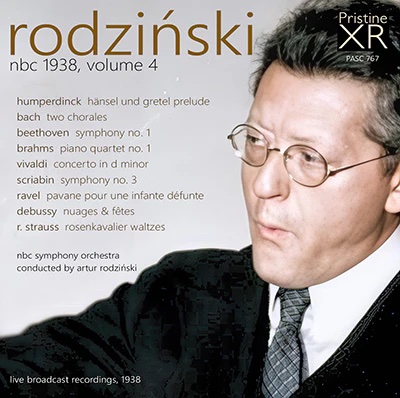
Rodziński Conducts the NBC Symphony Orchestra, 1938 Vol. 4 – Bach, Beethoven, Brahms, Strauss… – Pristine Audio
From Pristine – Volume 4, of their revival of the NBC Symphony concerts led by Artur Rodzinski.