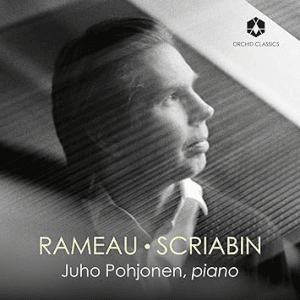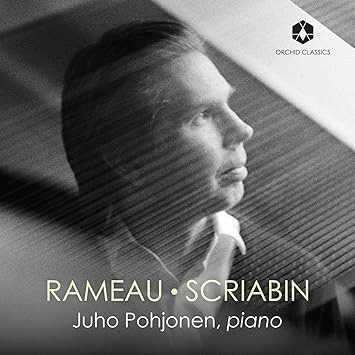
RAMEAU: Suite in A Minor, RCT 5; Suite in G Major, RCT 6; SCRIABIN: Sonata No. 6, Op. 62; Sonata No. 7, Op. 64 “White Mass” – Juho Pohjonen, piano – Orchid Classics ORC 100312 (80:36) (5/2/24) [www.orchidclassics.com] ****:
Finnish piano virtuoso Juho Pohjonen (b. 1981) provokes our musical curiosity by juxtaposing two distinct personalities, that of the epitome of the French Baroque style, Jean-Baptiste Rameau (1683-1764) and the Russian mystic Alexander Scriabin (1872-1915). Rameau set forth the edicts for French taste in his 1722 Traité de l’harmonie, which his 1728 Pièces de clavecin realize in their approach to rhythms (notes inégales), instrumentation (on the grand ravelement, double keyboard of five octaves), and the brilliant execution demanded of the spectacle des mains (the art of hand-crossing) to enliven the sonority. Scriabin possessed a highly subjective, imaginative vision, solipsistic in fact, that projected his ego upon a universe profuse in color and innate, monumental poetry. Both composers blend a demand for precision and imaginative freedom, simultaneously.
Pohjonen opens with Rameau’s Suite in A Minor, a set of dance movements that no less embrace genre and character-pieces. The emphases on clarity, order, and good taste reflect the French Enlightenment, de rigeur. The seven selections gravitate between the major and minor modes of A, often opting for enharmonic transitions, while allowing the performer his own decisions as to ornaments – especially trills and mordents – and repeats. The stately Allemande and lively Courante exemplify the Rameau sensibility in brief, both delivered with a transparency that remains incisive and compelling. Intricate half-step patterns, quick scale patterns, and wide leaps pose no obstacle, nor do the sudden accelerations and leaps in liquid arpeggios. The vocal character of the writing impresses us, as it would eventually move Debussy and Ravel. For graceful, balletic mimicry, the (Spanish) Sarabande suggests the stylized gestures required for the theater. Three genre pieces ensue, the first of which, Les Trois Mains, insists on clever counterpoint to convince us of Pohjonen’s extra hand. Fanfarinette hints at gracefully delicate innocence of character, while La Triomphante projects hauteur in the form of a rondo and periodic episodes, the diminished chords alternately legato and staccato. The concluding Gavotte et six Doubles has had independent life, as witnessed by pianists Casadesus and Cherkassky. The original, simple, galant tune acquires complex momentum as it proceeds to a colossal height, a thrust at Parnassus.
Rameau’s Suite in G Major will employ the 8-note chordal structures that Scriabin will himself utilize in his especial search for transcendence. The opening piece of thus eight-movement suite, Les Tricolets, captures the flurry of knitting-needles in the precise, staccato notes en rondeau. L’Indifférente suggests a conversation involving two voices, neither of which cares to contradict the other. Elegance and introspection alternate in two successive Menuets, in major and minor modes.
La Poule offers a barnyard conceit that Haydn will find equally compelling. Les triolets, as the title insinuates, offers a tripartite melody, the motion in sustained, sighing triplets. Les Sauvages appears to be a nod to Jean-Jacques Rousseau and his “noble savage.” Whether the analogy, with this piece in wide, jabbing leaps, holds for the New World in general or Edgar Rice Burroughs’ Tarzan is a matter of taste. Rameau’s penchant for experimentation blatantly ushers forth in the expansive L’Enharmonique, with its eight-note group of half and whole steps. The dramatic pause on an unresolved, diminished chord opens the way for future explorers, Beethoven, Chopin, and Scriabin, not to mention Debussy’s eerie footsteps in the snow. The suite ends in the spirit of the elusive feminine: L’Egyptienne, a depiction of an alluring, exotic character in descending arpeggios and in the spectacle of crossed hands. As an ethnic type, the musical characterization has the power to seduce the later Saint-Saens.
Even in his “romantic” period of development, Alexander Scriabin felt confined by the traditional tonal system, so he experimented with chords built on fourths, taking Wagner and Liszt as his first points of departure. By 1911, the year of his Sixth Sonata, the octatonic chord had been instituted, despite its limits for modulatory development. The artificial, narrow range of expressive possibilities becomes its own challenge, as the self-centered ambiguities of key and color hues circulate among themselves repetitiously, then suddenly and convulsively accelerate in open rebellion. The haunted dream quality “takes shape,” as Scriabin demands it, and the incursion of “mysterious forces” unnerve us in their violent, jarring character. The whole broods and then surges forward to a voluptuous finale, a maelstrom of conflicting forces, the dance and the delirium compounded to an incandescent extreme. Scriabin wants terror as well as ecstasy, possibly a distinction without a difference, agonizingly realized by our Finnish master.
Having succumbed to his own, intoxicated reverie of transcendent, chromatic harmony in Sonata No. 6, in Sonata No. 7 of 1912, “White Mass,” Scriabin seeks refuge in the past, especially in diatonic harmony, the very “anachronistic” basis of the major and minor scales. Theme I (4/8) must attack “mysteriously sonorous,” seeking to throw off the “mortal coil” of the physical world, its angry conflicts and spiritual darkness. As sharps and flats collide, the music drifts into a calm 6/8, interrupted by silken then choppy scalar gestures. Theme II demands “celestial voluptuousness,” and the trill assumes the task of translating physical experienced into the “deep softness” of pure aether.
At the mid-point of the single movement, a crisis erupts, rife with broken chords, melodic fragments, sudden dynamic shifts, and pianissimo alternates with bell or gong tones. Suddenly, luminosity and erotic reverie emerge, “insinuating” themselves in a motto: E-E#-F#. A series of scintillating trills, evaporating even as they appear, take us to an ineffable realm beyond reason, into Scriabin’s cosmic sense of faith. Potent, resonant Scriabin and visionary Rameau from a still-youthful acolyte.
—Gary Lemco
More Information through Amazon