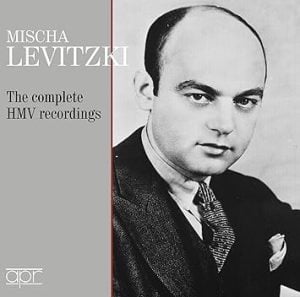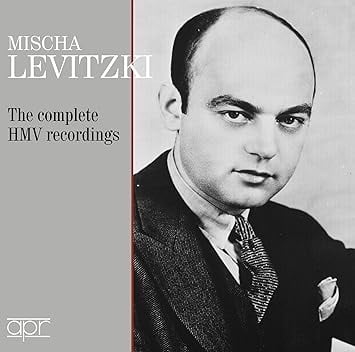
MISCHA LEVITZKI: Complete HMV Recordings, 1927-1933 – Mischa Levitzki, piano/ London Symphony Orchestra/ Landon Ronald – APR 6043 (2 CDs = 78:58; 74:45) (3/5/24) [Distr. by Naxos] ****:
APR has re-issued their own 1992 APR7020 set devoted to Kiev-born, piano virtuoso Mischa Levitzki (1898-1942), now with corrected pitches and enhanced dynamic presence. Levitzki impressed me many years ago in my listening, with his brilliant filigree in pieces like Liszt’s 6th and 13th Hungarian Rhapsodies. He was a pupil of Michalowski, Stojowski, and Dohnányi and quickly established himself as a major rising star in the 1920s. Despite a meteoric rise to fame, Levitzki had his detractors, like Vladimir Horowitz, who felt Levitzki possessed “merely fingers.” Abram Chasins, on the other hand, writes of Levitzki as “a vibrant master workman: everything was pure radiance. . .” Levitzki’s premature death from heart failure in 1942 certainly robbed the music world of a dynamic talent whose maturity might well have brought many bounties.
Having already been somewhat familiar with Levitzki’s Liszt, I decided to audition Disc 2 first, leading off with the 11-14 November 1929 E-flat Concerto with Landon Ronald. In the opening Allegro maestoso, Levitzki reveals a fluid legato, and his own bravura in scalar passages and quick filigree arouses the usually routine accompaniment from Landon Ronald. Levitzki’s pearly play invests the second movement, Quasi adagio, with a poetic luminosity that soon segues into dramatic tension, albeit a mite pesante.
The extended, high trill that segues to the Allegretto vivace will prove vital to his two renditions of the La Campanella Etude, recorded December 1927 and November 1928, their respective torrents differing by one second! The last movement of the Concerto, Allegro marziale animato, has Levitzki in full throttle to complement the LSO triangle, horns and winds, a flighty dash and gallop to various virtuoso roulades and curlicues.
The succeeding Liszt arrangement of Bach’s Prelude and Fugue in A Minor, BWV 543 from 16 December 1927 moves from rather chaste austerity to a more serenely confident bravura style, projecting an organ sonority, alternately thick and crystalline, that retains clarity in the midst of Bach’s compelling strettos. The D-flat major Concert Etude “Un sospiro” (21 November 1928) projects a romantic sweep convincing and affecting, despite the frequent heavy hand.
With the swaggering gypsy scale that begins Hungarian Rhapsody No. 6 in D-flat Major (15 December 1927 from Small Queen’s Hall, London), Levitzki embarks on his trinity of rhapsodies, extending into No. 12 in C# Minor (16 March 1933), and No. 13 in A Minor (16 March 1933), the latter two recorded at Studio 3, Abbey Road. Levitzki’s No. 6 seems to provide a model for the later rendition on RCA by Byon Janis. The No. 12 calls upon Levitzki to provide cimbalom effects, which he manages with sly aplomb. The dragonfly, music-box effects prove no less magically delicate. The last pages beg to be coated with asbestos. The A Minor No. 13 casts its meandering, askew beauty in a manner that begs the epithet “exotic.” Levitzki projects the competing modalities suavely, shifting accents and metrics with idiomatic panache. A brief pause, then the quicksilver runs on a tune Brahms found equally compelling for one of his Hungarian Dances. Levitzki’s staccato runs and repeated notes, despite a finger slip or three, embercatapult us to an explosive, devastating coda.
Disc 2 concludes with a triptych of short pieces: Moszkowski’s La Jongleuse, Op. 52/4 (16 December 1927), rather prosaic despite its bravura; Rachmaninoff’s popular G Minor Prelude, Op. 26/5 (21 November 1929), heavy on the outside but shimmering in the middle; and Levitzki’s own salon miniature, Valse amour in A Major (21 November 1929), sentimental in a fashion suited to a pianistic Fritz Kreisler.
Disc 1 offers a goodly survey of Levitzki’s Chopin, beginning with two versions of the Prelude in C, then the brief Prelude in A, and the Prelude in F, also played twice, all from 21 November 1929. Each has charm, light feet, and a touch of theater. Two idiomatic waltzes ensue, that in G-flat Major, Op. 70/1 (19 November 1928), with its sentimental lilt; then, from the same session, the slightly angular A-flat Major, Op. 64/3.
Several larger pieces of Chopin enter the lists, with mixed results. The Ballade No. 3 in A-flat Major, Op. 47 (22 November 1928) enjoys a slick patina and poetic gloss, but the approach feels glib and superficial, even hastily, brilliant. The Nocturne in C Minor, Op. 48/1 (21 November 1929) had not been issued in a 78rpm format. The touch and pacing instill a sense of imminent tragedy, on a par with moments in Ignaz Friedman and Artur Rubinstein. Levitzki likes to flaunt his “Aeolian harp” effects, which some auditors may feel disrupts the dramatic continuity, especially when Levitzki speeds up. The Nocturne in F# Major, Op. 15/2 (19 November 1928) receives gentle TLC from Levitzki, a slow and poetic series balanced periods. The central section seems to appear from a mysterious vapor quite special. The Scherzo No. 3 in C# Minor, Op. 39 (31 October 1929) possesses fine motor power, but the approach emphasizes the torrential “étude” capacity in Levitzki, though one must concede his special color range. The last of the grand works concludes with the “Heroic” Polonaise in A-flat Major, Op. 53 (16 March 1933), a truly dramatic tour de force in bold colors. Given the innate bravura Levitzki sports, we must acknowledge his avoidance of cliché in this gripping performance, which certainly indulges Chopin’s nationalist flair.
A set of six pieces then appears, showing off Levitzki’s virtues and defects, if so you care to judge. From 22 November 1928 Levitzki delivers a stylish, canny reading of Domenico Scarlatti’s Sonata in A Major, Kk. 113, sparkling in its quick imitation passages, sudden accents, and vivid, articulate pulsation. The Brahms arrangement of Gluck’s Gavotte from Iphigénie in Aulide (15 December 1927), a staple of German pianist Elly Ney, proceeds in delicate mannerism, almost a rarified museum piece. From the same session, Levitzki makes short work of Eugen D’Albert’s arrangement of Beethoven Ecossaises with a rather pounded certitude. Carl Tausig’s idiomatic arrangement of Schubert’s ubiquitous Marche militaire (22 November 1928) appeals to Levitzki’s stentorian bias. The middle section, however, allows Levitzki a soft, caressing gesture in the Austrian mode. The so-called “Staccato Étude” in C Major of Anton Rubinstein (16 December 1927) carries propulsive motor power and wrist dexterity galore, but profound it is not. This group of virtuoso display pieces ends with Mendelssohn’s Rondo capriccioso in E, Op. 14 (16 March 1933). A grand leisure inhabits the early pages, a sign of the lyricism that might have invested a set of Songs Without Words by Levitzki. Once the elfin filigree sets in, Levitzki’s concern, a la Josef Hofmann, concentrates on finger dexterity in manifold voice parts. The music itself defies the attempt to convert its deft spirit into anything more than a vehicle for technical virtues.
Disc 1 concludes with a more serious work, Robert Schumann’s Piano Sonata No. 2 in G Minor, Op. 22, recorded by Levitzki 10 March 1933. The last of Schumann’s three attempts at a sonata, the genre so dominated by Beethoven, the work consumed Schumann’s attention for a number of years of revision, 1831 to 1838. A light-handed fury marks Levitzki’s approach to the first movement, which wants to capture the psychological dichotomy, that of Florestan and Eusebius, in the Schumann ethos. Too often, the lines, a kind of running “fate motif,” become smeared in the mania of the moment. The Andantino shows off Levitzki in his more refined temperament, a noble, ardent song realized by a musical kinship to Benno Moiseiwitsch. The last two movements, Scherzo and Rondo: Presto revert to dazzle and pyrotechnical wizardry, some thunder and lightning, interrupted by the reflective voice of the poet.
–Gary Lemco
Mischa Levitzky – The Complete HMV Recordings
Disc 1 (78.58)
1-3. CHOPIN Préludes Op 28 Nos 1, 7 & 23
4. Waltz in G flat major Op 70 No 1
5. Waltz in A flat major Op 64 No 3
6. Ballade No 3 in A flat major Op 47
7. Nocturne in C minor Op 48 No 1
8. Nocturne in F sharp major Op 15 No 2
9. Scherzo No 3 in C sharp minor Op 39
10. Polonaise in A flat major Op 53
11. D SCARLATTI Sonata in A major Kk113
12. GLUCK/BRAHMS Gavotte from Iphigénie en Aulide
13. BEETHOVEN/D’ALBERT Ecossaises WoO 83
14. SCHUBERT/TAUSIG Marche militaire D733/1
15. RUBINSTEIN Étude in C major Op 23 No 2 ‘Staccato Étude’
16. MENDELSSOHN Rondo capriccioso Op 14
17-20. SCHUMANN Piano Sonata No 2 in G minor Op 22
Disc 2 (74.45)
1-4. LISZT Piano Concerto No 1 in E flat major S124
LONDON SYMPHONY ORCHESTRA / LANDON RONALD
5. J S BACH/LISZT Prelude & Fugue in A minor, S462/1
6. LISZT Étude de concert in D flat major ‘Un sospiro’ S144/3
7 & 8. PAGANINI/LISZT La campanella: Grandes Études de Paganini, S141/3 (two versions)
9. LISZT Hungarian Rhapsody No 6 in D flat major S244/6
10. LISZT Hungarian Rhapsody No 12 in C sharp minor S244/12
11. LISZT Hungarian Rhapsody No 13 in A minor S244/13
12. MOSZKOWSKI La Jongleuse Op 52 No 4
13. RACHMANINOV Prelude in G minor Op 23 No 5
14. LEVITZKI Valse in A major ‘Valse amour’ Op 2