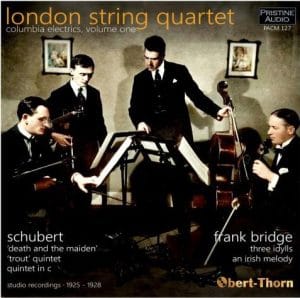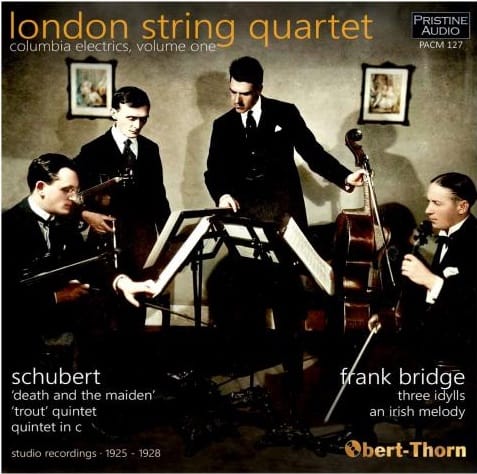
London String Quartet: Columbia Electrics, Vol. 1 = SCHUBERT: String Quartet No. 14 in D Minor, “Death and the Maiden”; Piano Quintet in A Major, “Trout”; String Quartet in C Minor, “Quartettsatz”; String Quintet in C Major; BRIDGE: Three Idylls; An Irish Melody, “The Londonderry Air” – Pristine Audio PACM 127 (complete credits below, 2 CDs = 2hr 19:47) [www.pristineclassical.com] ****:
Producer and Recording Restoration Engineer Mark Obert-Thorn turns his attention to the studio recordings of the London String Quartet (1908-1934) whom Columbia Records chose to represent Franz Schubert for the composer’s centenary, 1925-1928, using the recently innovative electrical recording process. The ensemble often receives note as the natural successor in British chamber music-making to the Flonzaley Quartet (1902-1929), soon to disband. Given the LSQ ensemble’s interest in new music, two pieces by Frank Bridge (1879-1941), recorded in 1925, have been included in this first installment of their Columbia recordings.
The proceedings begin (24 December 1925) with Schubert’s 1824 masterpiece, Death and the Maiden in D minor, opening with a pathos-laden unison chord and triplet motif, 4/4, that sustains us with its plaintive, morbid, affect throughout. The nasal intonation and occasional bouts with portamento applications define the state of musicianship of the period. Sudden shifts in dynamics and metric pulse only extend the sense of a mortal storm, and the two upper string parts seem to antagonize each other as the music evolves. Modalities in A and D alternate, sometimes receding into a quasi-chorale that eventually yields to the drum-beat ostinato that literally plagues the music in a concertante mode for the first violin, moving to D major only to succumb at last to its darker form.
Schubert bases his second movement Andante con modo on a lied (D. 531,1817) of his own to words by the poet Claudius, set in G minor and the melody’s extending over 24 measures. The extraordinary scoring allows each of the quartet members his own personality in the development of the five variants. The rhythmic likeness to the Allegretto second movement of Beethoven’s A Major Symphony has long been noted. Only one of the variations, No. 4 in triplet figurations, ventures into the major mode of G.
Manic syncopations in D minor define the third movement Scherzo: Allegro molto, ¾, that resound with macabre harmonies. The Trio section in the tonic major does little to arrest the feeling of impending doom, and the brief movement soon segues into a ferocious tarantella last movement, a rondo, 6/8, Presto, that incorporates another lied tune, that of the plaintive child from The Erl-King, who feels the presence of Death even while the father remains oblivious. The acerbic tone of the LSQ intensifies the totentanz affect whirling before us, and the appearance of a chorale theme seals the impression of an apocalyptic Judgment Day. The last pages yearn for D major, but the imprimatur of a dark fate, Prestissimo, launches us to a collective catastrophe.
Few chamber music works offer such an immediate contrast to the D Minor Quartet as Schubert’s own 1819 Piano Quintet in A Major “The Trout.” For the most part, this buoyant, optimistic score, incorporating his own 1817 lied Die Forelle into its fourth movement, conforms to the suggestion of a friend and amateur cellist, Sylvester Paumgartner, that it follow the example of a Hummel piano quintet of 1802, adding a double bass to the conventional piano quartet’s violin, viola and cello. The pianist in this recording (9-11 January 1928), Ethel Hobday (1872-1947) of Ireland, had made a career of assisting in chamber music ensembles.
Arpeggiated triplets mark the opening Allegro vivace and remain a constant feature to unite the movement’s progress as well as appearing in the famed “Trout” movement. Only the bustling, brightly lit Scherzo: Presto is exempt from the arpeggiated influence. The contribution of the double bass serves to liberate the piano from its deep ground function so it may set upon numerous ascents into high scalar regions. The keyboard has become a melodic instrument, having the two hands doubling the same line an octave apart. The first movement proves infectious as the music achieves a fixed momentum, its schwung, the energetic affection of the instrumentalists quite palpable.
The Andante provides a leisurely, cantering and gently martial, folk quality, warmly intoned. The fourth movement, eminent for its arrangement of Schubert’s strophic song, “The Trout,” sets the tune, Andante, to six clever variations. The presence of Robert Cherwin’s double bass clearly resonates mid-course through the waters. The final movement, Allegro giusto, initially sets an antiphonal march tune before the ensemble, and then the sonority deepens in volume and in textural diversity as the movement proceeds. Schubert pairs off his instrumentation for dazzling color effects, the piano bubbling along with its scales and arpeggios. A rhythmic ostinato enters the texture, to which he piano adds a brief epilogue. A pause, and the progression begins anew, adding some dynamism, tutti. The aerial, arioso virtuosity of the writing carries us along, Hobday’s distinctive voice an urgent force in a performance of resonant harmony, quite in spite of the almost-hundred-years of the recording.
Disc 2 begins with the 1820 Quartettsatz in C Minor, recorded 4 November 1927, a work firmly grounded in the so-called sturm und drang temperament of burgeoning Romanticism. The one movement, Allegro assai, proves so emotionally forceful that historians speculate that Schubert, having begun to sketch a second movement Andante, could not maintain the requisite tension or dramatic contrast. The work appeared for the first time in 1867, then in a published edition that Brahms had possessed, in 1870. The dark undercurrents of the piece receive a nostalgic, still potent rendition from LSQ.
LSQ next turns, with the assistance of second cello Horace Britt (1881-1971), to Schubert’s 1828 String Quintet in C Major of 1828 for the recording of 18-19 April 1928. Perhaps more than any other of the four movements, the opening Allegro ma non troppo combines harmonic intricacy with melody beauty, all the while operating in a rhythmic mode that allows for two competing tempos. A dotted rhythm alternates with a triplet impulse, while the initial gesture, a turn in C major, moves to a dominant seventh and back again – by circuitous, harmonic routes. The two cellos serve to provide, simultaneously, a melodic and ground-bass function in a tapestry adventurously rich in texture. The work received its world premiere in 1850, another posthumous example of an under-appreciated musical genius.
Once the LSQ set the ambiguities forth of the opening measures, the wonderful melody that ensues generates, despite the pizzicato march-rhythm, a spacious serenity rare in all of music. A clear final cadence sets the path for the expansive, martial development section and its fierce counterpoints. The melodic impulse sits upon suspended chords while the low cello punctuates the gruff bass line. The higher cello takes us to the violin’s initial, contrapuntal impulse, that sets up the chromatic lines that prepare us, once more, to savor the heaven-sent melody. Agitation follows, and the melody gains resolve and impetus to proceed, in march-time, to the opening measures now enhanced chromatically to the diatonic version of the gestures, to end in a luxurious sigh.
The second movement, Adagio, opens and closes in E major, but first establishing a mood of mysterious expectation. The dotted-rhythm atmosphere feels nocturnal, but no less ripe in pizzicatos and suspensions for some emotional outburst, which will occur in the F minor central section. First violin and top-line cello carry on a turbulent dialogue, while a kind of “fate” motif resonates beneath the waves. We feel a similar angst in the central section of the late (D. 959) A Major Piano Sonata’s second movement. Almost drained of energy, the music incrementally rebuilds, the first violin in arioso over the grumbling cello, both suspended by the support strings, making their melancholy way to the home tonality. First violin John Pennington carries the melody line with suave grace.
The third movement, Scherzo – Presto, brusquely enters with a hunting motif harmonically audacious in the manner of crude folk music, modulating from C major to E-flat major to B major and back to C. Passing dissonances abound before the middle section opens with that sense of mystery that haunts movement one. The sense of menace becomes quite taut, and we feel trapped in an eerie twilight before the hunt calls us back to a more acceptable reality. Pungent energy marks the last movement, Allegretto, defined by a turn and triplet fanfare that rings both with Austrian folk music and rustic Beethoven. Violinist Pennington enjoys a concertante part that bounces above the fertile mix below. By degrees, the tempo increases in a manner we will hear again in the symphonic works of Bruckner, until an emotional ecstasy sets in. Layered effects lead to the coda, a manic, compressed version of the harmonic audacities that preceded it, a definitive conclusion to one of music’s supreme chamber works.
For the 3 and 17 November 1925 sessions devoted to Frank Bridge, the first desk violin part is performed by James Levey. In 1906, Bridge committed himself to chamber music composition, attempting to diversify his tonal palette. The first of the triptych, Adagio molto, casts dark hues, moodily melancholy, and its middle section turns to the Latin mode of a more passionately nostalgic temper. The short, second piece, Allegretto poco lento, opens with a series of sighs, then trips into a syncopated, reluctant arioso. The third of the set, Allegro con moto, projects a nervous, slightly bluesy energy. The musical shape meanders whimsically, then the motion becomes sustained and melodic, but only briefly.
Bridge in 1908 set the Londonderry Air, “Danny Boy,” for the string quartet medium, applying his own, idiosyncratic sense of harmonic syntax in melodic fragments. The music manages to acquire a convulsive, pained affect, enclosing a mysterious, minor key middle section variant on the original tune. At the close, we receive the entire melody whole. Typically, Bridge favors the sound of the viola (Henry Waldo Warner), along with Levey’s violin, in this arrangement.
—Gary Lemco
London String Quartet: Columbia Electrics, Vol. 1 =
SCHUBERT:
String Quartet No. 14 in D Minor, D. 810 “Death and the Maiden”;
String Quartet in C Minor, D. 703 “Quartettsatz”;
String Quintet in C Major, D. 956
with Horace Britt, cello
Piano Quintet in A Major, D. 667 “Trout”;
with Ethel Hobday, piano, Robert Cherwain, double bass
BRIDGE:
Three Idylls;
An Irish Melody, “The Londonderry Air”