MAHLER: Symphony No. 5 in C-sharp Minor – Leipzig Radio-Symphony Orchestra/Rudolf Kempe – Archipel ARPCD 0519, 63:29 [Distr. By Qualiton] ****:
This has to be one of Europe’s earliest post-WW II Mahler broadcasts–3 November 1948–since Rudolf Kempe (1910-1976) had not yet achieved his international status until his engagements with the Vienna State Opera yet to come in 1951. Kempe, moreover, never achieved a reputation as a Mahler conductor, though he seems to have maintained sympathy for this composer despite the scant recorded legacy. BBC Legends did sport one of his traversals of Das Lied von der Erde. The 1901-02 Fifth Symphony tends to mark the beginning Mahler’s middle cycle of symphonies, moving away from the lieder-based orchestral works and introducing a martial and morbid character more directly into his ethos. The first two movements–a grueling Trauermarsch with horn riffs reminiscent of the Beethoven 5th and an A Minor Sturmisch bewegt movement that serves as an emotional supplement–forming Part I; the Scherzo in D serves as Part II; and Adagietto in F and the Rondo: Finale in D constitute Part III.
The literally “stormy” second movement advances quite successfully under Kempe, who balances beautifully its almost erotic force and inner turmoil, along with a nostalgic dimension in dire contrast to the four-note “fate” motif that resounds in some snarling brass passages. That a D Major chorale emerges from the midst of emotional pandemonium can only be justified in the final pages of the work as a whole. Yet the energy culminates in A Minor paroxysms, ethereal strings and syncopated thirds in the woodwinds. The tympani part, too, has been forever active rumbling alternately with threats, abysses, and finally consolation. The huge D Major Scherzo Kempe treats in the manner of its model Schumann, who liked to invest two trios into his own scherzi. Mahler’s titanic Scherzo has seven sections, rife with a melodic character of their own but within the confines of a general laendler disposition. The first, B-flat trio, Kempe caresses as a Viennese waltz that soon succumbs to the brass fanfare of the Scherzo proper. Increasingly, polyphony plays a factor in the motivic development of Mahler’s tissue, as if the Fifth Symphony became a laboratory to prove Mahler’s true dimensions in absolute music. A second trio comes forth from the trumpet, the theme another waltz in minor key, but it evolves into a massive entity in six sections, some of which invite considerable irony. Kempe must again balance the lyrical elements in Mahler against his urge to the grotesque. The sound dissolves some two minutes prior to the coda in hazy reminiscences of waltz, descending fourth, and scurrying eighth-note riffs. The trumpets return along with the bass drum, a veritable savage feast of sound in an upward rush to abrupt judgment.
Happily, Kempe takes the F Major Adagietto at a moderate tempo, slowly but not dragging in distorted sentimentality. The harp riffs play elegantly against the strings in a visceral love song, presumably conceived for Mahler’s beloved Alma Schindler. The ethos of suspended space Kempe maintains without any sag in the melodic line, borrowing as it does from “the gaze” motif in Wagner’s Tristan und Isolde. Mahler indicates “seelenvoll” (soulful) as among his most ardent guides to this score, and Kempe’s haunting rendition is all that. The sonic quality of the mono recording is so good that I begin to wonder at the authenticity of the purported date on my disc. A high A segues directly to the D Major Rondo: Finale, upon whose materials sonata-form and learned counterpoint has been superimposed. That Mahler suddenly reverts to the theme of the Adagietto to develop his materials further casts another look back to both Beethoven and Schumann. The virtuosic ensemble glides through Mahler’s avoidances of regular cadences while constantly shifting key centers. Kempe always shone in matters of orchestral texture and clarity, and his prowess exerts itself through what could easily become a morass of divergent sonorities. If we consider that the opening theme of the movement is derived from the Wunderhorn lied, “Lob des hohen Verstandes” (To the Height of Intellect), the progress of this amazing movement – through so many fugal devices to a culminating chorale – plays as an indisputable triumph for both composer and faithful disciple Kempe.
Recommended as among the most intelligently passionate Mahler readings you will find this year.
— Gary Lemco
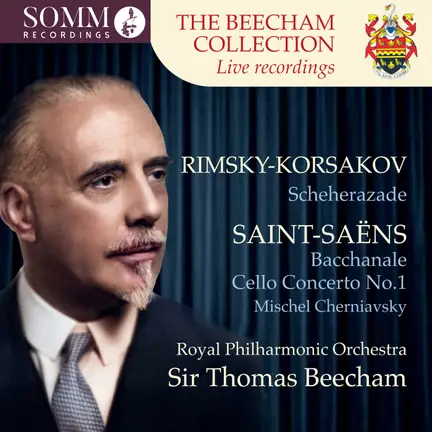
Sir Thomas Beecham conducts Rimsky Korsakov, Saint-Saëns – SOMM
Three mid-century concerts