Mordecai Shehori plays SCHUBERT, Vol. I = Four Impromptus, D. 935; Piano Sonata in B-flat Major, D. 960 – Mordecai Shehori, piano – Cembal d’amour CD 168, 75:06 [Distr. by Qualiton] ****:
Pianist Mordecai Shehori, who rightly prides himself on the production of a beautiful piano tone, outdoes himself in these Schubert performances from New York, 2 June 1997 (Impromptus) and 5 June 1997 (Sonata), respectively. The Four Impromptus of 1827 offer Shehori a variety of forms and touches, especially the opening F Minor, whose structure often suggests an extended sonata-form with two elaborate thematic groups. Shehori’s right hand remains busy, etching chords that extend high into the keyboard range, then producing a steady stream of 16th notes Schubert marks appassionato. The piece seems to lack a development section as such, and rather opts for alternations of thematic material more or less extended from fragmentary, lyrical impulses. The A-flat Major might be a courtly dance marked sempre legato, and Shehori does make it sing. The middle section in D-flat moves in urgent triplets before the ternary return.
The B-flat Major remains the most popular of the set, since Schubert employs a theme that occupies the Rosamunde incidental music and his own A Minor Quartet of 1824. The sequence of five variations has Shehori’s displaying staccati and non-legato touches that still maintain the basic pulse, while the harmonies often modulate into exotic regions. The playful and contrapuntal aspects of these variants are not lost on Shehori, who keeps the affect bright, fluid, and pointed. The last variation assumes the quality of a string of pearls, brilliant and lithe, certainly the model of what we likewise expect of the Chopin style. The last of the set in F Minor (Allegro scherzando, 3/8) insists on a plastic degree of bravura, the staccati the very soul of intricate wit that impressed Brahms. The Trio section, in galloping scales, under Shehori likens itself to an etude for wrist and articulated, fluid motion. Some fascinating modulations precede the brief but turbulent coda that concludes this exciting piece.
The 1828 Sonata in B-flat Major has had much ink spilled as to whether Schubert composed it as an ode to mortality: he died some eight weeks after its completion. And indeed, the somber discordant trill in the left hand’s eighth measure of the opening Molto moderato might well bode the interruption of all that is sweet in life. The piece seems to address two mortal elements: time and loss. And so, Shehori’s attention to the fermata indicates that silence as well as sound informs this work, as it does the oeuvre of Schubert’s great contemporary, Beethoven. What marks much of Shehori’s first movement comes in the way of intimacy and thoughtful articulation of the figures, and often these impulses form a delicate dance. The great harmonic license Schubert exerts wants to counter the restraints imposed by the rigors of mortality. Yet Shehori’s tempos remain brisk and the touches light; he does not drag us into some profound crypt despite the obvious menace that the trill and its brethren generate. The last chords of the movement make us think of a pained, resigned chorale of sorts.
The Andante sostenuto in C-sharp Minor proffers dark beauties of its own, the left hand outlining an almost Spanish rhythm that manages to skip upward four octaves. Shehori plays the opening bars with a musing inwardness that might have inspired all of Granados’ Goyescas. The melody that arises, cello-fashion, moves forward with a nobility we associate with an Aeolian harp. The unforced naturalness of phrase from Shehori may remind other auditors of the much respected version by Artur Rubinstein.
Wonderful resonance, by the way, from Shehori’s bass chords, which seem to sound out a “fate“ motif. The Scherzo designates con delicatezza as its desired affect, and Shehori dons the velvet glove here. The music yields to a waltz-like impulse while A Major and B-flat Major saunter back and forth. Shehori occasionally releases a sforzato or biting accent that indicates the demon lies just beneath the surface. Shehori resists driving the finale: Allegro, ma non troppo too fast; so a perky dance emerges, its repeated notes and brilliant runs integrated most nobly, even passionately, into an architectural whole that yet evinces a tear, a moment of thoughtful pause.
—Gary Lemco
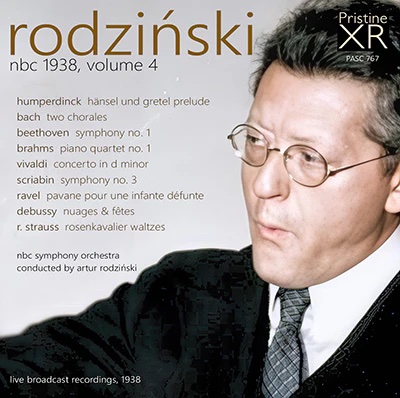
Rodziński Conducts the NBC Symphony Orchestra, 1938 Vol. 4 – Bach, Beethoven, Brahms, Strauss… – Pristine Audio
From Pristine – Volume 4, of their revival of the NBC Symphony concerts led by Artur Rodzinski.