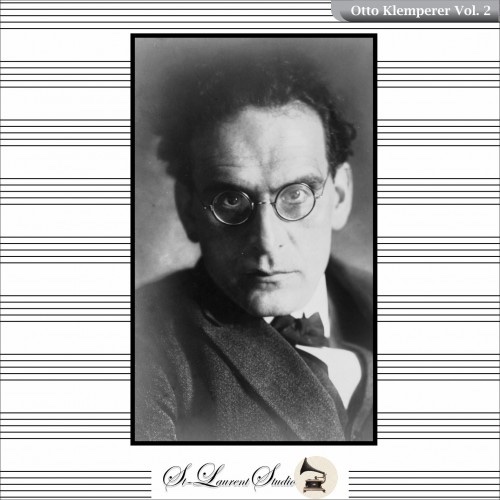
Otto Klemperer Vol. 2 = BRAHMS: Symphony No. 3 in F Major, Op. 90; SCHUMANN: Symphony No. 4 in D Minor, Op. 120 – Philadelphia Orchestra/ Otto Klemperer – Yves St-Laurent YSL T 1778 (65:50) [www.78experience.com] ****:
I first began to appreciate German conductor Otto Klemperer (1885-1973) and his capacity for monumental architecture in musical interpretation when I auditioned his Beethoven Pastoral Symphony with the Philharmonia Orchestra. The ability to maintain long, fluid lines without permitting any slack in the taut, balanced phraseology impressed me in the same way Toscanini had in his NBC reading, but here with more sonic articulation and textural density. Klemperer, after having been absent from the USA for a number of years, returned to Philadelphia in October and November of 1962, in concerts documented here and by Pristine Audio. That label’s more extensive survey features the same high level of sonic restoration as we enjoy here from Yves St-Laurent.
Klemperer asserts his predilection for structural mass by taking the first movement repeat for the opening Allegro con brio, with its several homages to Robert Schumann by way of the Rhenish Symphony and the F-A-F motto. Volcanic declamations and tender intimacy alternate in the chiaroscuro waltz of major and minor modes in rhythmic alteration of triple and duple meters, the Philadelphia strings, horns, and woodwinds at their admirable best. The compressed, cyclically unified nature of the symphony will become even more obvious later, when the Andante movement’s secondary theme recurs, and the work ends with a soft utter of the opening motto defines the coda. Meanwhile, several palpable allusions to Beethoven, idol of Brahms and Schumann both, invoke the influential power of the Fifth Symphony, no less apparent in the Schumann Fourth.
The idyllic second movement Andante captures Klemperer’s attention as well, as the warmth of the orchestra sets a lulling mood of bucolic intimacy and spiritual repose, especially in the horn sonorities. The third movement, Poco allegretto, immortalized in the film Undercurrent, another wistful waltz, takes its cue, like most melodic ideas in this symphony, from the opening, sequential pattern in movement one. “A pearl dipped in a tear of woe,” proclaimed Clara Schumann. At last, Klemperer’s Teutonic prowess asserts itself in the Allegro last movement, where the “fate motif” competes with lyrical impulse in Brahms, the latter of which gains supremacy by gentle default, the coda a gradual releasing of the original impulse into the aether.
Schumann’s 1841 Symphony No. 4 epitomizes the cyclic-form principle, in the way of Beethoven’s Fifth, a single idea’s “unfolding itself in the form of being different,” to paraphrase Hegel. Klemperer projects a rather fluent, buoyant interpretation, in which the only appearance of Teutonic heaviness occurs in the Scherzo. Whie the transition into the second movement Romanza does not quite achieve a seamless attacca, it comes close, a brief pause that proceeds with Klemperer’s milking the violin solo and its warm cushion of strings into a true reverie. The forceful third movement slows direly to graduate to the Langsam – Lebhaft finale, masterful and familiar, though not so portentous as Furtwaengler achieved in Berlin, nor as fluidly transparent as Cantelli in London, but effectively convincing. The audience reacts immediately with an unbridled approval, Klemperer’s disarmingly youthful approach having won them over to a man.
—Gary Lemco
From Yves St-Laurent recordings, Volume 2 of Otto Klemperer, conducting Brahms 3rd Symphony and Schumann’s 4th Classical Music Review by Gary Lemco.