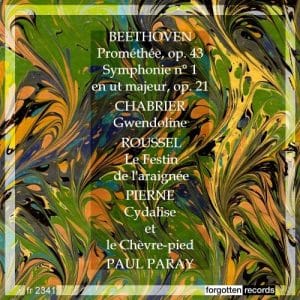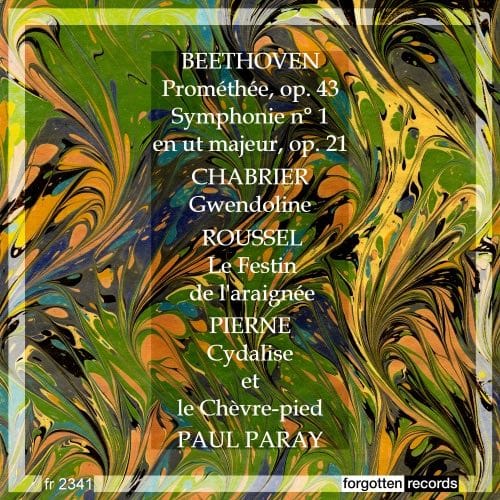
BEETHOVEN: Prometheus Overture,; Symphony No. 1 in; CHABRIER: Gwendoline Overture; ROUSSEL: Le Festin de l’araignée – Suite; PIERNE: Cydalise et le Chèvre-pied – selection – Paul Paray – Forgotten Records FR 2341(65:20, complete credits below) [www.forgottenrecords.com] ****:
The collective legacy of French conductor Paul Paray (1886-1979) receives a colorful addition in these recorded Besançon Festival concert excerpts from 11 September 1960 and 13 September 1957, respectively. The combination of music by Beethoven and French composers typifies Paray’s cosmopolitan range for orchestral nuance and balance, complemented by his taste for classical and novel scores.
Paray opens (9/11/60) with Beethoven’s 1801 Overture to his ballet The Creatures of Prometheus, which contains 16 other numbers as well, many related to his First and Third Symphonies. The opening chord shares its impulse with the opening of the C Major Symphony and then progressing in a volatile sonata form indicative of what Beethoven termed “a new path” in his musical evolution. Paray gets his forces in full tilt quickly, reveling in the woodwind play that alternates with some fine string legatos and crescendos. The main theme proper derives from the ballet’s conclusion, which has established Prometheus as the heroic figure who sacrifices himself on behalf of Mankind.
Paray illuminates the opening of the 1800 C Major Symphony in broad strokes, luxuriating in the strings and horn interplay. The Allegro con brio does not dawdle, rather indulging briskly in those bits of rebellion in Beethoven’s syntax that distinguish him emotionally from Haydn. No repeat, but a menacing, steady pulse in F major to the various condensations of impulses Beethoven combines with fertile energy. The second movement, Andante cantabile con moto, with its melodic use of counterpoints, never fails to bespeak Beethoven’s lyric capacities. Paray manages to elicit fine hues of color from his horns and winds, his Frenchman’s sense of good, classical taste.
Beethoven’s departure from his Classical contemporaries breaks more bounds in the so-called Menuetto, whose aggressionsiruall lie a far distance from courtly dignities. The sheer speed of execution proves toxic to refinement, and Paray hustles the music along its impulsive, irreverent course. A slow beginning, Adagio, lures us into the throes of the ensuing Allegro molto e vivace that virtually cascades in motion, both an instance of and parody of the “Mannheim rocket” gambit of the older symphonists. When performed with light feet, the music almost imitates aspects of Rossini, another musician of disrespectful temper. The last brick-bat occurs just prior to the coda, full stop; and then, the dagger thrust to the last, jolting chords.
Paray turns to the Overture to Chabrier’s unsuccessful 1886 opera Gwendoline, whose Ninth Century setting provides a Wagnerian sensibility to the plot, that involves a confrontation between the invading Danes and the Saxon residents of Britain. The main melody derives from protagonist Harald’s dream of entering Valhalla with Gwendoline at his side, so the blend of French colors in brass and harp and Wagnerian dramaturgy, while effective here, did not play out at the theater. The 1912 pantomime ballet, The Spider’s Feast, of Albert Roussel provides the next quarter-hour of intensely etched colors, with the active strings’ defining the allure the webbing, as various creatures come to be victimized. Paray chooses six sections, including the Prelude and the intriguing Eclosion et danse de l’Éphémère to illustrate the ensemble’s virtuosity in the woodwinds. The precision and clarity in Paray’s string lines deserve mention. The suite ends with two funeral pieces, the Funérailles de Éphémère and La nuit tombe sur le Jardin solitaire, marking the spider’s demise by a mantis and the cessation of another day in the active life and death struggle for existence.
The concerts end with the 1923 two-act ballet suite Cydalise et le Chèvre-pied of Gabriel Pierné (1863-1937), an exponent of the Franck school, but no less alert to the innovations of Ravel and Stravinsky. The title refers to the goat-footed satyr of Greek myth, and Pierné employs much of the impressionist musical syntax in Ravel’s Daphnis et Chloe, especially given the original date of composition, 1914. Again, the marvel lies in the acoustical richness of the score, with ardent and sweeping melodies in the strings and multiple effects achieved by winds, brass, and percussion. Paray elicits from his French ensemble a variegated sense of color that rivals what Reiner and Martinon accomplished in Chicago. For a distinctly different approach to color in a symphony concert, this disc remains unique.
—Gary Lemco
Paul Paray Conducts:
BEETHOVEN: Prometheus Overture, Op. 43; Symphony No. 1 in C Major, Op. 21
Orchestre Philharmonique de la Radiodiffusion-Television Française
CHABRIER: Gwendoline Overture;
ROUSSEL: Le Festin de l’araignée – Suite, Op. 17;
PIERNE: Cydalise et le Chèvre-pied – selection –
Orchestre National de la Radiodiffusion-Television Française