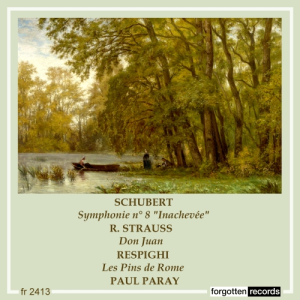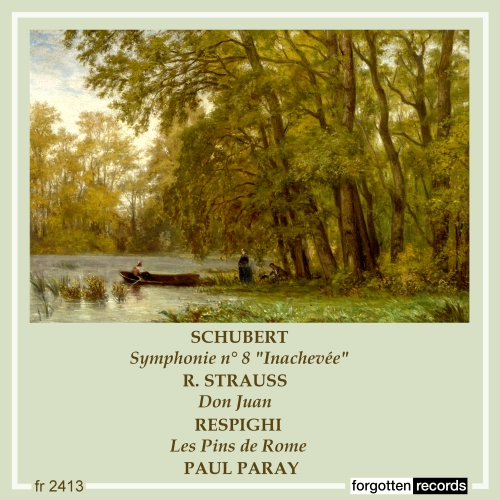
SCHUBERT: Symphony No. 8 in B Minor, D. 759 “Unfinished”; R. STRAUSS: Don Juan, Op. 20; RESPIGHI: The Pines of Rome – Detroit Symphony Orchestra/ Paul Paray – Forgotten Records FR 2413 (56:04) [w.forgottenrecords.com] ****:
Forgotten records splices together two live appearances by Paul Paray (1886-1979) with his Detroit Symphony Orchestra, featuring music by Schubert (28 December 1961) and by Richard Strauss and Ottorino Respighi (5 December 1961), each a mainstream composition which manages to fill out the discography of the noted French conductor. While Paray achieved high eminence for his persuasive interpretations of French music, his command of the German and Italian repertory no less exemplified the discipline he had instilled in the DSO for clarity, precision, and vitality, as attested here by the fierce level of applause accorded each musical offering.
Paray’s assembled program begins with Schubert’s 1822 masterpiece, his B Minor Symphony “Unfinished,” ever the subject of speculation for its fragmentary character. In two movements – though sketches of nine, fully-scored measures exist for a third movement Scherzo – of sublime melodic and emotionally turbulent energies, they receive from the conductor a brisk but sensitive pace and inflection. The DSO strings, cellos and violins, sing exuberantly the immortal, G major melody prior to the onrush of pained drama that ensues and acts as a countercurrent to the enchanted lyricism. Pary elicits consistent, vivid tension and deep anguish in the evolution of the more frenetic passages, punctuated by tremolos and horns in dire fanfare. The ostinato “fate” motif in the bass line be ascribed to the influence of Beethoven, whose creative presence often intimidated Schubert.
A palpable, radiant glow accompanies the introductory bars of the 3/8 Andante con moto, a stern march, at times, whose E major tonality feels at odds with its haunted anguish. The C # minor clarinet rises above the hushed agitation, offering a tenuous consolation. The Manichéan battle of light and dark, major and minor, continues in graduated, syncopated episodes that sail in their lyricism before plummeting into the Abyss. The last measures, A-flat transitioning into E major, resolve into a transcendent firmament much admired by the Detroit audience.
Paray’s next gambit actually occurred two weeks prior, on 5 December, with the Richard Strauss 1888 symphonic poem Don Juan, after the playwright Nikolaus Lenau’s Don Juans Ende (1844), a theme in harmony with conductor Strauss, who had been preparing Mozart’s Don Giovanni. Opening with a Herculean gesture, the music proceeds in rapturous, arrogant gestures, alternately heroic and erotic, as Don Juan pursues women as if each conquest were an opus number. Paray and his musical forces meet all the challenges, rife in the woodwinds – especially the oboe – and horns, eliciting bluster as well as caressed tenderness. The four erotic sequences conclude, despite some heavenly assaults, in a tone of disillusionment and death-wish: “death like stone is all wishing and hoping,” laments Lenau. “The fuel has been consumed, and the heart is cold and dark.” Having been stabbed by an avenging father, Don Juan accepts his cruel fate, emblematic of Silenus’ wisdom, that Man’s greatest good is never to have been born; or barring that, to die soon. Nevertheless, the virtuoso reading by Paray and the DSO remains colossal for its sweep and variety of effect, here presented in that sound the Mercury label would capture for posterity. The audience does not the last chord fall before it erupts into an ovation.
Composer Ottorino Respighi conceived of a Roman Triptych, of which “The Pines of Rome” (1924) served as the second installment: the four movements are named for the trees within the Villa Borghese gardens, near a catacomb, on the Janiculum Hill, and along the Appian Way. In its own way, the procession of scenes outlines the juxtaposition of life and death, moving from children at play in the boisterous opening, to the dire sentiments of the catacombs, the singing of a bird in the moonlight, and concluding with a vision of Rome’s past glories along he Appian Way, scene of many a former triumph. The third movement, “The Pines of the Janiculum,” features a wonderful woodwind cavalcade, clarinet and oboe, with piano obligato and a recording of a living nightingale. Given Respighi’s musical training in orchestration with Nikolai Rimsky-Kosakov, the immediacy of color effects seems inevitable. The imaginary pageant concludes with the dire approach of past armies, the orchestral colors drawn from Debussy, most likely from the second of his Nocturnes. The stern, Roman legions loom great and invincible, with brass and percussion to attest to their musical immortality, should all military quests prove pyrrhic. The audience feels convinced that Art is the Eternal City.
—Gary Lemco