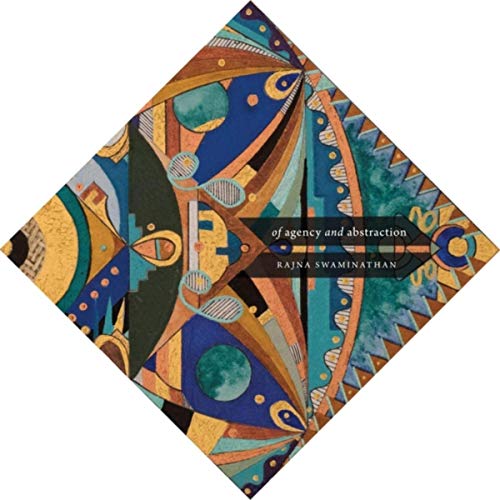
Rajna Swaminathan and RAJAS Ensemble – Of Agency and Abstraction – [TrackList follows] – Biophilia BREP0013, 71:36 [4/26/19] ****:
Performing Artists:
Rajna Swaminathan – mrudangam, vocals (track 12); Ganavya Doraiswamy – vocal (tracks 5, 8, 10, 12); María Grand – tenor saxophone; Amir ElSaffar – trumpet (tracks 4-7); Anjna Swaminathan – violin; Miles Okazaki – guitar; Stephan Crump – bass; Vijay Iyer – co-producer
There are deep Asian Indian roots in the 71-minute Of Agency and Abstraction, the debut from percussionist, composer and vocalist Rajna Swaminathan. Swaminathan’s jazz/Indian music project focuses on the South Indian Carnatic tradition. She melds creative jazz with her cultural music history, deftly producing a blending of different aspects. Swaminathan is part of the NYC new music/jazz community and has worked with Amir ElSaffar, Craig Taborn and most significantly her mentor, pianist Vijay Iyer. Of Agency and Abstraction, like others on Biophilia, is a digital-only release, although it’s highly recommended to get the multi-panel, foldout physical paper package which comes with a download code.
Swaminathan uses the RAJAS Ensemble for this record. According to the liner notes the group was titled for the Sanskrit word which translates to “the inner energy which compels us toward action, creation and change.” Swaminathan formed RAJAS in 2013 and the assemblage has gone through varied configurations. For the band’s first studio recording, RAJAS consists of Swaminathan on mrudangam (a double-sided hollow drum) and vocals on one track; vocalist Ganavya Doraiswamy on four cuts (she sings in an Indian dialect); tenor saxophonist María Grand (credits include Iyer, Steve Coleman, Taborn, Steve Lehman, Mary Halvorson and others); ElSaffar on trumpet on three pieces; violinist Anjna Swaminathan (Swaminathan’s sister); guitarist Miles Okazaki (he’s worked with Coleman, Halvorson, Adam Rudolph and more); and bassist Stephan Crump (who has played in Iyer’s trio, as well as with Lehman, Rudresh Mahanthappa and like-minded artists).
The 12-track record is highlighted by a four-piece suite which provides a centerpiece for the full group plus Doraiswamy and ElSaffar. This expressive and dynamic compositional set of tunes opens with the rhythmically complex “Departures,” where Doraiswamy sings excerpts from the 15th-century Marathi poem “Pasayadan” by Sant Dnyaneshwar (an English translation of the poetic lines can be found in the origami-like Biophilia package). That’s followed by “Ripple Effect,” which contains more Marathi poetry. Swaminathan states “the music is a composite of waves we embody; beauty and divinity are refracted through the collective relation, a ripple effect.” The weaving “Communitas” (which comes from a Latin noun commonly referring either to an unstructured community in which people are equal, or to the very spirit of community) finds the group exploring a changing arrangement accentuated by ElSaffar’s soaring trumpet and Swaminathan’s equally stellar violin. The suite concludes with the cosmically-inclined “Retrograde,” which emphasizes Okazaki’s guitar artistry. Swaminathan affirms in the liner notes her tune is akin to “sounding the push and pull of planetary and astral bodies—perhaps there is truth in moving backward and forward at once, knowing we have been here before.”
The album’s second half includes four lengthy and memorable numbers. The seven-minute “Rush” begins quietly and compactly with a slightly dark hue. Gradually the music escalates, eventually shifting to an ardent and lively dialogue between mrudangam, sax, guitar and bass. Doraiswamy returns to sing Tamil lyrics to one of her own songs, the keen 6:25 “Vagabonds.” There is English-translated verse in the booklet, which mentions the search for love and has a metaphor about how there is no light in darkness. More dimness permeates the shadowy, ebbing, nearly six-minute “Tangled Hierarchy,” where Crump’s dusky arco bass mingles with Swaminathan’s opaque violin. During this twisting and turning tune there is also an interesting intersection between Grand’s sax and Swaminathan’s percussive elements. Of Agency and Abstraction ends with the seven-minute “Yathi,” which seems to get its title from the Sanskrit word for ‘striver’ or ‘sage’ and is synonymous with a spiritual person, yogi or monk. The raga-inspired “Yathi” is the only piece where Swaminathan’s deep voice can be heard and is balanced against Doraiswamy’s vocal improvisations of more verses from “Pasayadan.” “Yathi” is a notable composition with both a meditative mood and an eddying sound construction. Some artists fuse Asian Indian traditional music into a jazz tapestry, but Swaminathan and RAJAS Ensemble appear to come from the opposite direction, mixing jazz into Indian material, which supplies sophistication and an individualistic characteristic. If you missed Of Agency and Abstraction when it was released in spring 2019, seek it out. Hopefully this is just the commencement of a long career path for Swaminathan. It’s obvious from this initial effort she has a lot to say musically and otherwise.
TrackList:
Offering
Peregrination
Vigil
Departures
Ripple Effect
Communitas
Retrograde
Chasing the Gradient
Rush
Vagabonds
Tangled Hierarchy
Yathi
—Doug Simpson