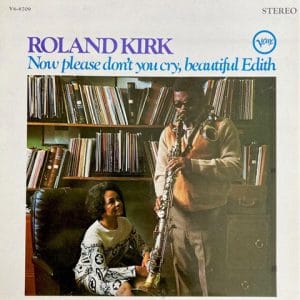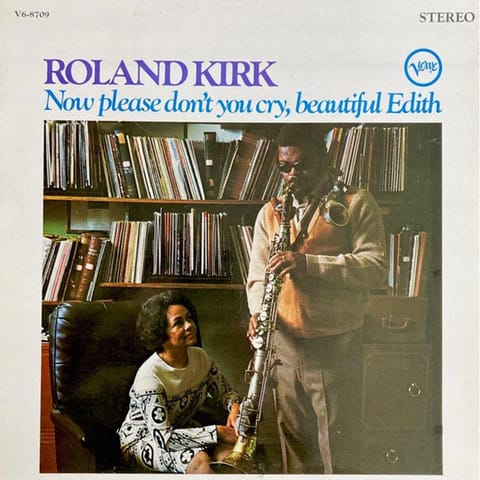
Roland Kirk – Now please don’t you cry, beautiful Edith – Verve Records V6-8709 (1967)/Verve/Universal Music Group 602475207788 (2025) Acoustic Sounds Series 180-gram stereo vinyl, 32:12 ****1/2:
(Roland Kirk – tenor saxophone; manzello, stritch, flute; Lonnie Liston Smith – piano; Ronnie Boykins – bass; Grady Tate – drums)
Rashaan Roland Kirk was an influential jazz musician who performed and recorded primarily as a band leader. From 1955-1977, his repertoire was formed by soul, gospel, hard bop, classical and even popular music. He is widely renowned for playing up to three saxophones (tenor, stritch and manzello) simultaneously, often harmonizing with himself. Additionally, he was fluent with flutes, clarinet, trumpet, recorder and English horns. He influenced many rock stars including Frank Zappa, Ian Anderson, Derek Trucks and Jimi Hendrix. Like many jazz artists, Kirk embraced topical socio-political themes in his work.
Verve/Universal Music Group (as part of the Acoustic Sounds Series) has released a re-mastered 180-gram vinyl of the 1967 album, Now please don’t you cry, beautiful Edith. Inspired by his wife, Kirk is joined by Lonnie Liston Smith (piano), Ronnie Boykins (bass) and Grady Tate (drums). His forays into spacey, near avant-garde were unique, but on this project, an inherent groove anchored the multi-textured sound, establishing this record as essential Sixties jazz. Side A opens with “Blue Rol”, a slow-burning blues treatment that is immersed in layered reeds. Kirk’s solo is expressive and his endless breathing technique steals the show. Smith adds a gentle touch on piano, as the group subtlety increases tempo. Burt Bacharach’s sumptuous “Alfie is rendered with emotional depth on tenor and the quartet adds some nuanced rhythm. The ending is a punctuated reed chorus that is compelling. Kirk’s arrangement diversity permeates the album. “Why Don’t They Know” has a gentle Latin-infused rhythm, and Smith has the first solo that he delivers succinctly with lyricism. RRK follows with a deft run and some verbal exhortation. The groove treatment continues on “Silverlization” with a lithe bass line and soaring reed harmonies.
“Fall Out” (Side B) is “down ’n’ dirty” blues framed by a muscular arrangement, featuring head-nodding resonance. It is festive, brief (around three minutes) with a playful touch. A certain highlight is the haunting title track. Kirk distills the essence of the melody as the band shifts from ballad to gentle swing and then back again. Smith’s graceful piano shading is a fitting complement to the easy flowing jam. On “Stompin’ Ground”, the quartet operates in cohesive fashion and Kirk’s furious lead and solos (on all three reeds) are compelling. Smith’s piano touch is deft, and Tate’s drum breaks are propulsive. Kirk’s final verse on tenor is soulful. The finale (“It’s A Grand Night For Swinging”) is vibrant and showcases the master on flute. His unconventional technique and harmonics take flight in this medium-tempo tune, and the band responds accordingly.
This is a significant achievement for the acclaimed Acoustic Sounds Series. It is an historical document of a key jazz figure making a directional change. The original pristine Verve engineering remains intact. Vinyl enthusiasts will appreciate the hi-gloss gatefold jacket and protective album sleeve. The 180-gram pressing (The Mastering Lab/QRP) has no surface noise, hisses or pops.
Highly recommended
—Robbie Gerson
Roland Kirk – Now please don’t you cry, beautiful Edith
TrackList:
Side A: Blue Rol; Alfie; Why Don’t They Know; Silverlization
Side B: Fallout; Now Please Don’t You Cry, Beautiful Edith; Stompin’ Grounds; It’s a Grand Night For Swinging