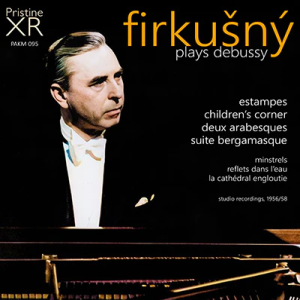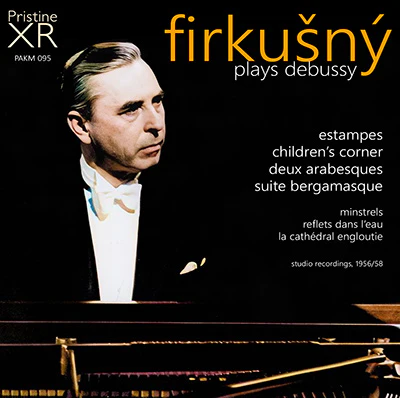
DEBUSSY: Deux Arabesques; Suite Bergamasque; Children’s Corner; Estampes; Reflets dans l’eau; Two Preludes, Book I – Rudolf Firkusny, piano – Pristine Audio PAKM 095 (65:22) [www.pristine classical.com] *****
Czech pianist Rudolf Firkusny (1912-1994) – whom I had the privilege of having interviewed twice – embodied an innately noble and warmly debonair musical tradition, a cross of Moravian (via Janacek) and French (via Cortot) influences. Firkusny consistently evinced taste and color refinement in his music-making, and he emphasized clarity as well as grace in his expressive palette. Pristine restores Firkusny’s Capitol recordings of music by Debussy, 1956 and 1958, in ambient stereo, creating a modern, resonantly deft acoustic in order to savor the especial piano repertory of Claude Debussy, whose style bridges the Romantic and Impressionist impulses of his time.
From the outset of the first selection, Debussy’s 1890/1905 Suite Bergamasque, the Firkusny stylistic traits become evident: sobriety of conception, lucidity of articulation, a clear, singing line, an uncluttered dynamism of expression. Firkusny does not possess Gieseking’s obsessive command of the pedal, nor does he exude Michelangeli’s neurotic eroticism, but the enchantment and passion innate in Debussy’s music evolves with nocturnal, fragrant poise, majestic in its gossamer allure. The demands of the Baroque finale, the Passepied, with its contrast between short staccato notes and long, fluid treble notes, pose no obstacle for Firkusny’s refined skills, and the archaic dance resounds with virile, witty authority.
The influence of Ravel’s 1901 Jeux d’eau reverberates in Debussy’s 1903 triptych, Estampes, in which the keyboard has becomes both more percussive and boldly fluid for the composer, now compelled by Javanese and Spanish motives. The mixture of whole-tone and pentatonic scales in Pagodes sets for Firkusny a rich, variegated palette. The rigid adherence to the G#, C#, D# triad evokes the penetrating surface of the oriental structures, while fluid arpeggios suggest the flow of exotic pageants in surreal time. The most familiar movement, La soirée dans Grenade, throbs with Iberian impulses, the plastic ripple of guitars, the sultry intimations of moonlight. Some would deem the last movement Jardins sous la pluie the most “impressionistic,” given the perpetual, rainy effects from chromatic scales and whole tones, the waters piercing from above and gurgling below. Quite literally a toccata for degrees of touch, the piece calls forth from Firkusny a richly ornate tapestry of vital color, thoroughly stylistic.
Another decisive water-piece, the 1905 “Reflets dans l’eau” (1905) from Images, Book I offers a diatonic but modal motif (Andantino molto) that asserts itself by assuming that light permeates its mass. He adjusts his timbres to suit the shifting rhythms – sometimes in the compound 8/4 – in this work, the glistening of the water’s surface and the deeper implications of its sensuous life. With Firkusny’s maintaining the pedal in the diatonic notes, the swirling energies of the piece assume a refined luminosity.
The most extended work, the 1908 Children’s Corner suite, composed for Debussy’s three-year-old daughter Claude-Emma by way of her selected toys, finds Firkusny in virtuoso form, given the étude character of “Doctor Gradus ad Parnassum.” Sleep-time merges with the sense of imaginative play as we proceed to Chou-Chou’s stuffed (Indian) elephant, Jimbo, and then to her porcelain doll. The parlando and chime elements, oriental in tone, accelerate to a bass-dominated canter that yet retains tenderness for its owner. The “Serenade for the Doll” may owe Tchaikovsky just a nod of appreciation. Delicate ostinato figures trace “The Snow is Dancing,” while children, rendered captives indoors, watch in dazzled fascination. “The Little Shepherd,” perhaps an homage to Edvard Grieg, possesses a simple, whimsical but plaintive air, a landscape well away from Paris. The final number may well be the most “Parisian,” given Golliwog’s Cakewalk’s debts to early ragtime and bar-room rhythms. The irreverent intrusion by Wagner’s Tristan might imply the tragedy behind every romance that Paris inspires. Banjo motifs follow, clumsy and vulgar, a dark side of love well explored by Oscar Wilde and the French Decadents.
The appearance of the first of the Deux Arabesques (1888; 1891), that in E Major, always conjures up the 1948 film Portrait of Jenny, written by Ben Hecht and directed by William Dieterle. Debussy’s harmonic syntax, so alluring in its whole tone scales and cascades of arpeggios, transformed New York City into a mysterious landscape where Love could persist in spite of Time. Firkusny plays it as a tender ballad, worthy of Liszt. Pentatonic scales in rondo form define that second Arabesque in G Major, whose staccato motions and syncopes once more insert a degree of playful whimsey, played with a finesse and jeu perlé that disguise Firkusny’s innate bravura.
Firkusny concludes with two of the Preludes, Book I (1909-10): “La cathédrale englouie” and “Minstrels.” The larger of the two, somewhat surreptitiously, refers us back to Wagner’s Tristan, since the site of the legendary cathedral, Ys’, denotes Iseult’s heritage. Firkusny invests an expansive, dramatic sonority into his rendition competitive with Mussorgsky’s Great Gate at Kiev before the sea’s waves close over the tableau. The second, in G major, asks to be played “Nervously with Humor,” as a clumsy 2/4 dance erupts and allows a second minstrel to appear, who rather swaggers. Eventually, a kind of militant dance emerges, in which we can hear the staccato of the snare drum. If they were about to join the Foreign Legion, the music insists they depart friends.
—Gary Lemco