SCHUBERT: Violin Sonata in D Major, D. 385; BEETHOVEN: Violin Sonata No. 10 in G Major, Op. 96; Violin Sonata No. 7 in C Minor, Op. 30, No. 1 – Alexander Schneider, violin (Schubert)/ Joseph Szigeti, violin/ Mieczyslaw Horszowski, piano – IDIS 6618, 74:07 [Distr. By Qualiton] ****:
Polish piano virtuoso Mieczyslaw Horszowski (1892-1993) remains the most enduring of all classical performers, having begun playing before the public at around the age of nine and continuing until his 100th year. He brought an immense authority to the works he championed, having studied with Mikuli, a pupil of Chopin. Himself a veteran of the Leschetizky school of playing, Horszowski possessed an innate sense of his own sound, supported by his tasteful intellect and immaculate sense of style. In this collection, Horszowski collaborates with two violinists with whom he enjoyed lasting friendships, Alexander Schneider (1908-1993) and Joseph Szigeti (1892-1973).
The chaste “live” performance of the 1816 Schubert Sonata in D (29 April 1957) communicates a grand leisure, as nothing is forced, nothing over-emoted. Schneider, a long-standing member of the Budapest String Quartet and his own Schneider Quartet, could project visceral intensity, as in the Andante movement of this sonata, without false emotional distortion. The brief third movement Minuetto rather reverses the priorities of the sonata, becoming something of a piano sonata with violin obbligato. The lyrical side of Schubert enjoys expansive treatment for the concluding Allegro, beginning as a song without words that breaks out into adjusted rondo-sonata form.
Hungarian violinist Joseph Szigeti established himself early in his career as an intellectual artist, an exponent for the “modern” music of Bloch, Bartok, Martin, Busoni, Webern, and Prokofiev. His razor thin tone did not project lush romanticism but demure classical lines, well-honed until his intonation suffered from debilitating disease. He and Horszowski inscribed the three Brahms sonatas for CBS and Mercury, and in 1944 he and Claudio Arrau surveyed the Beethoven sonata-cycle. Szigeti also recorded Beethoven two sonatas with Artur Schnabel. The studio inscription of the G Major Beethoven Sonata (rec. May 1951) suffers some pitch variation, but the performance remains lyrically intimate and poised. The presence of romance, however, does not escape the lovely Andante espressivo, which achieves a serenity all its own. The brusque transition to the Scherzo thrusts us into a more rasping persona from Szigeti, a driven spirit with bite. The last movement, an amalgam of styles that includes recitative and arioso figures, maintains both an easy and taut gait, has Szigeti soaring in thoughtful bliss before the last statement of the main theme and its spirited coda.
The studio recording of the C Minor Sonata of Beethoven (rec. March 1949) adds another potent pillar in that temple of his so-called “second period” of his spiritual development of which the Op. 37 C Minor Concerto seems definitive. The edgy first movement often rockets forward, demanding brisk, driven filigree of both principals. Six damaged bars of the original inscription had to be replaced with measures from the Szigeti-Arrau collaboration from the Library of Congress. The potent bass figures from Horszowski indicate what his Waldstein Sonata might have offered us. The A-flat Major Adagio cantabile provides the emotional heart of the work, and Szigeti and Horszowski assign the music lofty sentiments in large periods, a presage of those extended adagios of the late quartets. The playfully short Scherzo exploits a motive based on a dotted eighth and sixteenth note, setting the music in nervous kilter that moves to a parody of pageantry in the trio section. Horszowski and Szigeti attain nothing short of explosiveness at the cadences. The last movement has the emotional instability of a battlefield between major and minor, often wrestling in fugato figures. The galloping momentum becomes quite mesmeric, and sforzati from each player pierce our musical complacencies. The last pages do nothing less than sizzle to a demonic close in C Minor.
–Gary Lemco
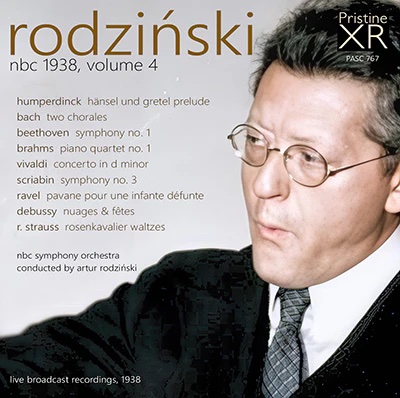
Rodziński Conducts the NBC Symphony Orchestra, 1938 Vol. 4 – Bach, Beethoven, Brahms, Strauss… – Pristine Audio
From Pristine – Volume 4, of their revival of the NBC Symphony concerts led by Artur Rodzinski.