SHOSTAKOVICH: Symphony No. 3 in E-flat Major, Op. 20, “The First of May”; Symphony No. 10 in D Minor, Op. 93 – The Orchestra and Chorus of the Mariinsky Theatre / Valery Gergiev – Mariinsky multichannel SACD MAR0511 [Distr. by Harmonia mundi], 80:23 ****1/2:
PROKOFIEV: Symphony No. 1 in D Major, Op. 25, “Classical Symphony”; Symphony No. 5 in B-flat Major, Op. 100 – Sydney Symphony Orchestra / Vladimir Ashkenazy – Exton multichannel SACD EXCL-00042 [Distr. by Allegro], 55:57 ***:
Here are two modern masters’ greatest symphonies in very different sorts of pairings. On the Ashkenazy recording, Prokofiev’s wartime masterpiece shares disc space with the Russian’s most beloved and often-performed symphony. Meantime, Valery Gergiev yokes Shostakovich’s sprawling anti-authoritarian musical diatribe with the composer’s most avoided symphony—the early propagandistic Third.
This is the kind of pairing that gives music lovers pause: the question emerges, “Even if I get a really fine performance of the Tenth in the bargain, do I really want to put up with the sound and fury of the Third?” Well, dear reader, this is a very fine performance of the Tenth and probably as good a performance of the negligible Third as you’re likely to hear, so the ball is in your court, as they say. As it turns out, Gergiev’s recording completed my Shostakovich symphony collection since, probably like many collectors, I had previously avoided the Third. So for me, it’s a win-win.
The Third Symphony is the second and last in a projected cycle of symphonies designed to celebrate holidays with revolutionary overtones. The Second celebrated the October Revolution of 1917, while the Third is a paean to May Day, International Workers’ Day in the Soviet Union. The choral finale of the symphony uses as its text a poem by Semyon Kirsanov extolling the triumph of revolution and the rise of the proletariat. The symphony starts quietly, with a solo for the clarinet, but then unfolds in a series of bumptious marches interrupted by a somber, measured passage analogous to a symphonic slow movement. As the notes to the recording suggest, this is a quasi-symphony in which various sections approximate features of the traditional four-movement symphony, including a section that’s analogous to a symphonic scherzo and of course a choral finale that makes you think of anything but the great finale of the granddaddy of choral symphonies. It’s all pretty shallow and cheap; here and there you get glimpses of the Shostakovich to come, but you have to listen up because they pass in a flash.
With the Tenth Symphony, the musical potential evident in the early symphonies is fulfilled in its highest form. The Tenth appeared following the death of Stalin and was probably read by its first audiences as Shostakovich’s Eroica Symphony. Actually, according to Shostakovich (at least as represented in his purported memoir Testimony), only the brief and violent scherzo is a direct reference to Stalin. The rest of the symphony seems to have more personal overtones as hinted at in the appearance of two themes, one Shostakovich’s signature theme DSCH and the other based on the name Elmira, referring to Elmira Nazarova, a pupil with whom Shostakovich had fallen in love. If the symphony charts a movement from darkness toward light, this is decidedly not an apotheosis of Stalin but of the composer himself. Though Shostakovich had been denounced in the official Soviet directive of 1948, in December of 1953 he was still very much alive and producing, unlike his bitter enemy Joseph Stalin, a fact worth celebrating in this greatest of Shostakovich’s symphonies.
Gergiev’s performance maps the eventful contours of this work with great sensitivity. The melancholy first movement unfolds with a palpable sense of dread and sorrow, the second movement crackles with violent energy, and the third has all the sardonic wit of Mahler’s night-music interludes. The last movement builds to its wild celebratory final pages with the proper sense of inevitability. Throughout, the Mariinsky players give their all, fired up no doubt by the presence of a live audience. This is a very, very fine Tenth Symphony, certainly among the best in SACD.
Alas, Prokofiev’s greatest symphony hasn’t been as lucky in getting the high-res treatment. Recordings by young lions Paavo Jarvi (Telarc) and Vladimir Jurowski (Pentatone), which on paper would seem to be winners, have failed to make their mark. I’m afraid the situation doesn’t improve with this recording by Vladimir Ashkenazy and the Sydney Symphony. Ashkenazy’s hasty run-through of the first movement doesn’t bode well for the rest of the work. Indeed, this is not a very eventful performance—not perfunctory exactly but with few high points, although Ashkenazy does build the languorous third movement up to a convincingly tragic climax. Still, there just isn’t enough grit and glory to make this a truly memorable performance. The First Symphony is more successful, with some very alert playing by the orchestra, but that symphony isn’t the main event, and I venture to say that most collectors will have more than their fair share of Classical Symphony performances on their shelves. [My pick is the original RCA vinyl of the Prokofiev Fifth with Jean Martinon, which seems no longer available – even as a CD reissue, though he conducts it on a Vox Allegretto multi-CD set of all the Prokofiev orchestral works, which I haven’t heard. I’m really into this symphony since I recall playing bass drum in our university orchestra when we performed it…Ed.].
Maybe I’d be more favorably inclined if Exton’s recording had been anything special, but instead it sounds like what would have passed as a good stereo recording a couple of decades ago—dryish, very forward, with prominent percussion and no appreciable surround effect. Gergiev’s live recording isn’t perhaps top of the line as far as SACD sound is concerned (try, for example, Semyon Bychkov on the Avie label), but it is much warmer than Ashkenazy’s Prokofiev, with a finer sense of depth and spaciousness. If you want a generously filled all-Shostakovich disc with the Tenth Symphony as the main event, you can’t go wrong with Gergiev and his Mariinsky forces.
— Lee Passarella
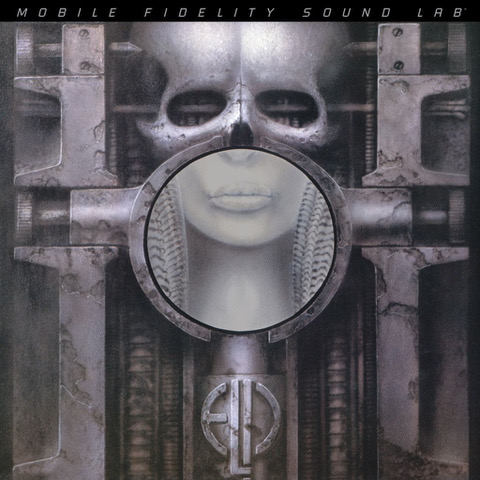
Emerson Lake & Palmer – Brain Salad Surgery – Mobile Fidelity Sound Lab
Mobile Fidelity Sound Lab releases a dazzling vinyl upgrade of ELP’s Brain Salad Surgery.