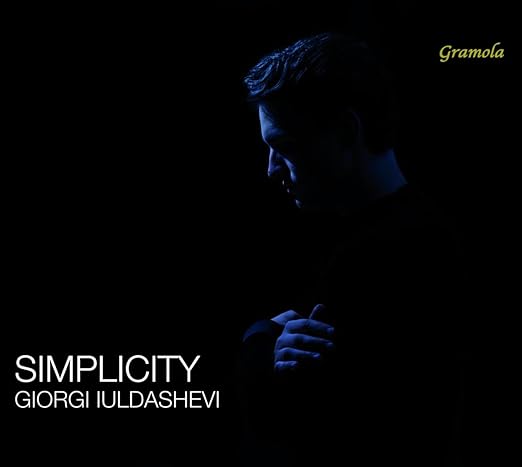
SIMPLICITY – GABUNIA From a Pupil’s Diary. BARTOK For Children; KURTÁG Játékok; PROKOFIEV Music for Children; TCHAIKOWSKY Children’s Album; SCHUMANN Album for the Young – Giorgi Iuldashevi, piano – GRAMOLA 99291 [Distr. by Naxos] (68:27, complete content listing below) ****:
It seems safe to assert that Romanticism discovered childhood in human affairs: Jean-Jacques Rousseau, in his Emile – On the Education of Man (1762), recognized childhood as a separate and distinct stage in human development, ‘with its own way of walking, thinking, and feeling.” Educator Heinrich Pestalozzi and sympathetic writers like E.T.A. Hoffmann insisted that schools and homes provide cultural materials suitable for children, in their reading and in their musical instruction. With the rise of the bourgeoisie and Biedermeier art movement in Europe came the expectation of musical literacy, a piano or guitar in the home, and the accessibility of private instruction. Robert Schumann specifically helped to disseminate pieces for the youth, with his production of Musikalische Haus- und Lebensregain, “Musical Rules for the Home and in Life,” a collection of 90 pieces of musical advice for aspiring practitioners. His 1848 Album for the Young conforms to a model J.S. Bach provided for eldest son Wilhelm Friedemann and second wife Anna Magdalena by way of his Notenbüchlein.
In his accompanying, comprehensive liner notes for this album (recorded December 19-21, 2021), pianist Georgi Iuldashevi, a pupil of luminaries Christian Zacharias and Khatia Buniatishvili, asserts his desire to combine pedagogical and virtuoso ambitions, especially focusing upon “the importance of childhood in past eras.” He agrees with the dictum that “the simplest means is enormously demanding,” confirming the insight from Wolfgang von Goethe that “in limitation the master shows himself.” Iuldashevi states his intention of “putting together an interesting piano recital with a selection of such [children’s] music and to develop myself to these miniatures with seriousness.”
The recital opens with music by a Georgian composer, Nodar Gabunia (1933–2000), a student at the Moscow Conservatory who studied piano with Alexander Goldenweiser and composition with Aram Khachaturian. Gabunia’s collection From the Diary of a Pupil (1977) consists of twelve short pieces for children. Set in a modal syntax that looks to Bartok as a template, Gabunia traces the daily schedule of music students, from their morning arrival and opening bell, through their lessons, followed by some free time, and concluding with a lullaby and a dream. Iuldashevi’s Steinway D chimes most transparently to open “Morning.” The staccatos and repeated notes “On the Way to School” and “School Bell” capture the vibrancy and expectation of youth, with hints of “Twinkle, twinkle, little star.” The longest of the set, “History Lesson,” resounds with the slow, pedantic import adults attach to the topic. A bit more animation attends “Arithmetics,” even galloping in decision. “Singing Lesson” hesitates at first, then it begins to echo Schubert, runs ahead, slowly resumes the song, and ends abruptly. Another slow progress, “Physics Lesson,” jabs intermittently with insight or wonder, the tempo of the individual notes a kind of askew monody; maybe “entropy” is the proper term. With No. 8, “On the Way Home,” a jazz element appears, or is it simply happiness? Brilliant motion from our performer “In the Yard (on Horseback,” small toccata of its kind. “Watching TV” receives a fluidly luminous treatment almost worthy of “Clair de Lune” from Debussy. Both intimate and disarmingly simple, “Lullaby” and “Dream” suggest the youth of our musical protagonist, a time when magic still inhabits one’s imagination.
Bartók’s “For Children,” a collection of 85 pedagogical arrangements derived from Hungarian and Slovak folk music, dates from 1909. Iuldashevi selects ten pieces that reveal the best juxtaposition and contrast in terms of hand position, metronome marks, stretch, accompaniment figures, scales, and chords. No. 21, Allegro robusto, asserts itself with gusto. The Moderato (No. 26) that follows bass in intimate self-possession. JEST (No. 27) more than hints at the power the keyboard might release. Allegro tranquillo (No. 31) plays like a study in soft, harmonized dynamics. Andante (No. 32) richly asserts its Magyar roots in harmony and scales suggestive of Chopin and Gershwin, at once. The last of the set, Allegro non troppo (No. 33), sets a terse, modally alert, Hungarian march.
The group of pieces entitled Játékok (“games” or “miniatures”) from 1926 by Kurtág satisfies Iuldashevi’s desire to provide playful, adventurous exercises in the physics of the keyboard. Kurtág’s condensation of textures has often been likened to the strategy of the German Webern, but without the academic gravity. “Hommage à Zenon” proceeds in dynamic and tempo shifts in jabbed motion lasting forty-eight seconds. “Hommage à Farkas Ferenc,” lasting one minute, juxtaposes percussive play on white keys, vivacissimo, against slow chords on black keys, lento. The subtitle, “Petrushka’s Invocation,” tells us that buried in this exercise in alternative sonorites is a quote from Stravinsky’s ballet. “Konok Ász” refers to a “stubborn” A-flat, that Iuldashevi pounds for another minute’s duration. Admits Iuldashevi, “Perhaps the modern tonal language is not pleasant for all ears.” Good call.
Prokofiev conceived his Music for Children in 1936, a suite of 12 brief pieces that realize joyful innocence and the playfully diverse spirit of wonder. Iuldashevi selects four items: No. 1 “Matin”; No. 3 “Histoirette”; No. 8 “La pluie et l’arc-en-ciel”; and No. 10 “Marche.” Iuldashevi’s “Matin” peals gently in morning bells in a tenuto melodic line, not so distant from a charming Grieg moment. The “Little History” presents a gentle march rhythm over which a plainchant melody joins in transparent counterpoint and a shared scale passage. The texture shifts register and accent so that the young player might savor the contrasting colors of the keyboard. Percussive droplets invest “The rain and the rainbow” with a stately delicacy, with a dissonance or two or three to add a spice to a rainbow’s spanning three octaves. The last piece, “March,” speaks for tin soldiers on parade, touched with wit and perky energy, buoyed by Iuldashevi’s bright Steinway sound.
Tchaikovsky wrote his Children’s Album in 1878, a suite of 24 pieces, all of which remain limited to between 20 to 80 measures in length and to no more than three accidentals. Tchaikovsky, even more so than Robert Schumann in his op. 68, uses his pieces as character studies and less as technical exercises. The first of the selections is the longest, No. 6 “My doll is ill,” with its small, repetitive sequences drooping in sad wistfulness as the texture becomes delicately richer. No. 7 “Dolly’s funeral” does everything except quote Chopin directly. The rhythm remains virtually the same though the melodic line enjoys a noble restraint. The “Waltz” (No. 8) inserts a lively sense of energy, again in imitation of Chopin. Its successor, No. 9 “My new dolly,” moves with the animation worthy of invigorated spirits. Tchaikovsky then moves to foreign influences with a “Polka” (No. 14), No. 16 “Old French Song,” and No. 18 “Neapolitan Song.” The first, rather repetitious, exploits register shifts. The final two capture their regional flavor intimately, with salon expressiveness. The last will be familiar to anyone who knows the ballet Swan Lake, note for note, merely idiomatically transparent and pianistically brilliant.
Robert Schumann composed his 1848 Album for the Young, a collection of 43 pieces, on the occasion of eldest daughter’s Marie’s eighth birthday, dividing the pedagogical pieces into two sections: at No. 19, the items become more technically demanding, their level of difficulty requiring, in Iuldashevi’s words, “several years of piano lessons.” He opens, coincidentally, with No. 19 “Litte Romance,” a piece that exudes Schumann’s ideal of “desire and freshness” in execution. The No. 23 “Equestrian Piece” enjoys a prancing gait in 6/8 that immediately captures the imagination. The No. 25 “Echoes from the Theater” demands our attention for some theatrical lifting of the curtain, followed by some scurrying on stage. “Remembrance” (No. 30) offers essential Schumann, the romantic poet. The nocturne-sounding “***” insists that the performer or listener provides his own rubric for the relatively extended moment. The “Lied of an Italian Mariner” (No. 36), after a heavy bass note, launches into a quasi-tarantella rhythm with a touch of drama. Hesitant chords begin the final entry, No. 37 “Sailor’s Song,” whose somber chromatic line might have had allure for Richard Wagner, especially for its dark epilogue.
—Gary Lemco
Giorgi Iuldashievi – Simplicity
GABUNIA From a Pupil’s Diary.
BARTOK For Children, Sz. 42/1 – excerpts;
KURTÁG Játékok;
PROKOFIEV Music for Children, Op. 65;
TCHAIKOWSKY Children’s Album, Op. 39 – excerpts;
SCHUMANN Album for the Young, Op. 68
More information through Amazon
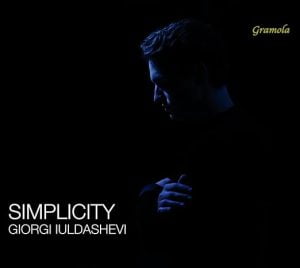
From Gramola/Naxos, Giorgi Luldashevi on piano with “Simplicity”, music by Bartok, Prokofiev, Schumann, and others Classical Music Review by Gary Lemco.