 RIMSKY-KORSAKOV:
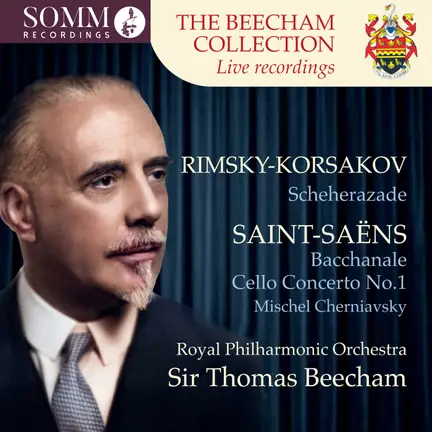
RIMSKY-KORSAKOV: Scheherazade; SAINT-SAENS: Bacchanale from Samson et Dalila, Cello Concerto – Sir Thomas Beecham – SOMM-BEECHAM 34 (70:03) (4/17/26; complete credits below) [Distr. by Naxos] *****:
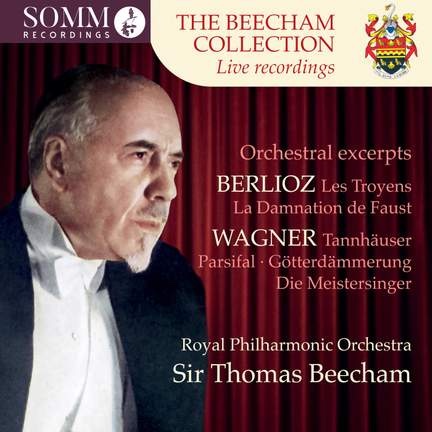
Culled from three distinct concerts by Sir Thomas Beecham (1879-1961), SOMM Producer and Audio Restoration Engineer Lani Spahr assemble music by Rimsky-Korsakov and Saint-Saens, masters of the color-music idiom whose works Beecham realizes in festive, jubilant style. Even as Beecham appeared at Kingsway Hall 17-10 March and 28 March 1957 for recording sessions, he scheduled Rimsky-Korsakov’s epic symphonic suite Scheherazade in concert 21 March, as though the studio performance served as a rehearsal for a much more energized version of his interpretation. While some connoisseurs of Rimsky-Korsakov’s 1888 extravaganza have criticized Beecham’s performance for agogic errors, preferring renditions by Reiner, Karajan, or my own alternative leader, Markevitch (with the LSO), the Beecham forever conveys a sense of story-telling, while Canadian-born concertmaster Steven Staryk (b. 1932) invokes a truly “feminine” point of view that befits the context of these Arabian Nights.
The SOMM collection opens with the thrilling excerpt from Saint-Saens’ opera Samson et Dalila, the Bacchanale, from the concert of 24 April 1960. In his accompanying note, Jon Tolansky testifies as an attendee of the concert, to Beecham’s having become “a generator of electric lightning” in the course of his performance. From the initial oboe entry (Terence MacDonagh), the level of intensity suggests controlled rage, intermittently interrupted by sensuality in exotic colors. The frenzied drive Beecham achieves seems not to disturb the accuracy of intonation one whit. While the middle section projects the languor of Samson’s ill-fated infatuation, the da capo metamorphoses into a force of nature, what Tolansky describes in apocalyptic terms: “the Royal Festival Hall seemed to be shaking in a catastrophic earthquake.”
Beecham, who much championed the music of French composer Camille Saint-Saens (1835-1921), never committed any of the string concertos to recording, so having the Cello Concerto in A Minor from the concert of 19 October 1958 adds a major account to his discography. The soloist Mischel Cerniavsky (1893-1982) had performed in a trio with his brothers while youths in their native Odessa. An essentially lyrical work, it offers few moments of profundity, but it does savor instrumental beauty of tone, which Cerniavsky possesses in abundance. The Andantino second movement enjoys a particularly courtly flavor, a delicate minuet with pizzicato accompaniment and nice work from the RPO bassoon (Gwydion Brooke). Propulsion and deft ensemble mark the last movement, Tempo primo, which does boast one lovely melody that Cerniavsky – as does his contemporary Gregor Piatagorsky on records – relishes in expressive power. The cooperative hustle Cerniavsky and Beecham realize in the last several pages, including the repetition of the arioso melody, captures both intimacy and dynamism whose energies receive opulent affection from the concert audience.
We have in this live Beecham Scheherazade an Eastern vision that sheds any false chastity of demeanor. The languorous nostalgia of Steven Staryk’s thoughtful solo finds resplendent response from the orchestra, ostensibly the incremental softening of Sultan Schakhriar’s bitter heart. The first movement vibrantly captures the sensation of weaving a tale literally by virtue of intertwined instrumental choirs in E and C, as Sinbad’s ship embarks on its epic journey. The juxtaposition of colossal masses of sound against the individual clarinet (Jack Brymer) or cello lament seems to have transferred the antique concerto grosso to a new level.
A new solo from Staryk invokes “The Story of the Kalendar Prince,” rife with individual colors that blend in with a soft, cantering, dance theme whose innately sensual melodic power never wanes. Jack Brymer’s clarinet solo has all the freedom of movement required to stir the brass and battery to respond with a “legendary” motif not far from Wagner’s “Magic Fire.” The militancy has something of Mozart’s janissary effects, here set near a mosque or muezzin’s retreat. The flute’s elongated solo suggests an aerial locale above the skies, despite the Sultan’s perceptible grumblings.
The RPO strings assume pride of place in their sympathetic reading of the “The Young Prince and the Young Princess,” a lovely Andantino quasi allegretto in 6/8, that serves as a ternary-form, pastoral intermezzo in an otherwise dramatic narrative. We hear echoes from Balakirev’s Tamara tone-poem, notable for oriental colors. Beecham has been intent on letting his forces have their head for the final movement, Allegro molto, 6/8, “Festival at Baghdad. The Sea. The Ship Breaks against a Cliff Surmounted by a Bronze Horseman.” Once the snare drum and trumpet enter the propulsion, the magical splendor of the (brazen) occasion bursts into inspired flame, and the tiny retreats in tempo do not relax the tension. The presence of a pageant, a visual spectacle, imposes itself, wild and militant, an ecstatic music dervish. A literally “frenetic” climax subsides to a lyrical, much-awaited reconciliation between the Sultan and the now vindicated Scheherazade, both resolved in the tonic major, to the eternal gratification of a grateful concert audience.
Much recommended for a permanent place on “the record shelf.”
—Gary Lemco
Sir Thomas Beecham conducts Rimsky Korsakov, Saint-Saëns
RIMSKY-KORSAKOV: 1Scheherazade, Op. 35;
SAINT-SAENS: Bacchanale from Samson et Dalila, Op. 47;
2Cello Concerto No. 1 in A Minor, Op. 33 –
1Steven Staryk, violin/
2Mischel Cherniasky, cello/
Royal Philharmonic Orchestra