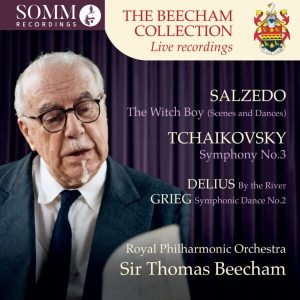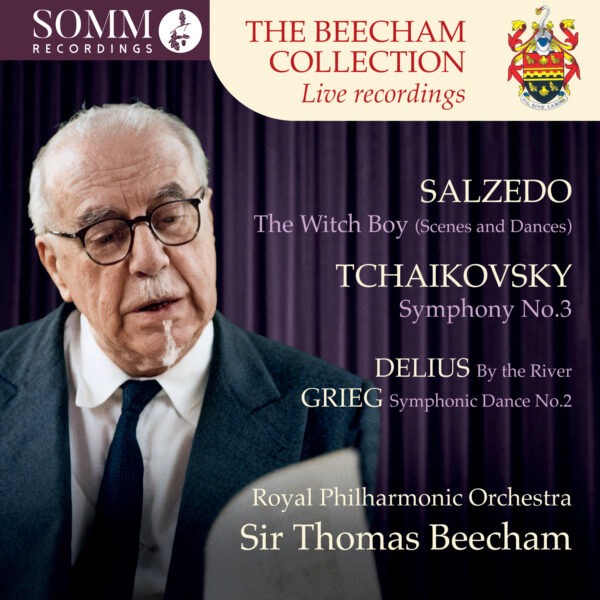
DELIUS: By the River from Florida Suite; SALZEDO: The Witch Boy: Scenes and Dances; GRIEG: Symphonic Dance, Op. 64/2; TCHAIKOVSKY: Symphony No. 3 in D Major, Op. 29 “Polish” – Royal Philharmonic Orchestra/ Sir Thomas Beecham – SOMM- BEECHAM 36 (76:30) [Distr. by Naxos] *****:
Three distinct concert dates provide music for the latest Sir Thomas Beecham program organized by audio restoration engineer Lani Spahr and SOMM records, all performed at Royal Festival Hall on 26 October 1954 (Grieg), 14 November 1959 (Salzedo, Tchaikovsky), and 24 April 1960 (Delius), the last marking – in the words of booklet commentator Nigel Simeone – “not only Beecham’s farewell to London concert life, but also to his beloved Delius.”
The most immediate point of interest lies in the music of Leonard Salzedo (1921-2000), who served in the violin section both in the London Philharmonic (1947-1950) and Royal Philharmonic (1950-1966) and became Beecham’s assistant, aiding in the re-orchestration music by Grétry. Beecham, who performed many works that lay outside his “official” recorded legacy, led (in 1956) the RPO in Salzedo’s 1955 melodramatic ballet The Witch Boy, an uncommon concession by the conductor, who prided himself on detrimental remarks about jazz and modern music.
The program proper opens with a lushly loving realization of the “By the River” sequence from Delius’ 1887 Florida Suite, its second movement. The source comes from Beecham’s final London concert, and the string melodic line, supported by harp and incisive woodwinds, creates a bucolic ecstasy of beguiling power. The Grieg Symphonic Dance No. 2 (1896), marked Allegretto grazioso, had been a constant “lollipop” in Beecham’s repertoire, with Beecham’s sense of Norwegian inflection in poignantly gentle, full command. Its middle section evinces more potent, rustic energy than the bracing materials of the ternary form.
The four-movement ballet score by Salzedo combines lyricism and violence that prepares us for the overtly American aspect of the two last movements, “Square Dance” and “The Lynching.” The palpably large scoring for the piece includes a vibraphone and muted strings for the “Dance of the Witch Boy” that begins the suite. An eerie vitality permeates the “Scene in the Store,” as the music moves to jazz riffs in brass and percussion. We might be tempted to ascribe the music to Alex North. The second movement, “The Dance of Love,” reveals Salzedo’s capacity for erotic sensuality, vibrant and haunted. The music crescendos in a manner appropriate for the score of the film “The Uninvited.”
Suddenly, we become party to the “Square Dance,” with its immediate associations with Americans Copland and Siegmeister. Beecham feels perfectly comfortable in this American folk idiom, and the music hustles with verve and metric savvy. The jazz band element intrudes into the blaring context, and the dance becomes eccentric and sassy. The audience belts out their enthusiasm, a full stop in the musical action. In a kind of loose cyclicism, the music of “The Lynching” reprises earlier motifs, including the presence of the vibraphone. Tensely atmospheric, the taut musical line carries the thrust and syncopation we associate with master cinema-colorist Bernard Herrmann. One H.G. Sear, the commentator for the program notes of the Beecham concert (14 November 1959), remarked on the “almost frightening ecstasy” of the occasion. Explosive applause recommends collectors of Sir Thomas Beecham to seize this release with grateful gusto.
Tchaikovsky’s 1875 Third Symphony found a recording from the RCA label and Beecham in 1947, a tempered, graceful reading on 78s which I happened to own. The work presents (to me) a musical anomaly: more orchestral suite in five movements than unified symphony, often projecting the lyrical aspects of a ballet. The symphony opens with a Moderato assai in the manner of a funeral march that keeps the RPO brass and winds engaged over pizzicato strings. The transition to the Allegro brillante Russian dance comes off with vivacious aplomb, the layered sound colors a sonic catapult. The appearance of a second movement Alla tedesca and third movement Andante elegiaco may well nod to the influence of Schumann’s Rhenish Symphony.
The movement “in the German style” proves gracious, eminently balletic in its swaying figures for the strings and generous application of woodwind colors. The music does appear to me rhetorical in spite of its lyric, often waltzing, appeal. The ensuing Andante elegiaco exhibits bucolic charm, touched by a note of wistful, intimate nostalgia. Often, the scoring seems an elevated, augmented serenade for strings possessing a moody coda worthy of Swan Lake. The Scherzo: Allegro vivo moves in fleeting, busily ephemeral gestures, a bravura exercise for woodwinds, brass, and strings, who often seem to emulate Mendelsohn’s light style. At one point, the orchestra appears to “tune up” to re-establish the colors in order to resume. I assume the consistently highly polished French horn work belongs to Alan Civil.
The symphony’s finale moves in the style of a grand ballroom polonaise, Allegro con fuoco, requiring the Beecham incarnation of musical fire, often in polyphonic character. The color balances, dramatic poise, and guided succession of dynamic adjustments to a ceremonial climax testify to Beecham’s unquestioned devotion to a score he felt transcended any perfunctory, critical dismissal as a “confection” or “sweetmeat.”
–Gary Lemco
The Beecham Collection – Live Recordings
DELIUS: By the River from Florida Suite;
SALZEDO: The Witch Boy: Scenes and Dances;
GRIEG: Symphonic Dance, Op. 64/2;
TCHAIKOVSKY: Symphony No. 3 in D Major, Op. 29 “Polish” –
Royal Philharmonic Orchestra/ Sir Thomas Beecham