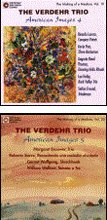
The Verdehr Trio – American Images Vol. 4 = RICARDO LORENZ: Compass Points; KEVIN PUTS: Three Nocturnes; AUGUSTA READ THOMAS: Dancing Helix Rituals; LEE HOIBY: Rock Valley Trio; STEFAN FREUND: Triodances – The Verdehr Trio – Crystal Records CD949, 60:06 ****:
The Verdehr Trio – American Images Vol. 5 = MARGARET BROUWER: Trio; ROBERTO SIERRA: Recordando una melodia olvidada; GERNOT WOLFGANG: Sketch Book; WILLIAM WALLACE: Sonata a Tre – The Verdehr Trio – Crystal Records CD970, 62:09 ****:
Elsa Ludewig-Verdehr, clarinetist and Walter Verdehr, violinist have been teaching at Michigan State University for many years now. They are both well known as excellent performers on their respective instruments, with international reputations for promoting new music. They are also both known as superb pedagogues. There are many young professional symphony musicians working in orchestras around the world who have come through the studios of the Verdehrs. What might well become their greatest legacy, however, is their over forty-year commitment to commissioning new work for violin, clarinet and piano. This commitment saw the formation of The Verdehr Trio, first with pianist Gary Kirkpatrick then, later, with Kathryn Brown and pianist Silvia Roederer serving with distinction on the past several recordings in their recorded output including these two most recent.
Crystal Records has a similarly long and distinguished commitment to The Verdehr Trio and the recording of these terrific works. Many people (clarinetists in particular) are familiar with the 20th century’s earlier masterpieces for this combination, such as Contrasts by Bartok or the Trio for clarinet, violin and piano by Khachaturian. These recordings over the years reveal more outstanding music for this grouping by a wide range of composers, including Menotti and Ned Rorem. These two newest additions in what the group has called the “Making of a Medium” series provide more wonderful examples. These two discs are also numbers four and five of what the Trio calls its “American Images” series; specifically showcasing trios by American composers. Each piece on these discs is an excellent piece of music and worth mentioning separately.
Volume 19, “American Images 4”, opens with Compass Points (Puntos en la Brújula) by the Michigan-based Ricardo Lorenz. This three-movement work reflects the composers “state of mind” examining three different circumstances from his life. The first, “Verde que te quiero Verdehr” was written while Lorenz was in Italy and, as the title implies, it has a lush “green” sound out of respect or like for the Verdehrs (an intentional word association). The second, “In memorium Robert Avalon” is characteristically darker out of respect for the director of the Houston Foundation for Modern Music (Avalon) who Lorenz had met just days before his sudden passing in 2004. The last movement, “Scherzarengue” is a made up word but in reference to the spiky duple-meter dance, the meringue, emanating from the Dominican Republic. Lorenz states that it reminded him of his hectic life as he has moved from Venezuela to Chicago to now Michigan. The whole piece is, indeed, an eclectic but vibrant blend of sounds with great passages for each instrument.
Kevin Puts is a St. Louis native who presently teaches at the Peabody Institute in Baltimore. His output is varied and all of his works, that I’ve heard, are highly attractive and tonal. He has some very prominent commissions to his credit including works for percussionist Evelyn Glennie and cellist Yo-Yo Ma. In his wind output, he seems to write especially well for the clarinet (including a very nice Concerto for Bill Jackson of the Colorado Symphony) His Three Nocturnes, heard here, is a beautiful work; each movement evocative of a sense or impression of night. Additionally, the scoring is innovative and clever in that each movement features a different instrument with the clarinet having a very rhapsodic role in the first movement, the violin the second and the piano – in the most true nocturne of the three – in the closing adagio. I was very impressed with this work!
Augusta Read Thomas is presently a professor of composition and modern music at the University of Chicago. She is one of America’s best known composers, whose music has been performed by many prestigious groups, including the Chicago Symphony. Her Dancing Helix Rituals was written for the Verdehrs in 2006 and, like many of her works, is a very buoyant dramatic piece fill with some jazz elements. Thomas indicates that a lot of her music, she feels, is conducive to dance. In this case, Dancing Helix Rituals was written as a work that could also be choreographed and performed in that manner. It is also true that the work does bear some stylistic resemblance or homage to the early Stravinsky ballets, such as Apollon Musagete. This very attractive piece showcases each member in the trio quite nicely!
The Rock Valley Trio is also a Verdehr commission and also one of Lee Hoiby’s last works. Hoiby is a true American original, trained at Curtis and possessing a voice that is reminiscent of the mid-twentieth-century American sound, typified by Copland or Hanson. Lee Hoiby actually spent most of his career as a freelance and successful composer, not directly affiliated with a university but more with opera houses. The Rock Valley Trio is wholly tuneful and engaging one movement work with strong melody lines and a very pastoral, relaxing and picturesque sense evocative of middle America; such as found in Rock Valley, Iowa – but without that specific reference. This piece is different in its flavor form the others in this collection but a very charming addition in its own right.
Stefan Freund was a new name for me. He is a professor of composition at the University of Missouri and, among his many contributions to new music; he is the cellist in the cutting edge ensemble, Alarm Will Sound. Interestingly, among his own his own teachers with whom he has studied is Augusta Read Thomas, as well as Joseph Schwantner and Christopher Rouse. Triodances was written in 2005 for the Verdehr Trio and is structured in three movements along somewhat classical lines. The first is a tongue in cheek “Frenuet and (Verdehr) Trio”, intended to pay homage to the classical, much composed for, menuet form. The composer cites a connection to Stravinsky’s Second Suite and it is fun to try to follow the little quotes from other works! The central “Pastorale” is a beautiful and restful work in a gentle triple meter and the work concludes with a furious and energetic “Tarantelly” which Freund says is “in honor” of all the spiders that he and his wife found when they moved into their new house! I greatly admire the sound of Triodances as well as the very amusing and jaunty approach to both the sound and the titles.
“The Making of a Medium” volume 19 is a terrific collection of new works that I greatly enjoyed! It is imperative to also appreciate the great dedication and skill of The Verdehr Trio as well. All three players are gifted with great technical skills, attractive tone quality and a true musicianship both individually as well as in ensemble. So it continues in Crystal’s “American Images 5” (Volume 20)
This set begins with the Trio by Margaret Brouwer. Brouwer is a past chair of the composition department at the Cleveland Institute of Music and has received many different awards including a Guggenheim Fellowship in 2004. The Trio is in three movements, each evoking a particular emotion (such as “Joyful Moment”, “Reverie” and “Escaping”) The composer states that the structures for the movements themselves were a result of some formulas for combining variables (in this case, pitches) that she learned from James Gleick’s book Chaos. I found that interesting because I did hear anything at all in this fascinating work that seemed a product of anything abstractly derived (let alone from any aleotory). Rather, Brouwer’s Trio is a very accessible, pretty and introspective work, with the middle, “Reverie”, being especially compelling.
Roberto Sierra is a native of Puerto Rico, presently serving as professor of composition at Cornell University. More importantly, his music has become more and more an important part of the major symphony orchestra repertoire, including multiple performances in Los Angeles, Detroit, Phoenix and Houston; to name but a few. Recordando una melodia olvidada (Remembrance of a forgotten melody) was written for the Verdehrs and is truly innovative in its construction and fascinating in its sound. There is no actual “forgotten melody” being resurrected here but rather the composer constructs a melodic fragment that emerges in the clarinet, ‘remembered’ in part by the piano. Only as the piece evolves over its twelve plus minutes do pieces of a long-line melody, clearly derived from the development and permutation of the original snippet emerge. It really does sound like a fully-developed – and quite attractive – melody and its harmonization that has been deconstructed. As the composer states, the concept was to examine the “way we remember and try to reconstruct a long forgotten melody”. This is a very fine work to listen to based on a very creative concept.
Gernot Wolfgang’s Sketch Book is another very entertaining work that shows clearly the composer’s connections to jazz and film. Wolfgang, originally from Austria, is very active in the film and television music industry in Los Angeles. This three-movement work is a collection of individually compelling programmatic short pieces. “Green Island” opens the work in a very jaunty and jazz inflected vein, being dedicated to the memory of saxophone great Michael Brecker. There is also a brief – but evident – allusion to the music and feel of Ireland from the composer’s trips there. “Night Breeze” is intended to depict the atmosphere or feel of a Southern U.S. front porch. Evocative of things somewhat antebellum, it does have a bit of that feel, helped a lot by the wonderful bluesy playing by Elsa Verdehr. The work concludes with “Chromatic Train” in which the violin and clarinet trade a passage that sounds like momentum building against a percussive and propulsive piano part. This work is very catchy and entertaining and stands out from the rest in this program for its uniqueness.
Lastly, booklet notes point out that composer William Wallace is not related to the 13th century Scottish warlord and hero (nice!) This William Wallace is a new name to me, as well, and has taught at Rutgers University and presently works in Wyoming. Performances of his music have taken place worldwide including the Warsaw Chamber Orchestra and the Slovak Radio Symphony. His Sonata a Tre, from 2004, was written for Verdehr and is structured in a traditional three-movement pattern. The rhythms provide some interest and challenge in this piece, with much use of asymmetrical patterns like 5/8 or 7/8. Additionally, the composer acknowledges that the second movement, “Andante semplice” is intentionally languid but repetitive, requiring much concentration on the part of the performers. This is a very nice and attention-getting work.
The best reason to acquire these two new fantastic compilations is for what they represent. The Verdehrs have done more than almost any other performers of their respective instruments to expand the literature for this combination. Certainly, clarinetists and violinists in particular will be highly interested in all these works; as should pianists. Any listener would be rightfully impressed by the quality of performance of Walter and Elsa, in particular, who have been doing this for a long time and still of highest quality. This almost represents but two volumes of an incredibly comprehensive collection by composers whom many will find new. I encourage anyone to look at Crystal’s website and see the list of repertoire on the other volumes and be amazed. I also look forward to getting the upcoming video series, “The Making of a Medium” a series sponsored by Michigan State. The work of the Verdehr Trio will be remembered as an important factor in contemporary chamber music for many years, as it should be!
—Daniel Coombs
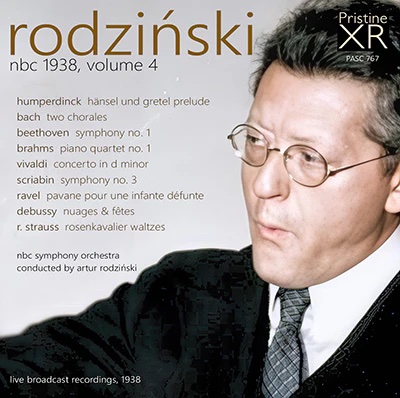
Rodziński Conducts the NBC Symphony Orchestra, 1938 Vol. 4 – Bach, Beethoven, Brahms, Strauss… – Pristine Audio
From Pristine – Volume 4, of their revival of the NBC Symphony concerts led by Artur Rodzinski.