VIEUXTEMPS: Violin Concerto No. 1 in E Major, Op. 10; Violin Concerto No. 2 in F-sharp Minor, Op. 19; Greeting to America, Op. 56 – Chloe Hanslip, violin/ Royal Flemish Philharmonic/ Martyn Brabbins – Hyperion CDA67878, 75:07 [Distr. by Harmonia mundi] ****:
It seems we learn the violin concertos of Belgian virtuoso Henri Vieuxtemps (1820-1881) in reverse, with our having imbibed the beauties of Concerto No. 5 in A Minor and No. 4 in D Minor via the efforts of Heifetz, Francescatti, Lin, and Menuhin. Another sort of reversal lies in the fact hat the Concerto No. 1 in E Major (1840) predates the No. 2 in F-sharp Minor (1836) by four years. Vieuxtemps calls this Op. 10 “Grand Concerto,” and its first movement Allegro of twenty-five minutes exceeds the standard playing time for the Beethoven Concerto’s first movement, The huge and shapely sonata-form structure rather conforms to the Paganini model (in the same key of D) of a violin concerto, alternating broad and virtuosic gestures with extended moments of tender, vocal tranquility. Much of the thematic material derives from the opening flourish in the solo part, E-F#-G#, so that the major scale infiltrates key dramatic moments in the course of the movement. Just about halfway through the movement, the violin enters with a rasping flourish (Maestoso) that might have inspired the opening of Ravel’s Tzigane. Doubtless, Chloe Hanslip’s work with Italian master Salvatore Accardo influences her own predilection for this bravura style. The Royal Flemish Philharmonic (rec. 6-8 July 2011), of which Martyn Brabbins resides as Principal Guest Conductor, certainly has its ostentatiously symphonic points to make, especially given the colossal scales and explosions that precede the first movement cadenza. The coda’s tension evolves over a huge pedal point that culminates in a kitchen-sink coda a la Rossini as much as Paganini.
Again, like Paganini, Vieuxtemps proffers a brief but passionately simple tune for his A Major Adagio, an extended cavatina that could serve as a bel canto aria. Rounded out by octaves and weepy tremolandi, the melody gains a lush texture that dissipates to set up the transition to the finale, Rondo: Allegretto in dotted rhythms. Hanslip can show off her detached bowing techniques and spiccato flourishes as well as her double-stopped chords and runs. The colors, aided by a singular triangle, enjoy a healthy pomp that approaches the spirit of Rossini and Chabrier. Vieuxtemps extends the parade of effects with a quick-march in B Major that rounds off its cadences with brisk runs, trills, and double stopped chords. The perpetual motion machine does interrupt the proceedings to alight once more on the Adagio tune, now become a Bellini arioso over pizzicati, until its light-hearted swagger catapults it once more into the pyrotechnical wizardry guaranteed to sell tickets.
An austere march motif opens the more classical wrought F-sharp Minor Concerto, Op. 19, a key Henri Wieniawski likewise found favorable for his own First Concerto. The Paganini model seems to rule, the march alternated with a lyrical second subject in A Major. The solo likes to soar in the high register, utilizing the expressive E string. Compared to the First Concerto, the scale of this Second Concerto proves smaller, more classical although its sense of architecture remains iconoclastic, laid out episodically in the manner of a Chopin Ballade. Still, hints of the Paganini D Major Concerto infiltrate the figures, and the bravura tapestry owes everything to the Paganini capacity for showmanship. Only the last movement, Rondo: Allegro, however, has a full cadenza written out for the solo. A modulating string section has taken us directly into the Andante without pause. In B Minor, the expressive theme wants the violin’s arioso present virtually every moment. The Poco piu lento section in D assumes a spectacular coloration from Hanslip and Brabbins, with Hanslip’s executing double-stopped thirds and sixths and then triple stops. We sail upward for two octaves luxuriously, in B Minor, and then the music dissipates into the rarified atmosphere.
The finale swaggers confidently, moving from Allegro to Allegretto rather suavely, certainly reminiscent of operatic Rossini. When Hanslip returns she invokes quadruple stops, just to set up the next descending motif, marked “pleading” and ripe for expressive treatment. Hanslip’s flute tone exploit’s the possibilities, and she basks in the smooth legato of her scales and trills. The cadenza quite beguiles in a throaty manner we haven’t heard since Milstein, Accardo, Gulli, and Ricci graced virtuoso violin music. The return of the orchestra also involves a darker turn into the F-sharp Minor with which these deliciously intricate proceedings began.
Anyone familiar with Itzhak Perlman’s classic rendition of Vieuxtemps’ Souvenir d’Amerique, Op. 17 will savor the posthumously published Greeting to America (1844), composed for his American tour 1843-1844. Vieuxtemps could excel at imaginative fantasies based on national airs, and the aforementioned Souvenir takes “Yankee Doodle” by storm. An “Old World” air from Italy opens the later piece, and we can almost visualize J. Carrol Naish waving at the Statue of Liberty. We segue into “The Star-Spangled Banner” fantasia in which the brass more the complements the violin’s ministrations. An extended trill and some heavy introductory chords from the basses, almost the Russian cavalry, lead to the inevitable “Yankee Doodle,” here in new pyrotechnics and a new key from the fiddle. The contrapuntal trick remains for the ingenious Vieuxtemps to combine the two major American tunes into a national stew rife with jingoistic fervor.
—Gary Lemco
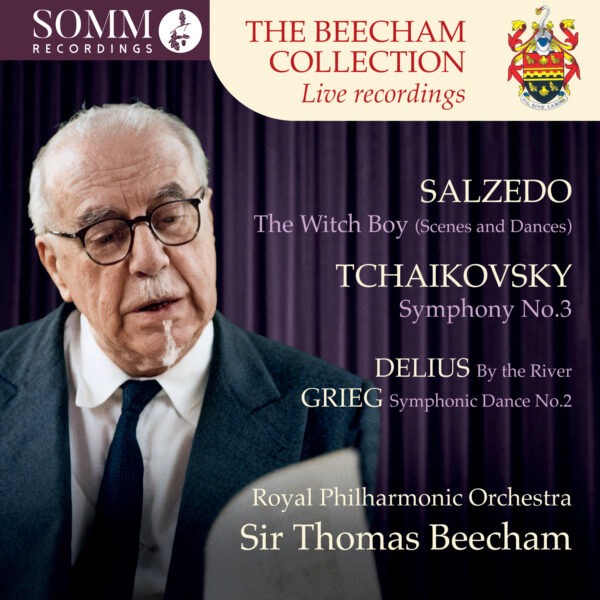
The Beecham Collection – Tchaikovsky Symphony No. 3 – SOMM
Live Concerts – historic recordings from the 1950s