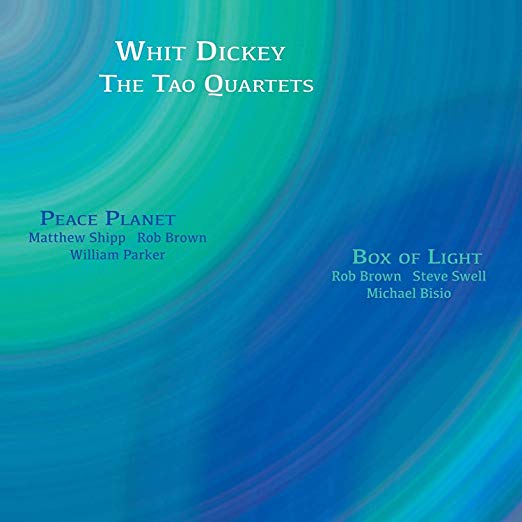
Whit Dickey/Tao Quartets – Peace Planet & Box of Light – [TrackList follows] – AUM Fidelity 108/109 (2-CDs), 53:26, 52:25 [7/5/19] ****:
Performing Artists:
Whit Dickey – drums, percussion, direction; Rob Brown – alto saxophone; Matthew Shipp – piano (Peace Planet); William Parker – bass (Peace Planet); Steve Swell – trombone (Box of Light); Michael Bisio – bass (Box of Light)
Drummer and percussionist Whit Dickey’s latest—Peace Planet & Box of Light—is a double opus of interrelated improvisational jazz. Dickey put together two interconnected but differing quartets for two albums issued as a 2-CD set with music which represents the Yin and Yang (Chinese for “dark-bright” or “negative-positive”). This yin-yang is linked to the concept of dualism in ancient Chinese philosophy and is also why Dickey named his two groups the Tao Quartets (Taoism is associated with becoming one with the unplanned rhythms of the universe called “the way”). Dickey may not be well known but his contributions to material by David S. Ware, Matthew Shipp, Ivo Perelman and others is notable and respected. The Peace Planet & Box of Light project was released as a limited edition 2-CD package, in a deluxe eight-panel digipak, printed on heavyweight stock; with extensive liner notes.
Epitomizing the Yin is the 53-minute, five-track Peace Planet. The set of tunes has a fluidity with a dynamic and sometimes sharp flow through instantaneous musical adventure. Essentially, Peace Planet is a gathering of the Matthew Shipp Quartet which was on Shipp’s 1992 record, Points: Shipp on piano, Rob Brown on alto sax, William Parker on bass and Dickey on drums and percussion. Peace Planet is like Points in that there is an edgy disposition where the quartet trades ideas, performs with alacrity and communication and there is push and pull. The ten-minute opening title tune features Dickey layering a rhythmic complexity while Shipp and Brown converse and display an animated tête-à-tête as Parker maintains a centered stance like an island amid a seething sea. The interstellar continuity stays throughout the 10:33 “Seventh Sun,” where Dickey and Parker unite as a pulsing rhythm section while Shipp and Brown prove how effortlessly they can craft changing harmonic patterns. Shipp showcases his artistry with his chords and notes, as does Brown when he contributes a solo improvisation.
While all the pieces on Peace Planet are mini-suites, the album’s highpoint is the 14-minute “Suite for DSW,” a tribute to Ware, who employed Dickey, Shipp and Parker in his quartet. During “Suite for DSW” Dickey’s malleable beat, groove and rhythm is demonstrated in a bravura performance where Dickey utilizes everything in his drum kit and drumming repertoire. It’s a wonder to hear Dickey as he shifts, adjusts to various time changes and musical elements, and modifies to wherever the other musicians go. Peace Planet concludes with the nine-minute “Blossom Time,” another standout which reveals the band’s deftness and ethos. The musical landscape travels from unbridled to a semi-lessened portion to a groove-flecked part. “Blossom Time” does not dispense with the avant-garde touchstones but nevertheless is the most straight-ahead selection.
The Yang is expressed throughout the 52-minute, six-track Box of Light. While the aesthetic is akin to Peace Planet, the details and minutiae is aimed somewhat separately. Brown is joined by trombonist Steve Swell (credits include Anthony Braxton, Cecil Taylor and Parker) while Michael Bisio (who has extensively recorded with Shipp) takes the bass slot. Shipp is absent from Box of Light. Thus, this version of the Tao Quartet has two horns, bass and drums but no keyboard. The four-minute “Eye Opener” commences the CD. Swell and Brown spin round each other with cycling and sometimes opposing aplomb. Bisio and Dickey supply supple rhythmic qualities. The music becomes more vibrant and colorful on the 7:23 “Ellipse: Passage Through,” where the rhythmic posture becomes forceful and open. Brown turns Coltrane-esque with his momentum and yelping sax; and Bisio offers disconcerting bass lines. The nearly 13-minute title track starts in a decelerated, almost memorial-like approach and then sifts into a fluctuating, fast-paced combination of free jazz and post-bop.
There are solo moments which exemplify this foursome’s expertise and improvisational intelligence. Box of Light ends on the 12-minute “Jungle Suite,” another example of how Dickey and his compatriots work so well as a group in sync. It’s marvelous to hear how this quartet concentrates and coalesces, especially because there is no obvious beat, groove or cadence which helps hold a focused center. The ensemble just goes for it. At the six-minute mark, the “Jungle Suite” takes a quiet pause with Dickey presenting calm cymbals and Bisio echoing on strummed bass lines. Swell becomes reflective but also lightly discordant and by the time Brown flits in, the track goes back to something intangible, contrasting and spiritual in the sense of Albert Ayler or Coltrane. Peace Planet & Box of Light can rightfully be perceived as a rebirth for Dickey, following in the footsteps of his 2017 release, Vessel in Orbit, which was Dickey’s first new group music in over a decade. Fortunately, AUM Fidelity reports more is to come, which will be a boon not only to Dickey fans but to anyone who enjoys abstracted jazz performed by master improvisers.
TrackList:
Peace Planet
Peace Planet
Seventh Sun
Ancient Monument
Suite for DSW
Blossom Time
Box of Light
Eye Opener
Ellipse: Passage Through
Ethereality
Box of Light
Rotation Steps
Jungle Suite
—Doug Simpson