“A Journey of Emotions”
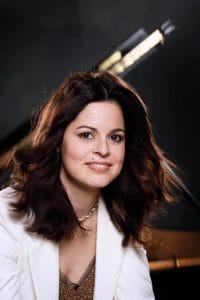
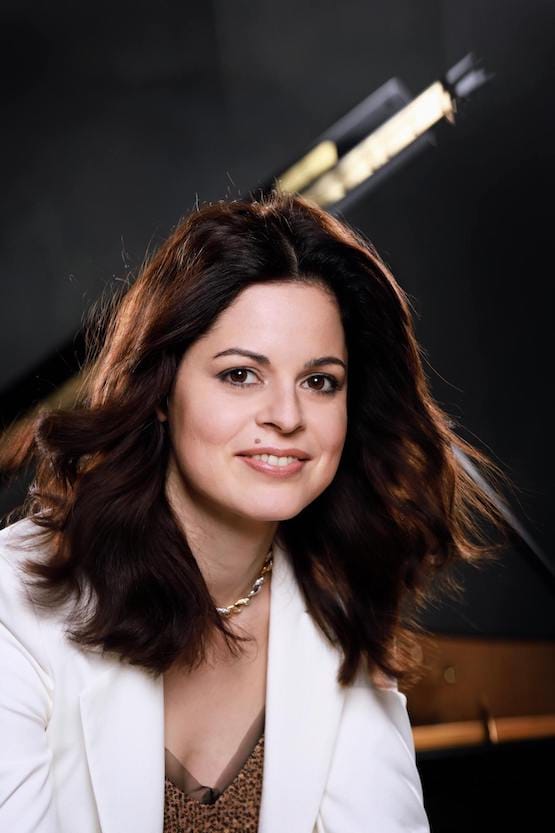
Pianist Zlata Chochieva graced the Saturday, March 29 audience for the Steinway Society – The Bay Area at the Cupertino Visual and Performing Arts Center with a marathon recital on a scale reminiscent of the virtuosos of old, Moritz Rosenthal and Benno Moiseiwitsch, a combination of digital finesse and stamina, and the uncanny blend, to paraphrase Goethe, of truth and poetry. Fixed in the Romantic tradition, Chochieva possesses a phenomenal memory to complement her stunning technical resources, and her innate, dramatic sense remains constantly alert to the pace and color of her chosen repertoire. By the end of her solo concert, the one encore from Soviet jazz composer Alexander Tsfasman (1906-1971), his amorously bluesy fox-trot, “Stay with Me,” telescoped the collective sentiment of each and every auditor at a spectacular demonstration of musical taste and virtuosity.
Chochieva began with Béla Bartók’s infrequently played arrangement of J.S. Bach’s Lento second movement from the Organ Sonata in G Major, BWV 530, whose extended, eminently vocal, lyric established the inwardness (Innigkeit) of the evening, the meditative concentration that Chochieva would apply progressively to the recital. To wit: immediately after the piety in the Bach, without any acknowledgement of the audience, Chochieva proceeded into Robert Schumann’s 1837 (rev. 1852) Symphonic Etudes, Op. 13, the composer’s first effort in establishing his grand notion of the keyboard’s sonorous potentials. Based on a theme created by amateur musician Baron von Fricken, to whose illegitimate daughter Ernestine Schumann was briefly engaged, the martial tune undergoes twelve formal variations, to which Brahms in the later edition addended another six that had been suppressed; of these, Chochieva interpolated three, each of which resounded with gossamer beauty and suave execution. In the course of Schumann’s studies, more or less études as such, he indulges in huge mood swings indicative of his personal dualism Florestan and Eusebius, the complementary aspects of his creative nature. Chochieva’s capacity to elongate extended color lines quite captivated our musical imagination, while the final gambit, a tempestuous march from Heinrich Marschner’s air “Proud England, rejoice!” from Ivanhoe, resounded in splendid, vehement array.
The first half of the concert concluded with two pieces from Johannes Brahms: the 1893 Romanze in F Major, Op. 118/5, gently exhibiting a sense of nostalgic fatigue and world-weariness, touched by a resigned humor of acceptance. The second of the Brahms pieces, however, the Scherzo in E-flat Minor, Op. 4, reverted to the composer’s tempestuous 1851 Scherzo in E-flat Minor, an independent piano work with debts to Chopin, Beethoven, and Schumann, especially the last, given that Brahms gives the music two trios, the second of which nods to Marschner, as had Schumann’s Op. 13, only this time to a tune from the opera Hans Heiling. The three-note, upbeat motto and fierce syncopations of the theme pervade the piece, with hammered impulses from Beethoven and the appearance of the composer’s idiosyncratic sense of melody, ben cantando ed espressivo. Chochieva imparted passion and flair to this early opus from the young Brahms, eager to impress his stamp on the Great German Tradition.
Sergei Rachmaninoff alone provided the impetus for the recital’s second half, although the final piece of the concert proper had inspiration from Mendelssohn, in the form of the wittily vibrant Scherzo from A Midsummer Night’s Dream. Chochieva opted to start with four preludes from each of the two sets, Op. 23 (1901-03) and Op. 32 (1910), giving us in microcosm the emotional range of this most nostalgic of Russian composers, whose pieces singularly demand the prowess he himself possessed, courtesy of his huge, talented hands. The D Major established contemplative ardor and organic polyphony as a port of call, No. 7 Allegro in C minor and the ensuing No. 9 Presto in E-flat minor hark back to Liszt for fertile energy and crossed-hands dexterity, in the manner of energized Liszt’s Un Sospiro. For pure gossamer sonority, few pieces can match the Prelude in G Major from Op. 32, which Chochieva realized in a manner worthy of Benno Moiseiwitsch, Rachmaninoff’s favorite pianist. The remaining pieces, in E, F minor and A minor, exhibited Chochieva’s motor prowess par excellence, though never losing her wondrously elastic power to keep the piano singing.
The major selection, Rachmaninoff’s 1931 Variations on a Theme of Corelli, stands as his last extended piece for solo piano, dedicated tp Fritz Kreisler. The original theme in D minor predates Corelli as a tune, La Folia, a highly adaptable bass framework that permitted Corelli, Glinka, and Liszt each to evolve a musically diverse response. There are 20 variations, not all of which prove emotionally compelling, though from a technical perspective they constitute challenges in voicing, color and articulation that Chochieva threw off effortlessly, impassive in her facial expression but intently focused on digital accuracy and selective, expressive pedal. The sheer stamina Chochieva exhibits without strain or gratuitous sentimentality bespeaks a major talent whose energies seem still only in the early stages of eminence.
—Gary Lemco