“Le Bestiaire” = HENRI SAUGUET: Les animaux et leurs hommes; DÉODAT DE SÉVERAC: Chanson pour le petit cheval; Les hiboux; IBERT: Le petit âne blanc; ANDRÉ CAPLET: Trois fables de la Fontaine; GABRIEL GROVLET: Les ânes; SAUGUET: Chat I; Chat II; JEANNE HERSCHER-CLÉMENT: Le bestiaire du paradis – Céline Ricci, sop./ Allan Palacios Chan, tenor/ Noriko Ogizawa, flute/ Daniel Lockert, p. – Sono Luminus DSL-92149 [Distr. by Naxos], 74:38 **(*):
Far and away, the best thing about this album is the program. It’s chock full of urbane, witty, gently satirical music of the kind that French composers, and the French poets behind the music, do best. All these pieces revolve around animals, either anthropomorphized or not. Of course, the more the animals portrayed act like people, the more they tend to point up our own foibles and failings, as in Jean de la Fontaine’s famous Fables, three of which are set with gusto by André Caplet: “The Crow and the Fox,” “The Cicada and the Ant,” and “The Wolf and the Lamb.” In each, the more clever or rapacious animal gets the upper hand of the other, which looks a lot like life in the human world.
Henri Sauguet’s seven brief songs from Les animaux et leurs hommes are based on equally short aphoristic poems published in 1920 by Paul Éluard. The poems have some of the deceptively simple language-driven argument of Gertrude Stein’s (“A rose is a rose is a rose,” remember?). On the other hand, Sauguet’s music has the casual almost throwaway air of Les Six and is as charming as their songs generally are. The subjects of these pieces are typical barnyard animals (“Horse,” “Cow,” “Hen,” “Pig”); despite the title, their people (leurs hommes) hardly figure at all.
The most remarkable and arguably the finest poetry here are Charles Baudelaire’s Les hiboux (“The Owls”) and Chat I & II (“Cat I & II”), which, reversing the trend in Éluard’s poems, are more about people than about animals. In typical Symbolist fashion, the animals are indeed symbolic of larger issues; the owls of Les hiboux represent the kind of patience and single-mindedness of purpose that humankind, often to its detriment, lacks. Intriguingly, the two cats represent, through various feline attributes, a woman with whom Baudelaire was in love, the actress Marie Daubrun, known as the “Green-Eyed Venus.” The first poem tells us outright that this is a symbolic cat, a cat of the mind and of desire: “A handsome cat is strolling in my brain, / just as in its rooms, very gentle and charming.” Henri Sauguet’s settings of Chat I & II are, as might be expected, meatier and more atmospheric than his settings of Éluard, while Déodat de Séverac’s much earlier setting of Les hiboux is a haunting bit of musical Impressionism. Just so his Chanson pour le petit cheval (“Song for the Little Horse,” based on poetry by Prosper Estieu), which sets the little horse a-galloping through the sprightly piano accompaniment.
The lion’s share of the program is taken up by Jeanne Herscher-Clément’s twelve pretty songs on poetry of Renée de Brimont. Both the poetry and the music are light but attractive; they concern themselves with a whole menagerie, from bees and flies to trout, weasels, and monkeys. Two works for solo piano by Ibert and Grovlet, both taking donkeys as their subject, provide welcome interludes.
If you think I was mincing words at the start of this review, you’re right; so now for the bad news: Céline Ricci is certainly a distinctive singer and one who invests her performances with a good deal of energy, but her voice, to these ears, makes for painful listening. It’s piercing, works in partnership with a wide vibrato, and is not the most accurate of instruments: Ricci often seems to tune as she goes, sometimes only approximating the note she aims at. She has very fine collaborators, especially pianist Daniel Lockert, and is given the usual fine advocacy provided by the Sono Luminous engineers. And then there’s that wonderfully varied program to consider. It’s your call. As for me, a little of Ricci goes a long way, and I’ll take this CD in bits and pieces from now on.
—Lee Passarella
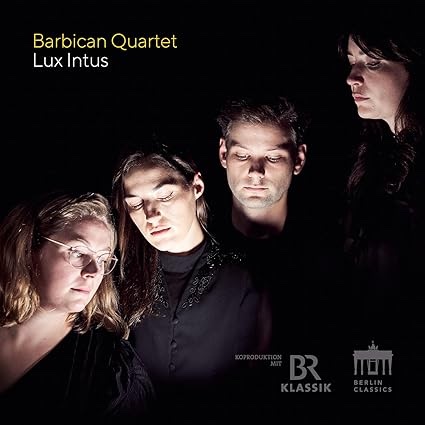
Barbican Quartet – Lux Intus – BR Klassik
“Internal Light”… illuminating the inner voices of the quartet