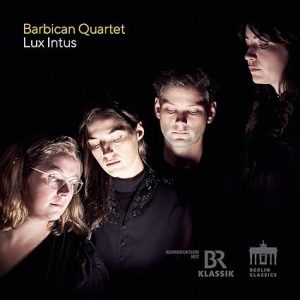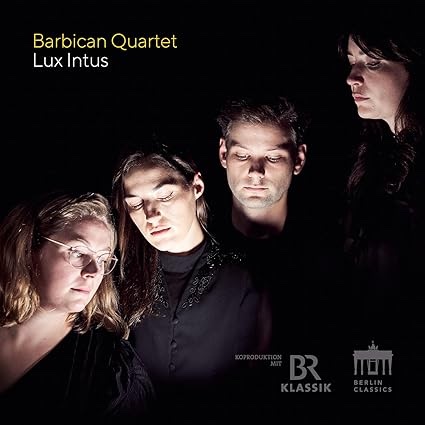
BARBICAN QUARTET: LUX INTUS – MOZART: String Quartet No. 21 in D Major, K. 575; R. CLARKE: Poem for String Quartet; BRITTEN: String Quartet No. 1 in D Major, Op. 25; ELGAR (arr. Slenczka): Nimrod from Enigma Variations, Op. 36; S. JANI: Postlude – Barbican String Quartet – BR Klassik 0303340BC (67:45) (11/2025) [Distr. by Naxos] ****:
Recorded in May 2025, this album whose rubric Lux Intus (“inner light”) unites the selected compositions, features the Barbican Quartet – Kate Maloney and Amarins Wierdsma, violins; Christoph Slenczka, viola; and Yoanna Prodanova, cello – performing works by Mozart, Prokofiev, Rebecca Clarke, Elgar, and Sophia Jani. The appeal aims at the inner voice of the quartet ensemble, the viola and (in Mozart) the cello, those instruments which shed an interior illumination upon their surrounding brethren.
The program opens with Mozart’s 1889 – though published posthumously in 1791 – Quartet in D Major, the first of the so-called “Prussian quartets” ostensibly meant for King Frederik William II, an adept cello player. The airy writing of the opening Allegretto instantly reminds us of Mozart’s own proficiency on the viola; but after a brief delay, the cello assumes the lead in its high register, creating a sense of a concertante quartet consisting of four virtuosi. Indeed, the instruments converse most genially, and the cello will often descend to insert a more emphatic moment of punctuation. The first violin part intones rather nasally, perhaps an attempt to project a (vocal) sense of original instrumentation.
Mozart spreads his melodic material in his Andante over the entire texture, once more instilling a truly collaborative, operatic effort. Expressive and intimate, this movement offers passing dissonances that resolve on lush chords, with the cello’s contribution having become most persuasive. Anticipating Bartok – in his Concerto for Orchestra – Mozart creates a pattern of duos in his genial Menuetto: Allegretto, which proclaims, in the Trio, the cello the resonant voice in a concerted moment of opera buffa. A distinct similarity exists in the melodic contour of the last movement Allegretto, resembling that of movement one. Viola and cello lead the ensemble, project a luxurious richness to an otherwise daintily explosive texture, set a rondo with variants. Juxtaposed against the political climate of the French Revolution, the work feels incredible secure in its means, conceived for an aristocracy whose own days would be numbered while this music endures.
Composer Benjamin Britten experienced a self-imposed exile in the United States at the outbreak of WW II. A declared pacifist, he accepted a commission from Mrs. Elizabeth Sprague Coolidge ($400) for this work to be premiered by the Coolidge String Quartet. A veteran viola player, Britten demonstrates in his initial Andante sostenuto – Allegro vivo a keen sense of his instrument’s tessitura, placing the viola line in the bass while the two violins and cello (pizzicato) sing in high, close intervals. The scoring reflects Britten’s sound concerns with his opera Peter Grimes, especially the “Dawn Sea Interlude.” Tempo I offers an unearthly rondo, contrasting abruptly with Tempo secondo, Allegro vivo. Syncopated in dizzying gestures, two impulses alternate over the cello’s low plaints. Eventually, the entire complex evaporates.
The spirit of Beethoven seems to merge with that of Shostakovich for the second movement, Allegro con slancio, a compressed scherzo-march in triplets trenchant with irony and acerbic wit. The 5/4 rhythm of the Andantino calmo transports us back to Britten’s Peter Grimes, particularly the “Moonlight Sea Interlude.” High violins compete with the viola and cello’s lower range, suddenly urging forth an organ-like sonority quite plaintive, even anguished. Commentators have dubbed this music “a requiem for a lost world.” The organ texture returns, casting the cello into its pizzicato motion while the upper strings sing the coda to an extended lament.
The final movement, Molto vivace, demonstrates Britten’s mastery of intricate, robust counterpoint, much the legacy of his teacher, Frank Bridge. This resurgence of energy includes the scherzo-like, rapidly running counterpoint of its opening, sharp, punctuated chords and the strong unison theme from the two violins and viola. The cello’s takes a solo position against his fellow strings. The pesante tune will return two octaves above its original position, the entire tissue having become symphonic and sonically daring as it sails into a final cadence.
Rebecca Clarke’s 1926 Poem for String Quartet presents a moody, eight-minute piece from a composer whose major emphasis lay in her dedication to the viola. The modal syntax of the piece casts a delicate sense of shadow, the more plaintive element expressed by the first violin. The cello repeats a sequence soon co-opted by the other strings, the dynamic’s becoming softly intimate. The last bar assigns the gesture to the viola, drawing in the warm, hazy timbre into a homogeneous, velvet hue.
Intimacy and intensity mark violist Christoph Slenczka’s arrangement of Elgar’s “Nimrod” Variation from the 1899 Enigma Variations. A celebration of Elgar’s supporter, the publisher Augustus J. Jaeger, the music evolves slowly and a trifle dissonantly, purportedly a discussion between Elgar and Jaeger on the subject of Beethoven string quartets. But the “secret” theme may likewise be operative, the presence of J.S. Bach in the powerful, “symphonic” progress.
The ecstatic visions conclude with Postlude (2025) by Sophia Jani, a piece ordinally conceived for four saxophones. Passages of various chords shared by the quartet members generate vibrations rather than any distinct melody, “spotlights” on motifs that do not reveal what they signify. Whether such an aesthetic proves existentially “illuminating” remains a matter of taste for a little over five minutes.
—Gary Lemco