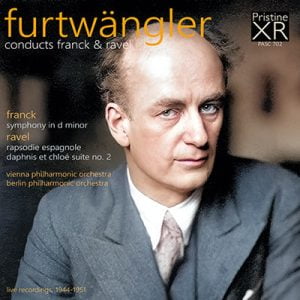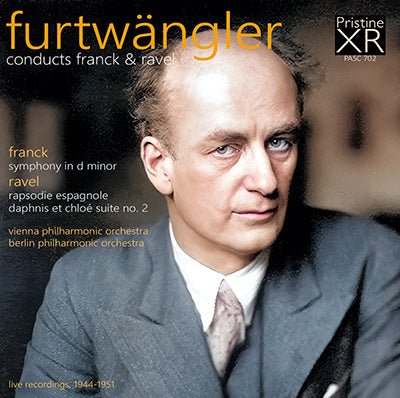
FRANCK: Symphony in D Minor; RAVEL: Rapsodie Espagnole; 1Daphnis et Chloé Suite No. 2 – Vienna Philharmonic Orchestra/ 1Berlin Philharmonic Orchestra/ Wilhelm Furtwaengler – Pristine Audio PASC 702 (71:41) [www.pristineclassical.com]*****:
Producer and Recording Engineer Andrew Rose has revitalized, via his patented XR process, Wilhelm Furtwaengler’s rare documents of his performing French music. The 1945 VPO live recording of the Franck Symphony in D Minor, a last gasp from Europe (28-29 January 1945) before the conductor self-exiled to Switzerland, has companions in two live performances of Ravel works, respectively, from Stuttgart and Berlin. The original Franck Decca LP (LXT 2905) garnered several responses to the effect: break out the incense! The fusion of Wagnerian harmony with musical kernels from Beethoven’s Op. 135 would have alerted Furtwangler’s intuitions as a composer himself. The startling economy of modulation in the first movement – D Minor, F major, B major – all the while exploiting the initial themes from the Lento onwards, finds in the Furtwaengler realization with his beloved VPO the tension of inspired architecture, even as the music gains in dynamics and acceleration.
Furtwaengler imposes a grandy introspective darkness upon the opening Lento, here infused with both mystery and terror. How quickly the music assumes a demonic urgency, veritably Lisztian in fervor, as Franck enters into his extraordinary virtues in transformation of theme. The Lento music will appear in the recapitulation, reprising the main themes, especially the song of glory in F; and even the lugubrious motto theme concludes in the major mode. To describe Furtwaengler’s final peroration as colossal does it injustice.
The Allegretto under Furtwaengler unfolds more in a walking tempo, the orchestral definition aided immensely by the Pristine remastering process to capture strings, harp, and Cor anglais to full, lyrical and dramatic advantage. The music unites a slow movement to a kind of wispy scherzo, the hybrid here infused with an erotic dimension not far from Wagner’s Tristan. The flurry motif of the scherzo episode evokes a muted, surreptitious drama’s unfolding, with the woodwinds now adding a spacious magic, via polyphony, to the proceedings. Franck said of his last movement, Allegro non troppo: “The finale takes up all the themes again, as in [Beethoven’s] Ninth. They do not return as quotations, however; I have elaborated them and given them the role of new elements.” A joyful energy tuns rampant from the outset, basking in the glories of prior movements while relentless pursuing the apotheosis in D major. We hear the English horn surrounded, almost cradled, in ecstatic mystery, with Furtwaengler’s molding each string phrase and woodwind entry with guided elasticity. When the VPO brass and battery contribute, the effect quite overwhelms, the potential of the original motto theme’s having been raised to transcendent heights.
Ravel’s 1908 Rapsodie Espagnole (22 October 1951) basks in Iberian languor, the opening “Prelude to the Night” (in A major) erotically restrained, the dynamics confined to mezzo-forte and below. The ensuing ‘Malagueña” cannot decide which modality of A it prefers, but its brief and lively incursion plays with the motif (F-E-D-C#) with which the opening “Prelude” seduced us. The intentionally drowsy “Habanera” (in 2/4) wants to exude the erotic charm we receive from Bizet’s Carmen; and again, the chosen key, F#, expresses modal vagaries. Furtwaengler in wily, dramatic fashion, milks the gradual explosion of the last movement “Feria” (in 6/8) so that the most “neutral” key, C Major, achieves romantic, slightly drunken, unfettered splendor.
Furtwaengler (earlier) turns again to the music of Ravel, here in the Wartime 19 March 1944 in the Berlin State Opera theater with his Berlin Philharmonic. Though Furtwaengler rarely embraced ballet scores as such, he exploits the 1912 Second Suite for the 1912 Daphnis et Chloe as an excellent display piece for the BPO. Ravel himself felt dubious as about the ballet’s potential for market success, having declared the work “a vast musical fresco, less thoughtful of archaism than of fidelity to the Greece of my dreams, which identifies willingly with that imagined and depicted by late-18th-century French painters.” A horn solo at the opening of the ballet provides the theme for the pastoral landscape illuminated in sunrise in “Lever du jour.” The sound of rivulets and bird calls marks the grotto of the nymphs whereby Daphnis slumbers. The Berlin string sound must have provided the model for anything Karajan was to achieve later with the orchestra.
Daphnis, awakened, finds Chloe amidst shepherdesses, and together they imitate the myth of Pan and Syrinx. Having been repulsed by the nymph, Pan plucks reeds to convert them into a flute, in order to play melancholy lament, and Chloe dances to the melody. The dance increases in intensity, evolving into a bacchanale. Chloe, infatuated, falls into the arms of Daphnis, and bacchantes of both genders join them in a general dance. The blatantly lush, erotic score finds an aroused sympathy in Furtwaengler’s rendition to produce a rare, transparent fabric from his war-besieged ensemble, here devoid of tragic implications.
—Gary Lemco
More Information from Pristine