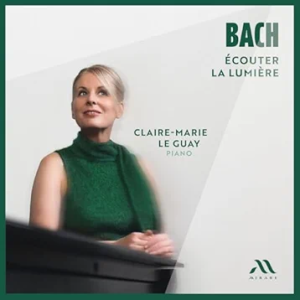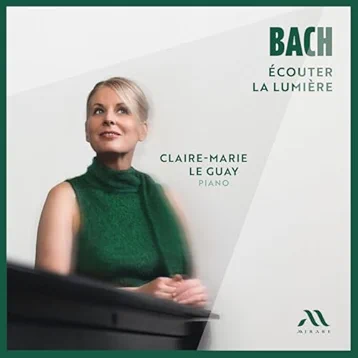
BACH: Écouter La Lumière = Works by BACH; VIVALD; MARCELLO; BUSONI; DUTILLEUX; RAMEAU – Claire-Marie Le Guay, piano – Mirare MIR792 (60:00) (3/6/26), complete contents detailed below) [Distr. by PIAS] ****:
Pianist Claire-Marie Le Guay assembles (8-10 July 2025) an hour’s homage to J.S. Bach, whose work she celebrates as a direct, visionary connection between earth and heaven, the selected works chosen for “their intensity of expression” in the effort to inspire “an inner listening experience: Le Guay offers the traversal as an experiment in dynamic, emotional, and spiritual contrasts. She opens boldly, with a single (Steinway) piano transcription of the Allegro from Vivaldi’s Concerto for 4 Keyboards, as “symphonic” a sound as could be accomplished without excess. Immediately, exquisite contrast, a Largo from Vivaldi in Bach’s arrangement, inward and intimate. The parlando droplets already subsume much of Scarlatti, the French Baroque and even an operatic impulse.
The aggressive, extensive Prelude, BWV 922 combines Bach’s brilliant toccata style with an ardent, arioso intimacy that much anticipates Schumann. At times, Le Guay’s sonority becomes percussive and harsh, but her control of timbres remains impressive. The allusions to the Chromatic Fantasy reverberate throughout. Alexandre Tharaud has transcribed a potent moment from the St. Matthew Passion, Pilate’s anguished attempt to spare Jesus the punishment the crowd of resentful pharisees demands. The vocal power of the keyboard assumes the same intimacy we know from the slow movement of the Klavier Concerto No. 5 in F Minor. The somber procession from Vivaldi’s Organ Concerto in Bach’s transcription continues the mood of exalted introspection, where even the passing tells suggest aerial eddies from cherubs’ wings.
For pure inspired solitude, the “Aria” from the Goldberg Variations bears its own bower of ardent bliss. The pearly legato Le Guay applies does not cater to the harpsichord sonority, a la Glenn Gould. At track 11, Le Guay proffers the slow, chromatically intricate Variation No. 25 from the Goldbergs, a passage not some primal mystery. No less haunted, the Adagio from Marcello’s D Minor Oboe Concerto has us recall what Wilhelm Kempff could realize in this music, since Le Guay proves equally poignant here. The spirit of Kempff rises once more for the chorale Ich ruf zu dir, Herr Jesu Christ, in the sturdy Busoni arrangement.
The spirit of engaged dialogue infiltrates the Praeludium in D Major from the 6 Little Preludes, to which Le Guay attaches the multicolored Fugue from BWV 904, a moment of Bach’s “learned style,” to cite the authority of J.C. Bach. Le Guay instills again an organ sonority to the occasion, clear and articulately forceful, at once.
The last five selections assume, if I may, a more “secular” temper, although the two Sarabandes – from English Suite 6 and Partita 4, respectively – carry their own sense of transcendence. Their Spanish, ornamental beauty slows down our meditational sensibility, and we feel the urge of the aesthetic impulse to claim a religious ecstasy. The Prelude of Rameau captures a serene and thoughtful sense of elevated taste, an ornamental tracery in varied tempos, an adagio and gigue. From the Well-Tempered Klavier, Book I, we have something akin to a musical Book of Genesis, so the demonic Prelude in D minor rounds out the survey, the vision of the ouroboros in passionate filigree. But I have not commented upon the one “outsider” to the Baroque family, Henri Dutilleux (1916-2013) and his singular Au gré des ondes – Hommage à Bach, which proceeds slowly, a measured, steady parlando whose simplicity of means creates a rarified moment of veneration.
—Gary Lemco
Claire-Marie Le Guay – Écouter La Lumière
VIVALDI/BACH: Concerto for 4 Harpsichords, BWV 1065 (trans. F. Noack): Allegro;
Concerto in G Major, BWV 1073: Largo;
Concerto for Organ in D Minor, BWV 596 – Largo e spiccato;
BACH: Prelude in A Minor, BWV 922;
St. Matthew Passion, BWV 244: “Aus liebe” (trans. A. Tharaud);
Goldberg Variations, BWV 988: Aria and Variation 25 “Adagio”;
Praeambulum in D Major, BWV 924;
Fantasie and Fugue, BWV 904: Fugue;
Well-Tempered Klavier, Book I: Prelude No. 2, BWV 847;
MARCELLO/BACH: Concerto for Oboe in D Minor, BWV 974: Adagio;
BACH/BUSONI: Ich ruf zu dir, Herr Jesu Christ, BWV 639;
English Suite No. 6 in D Minor, BWV 811: Sarabande;
Partita No. 4 in D Major, BWV 828: Sarabande;
DUTILLEUX: Au gré des ondes – Hommage à Bach;
RAMEAU: Suite in A Minor: Prelude