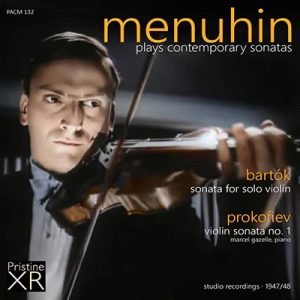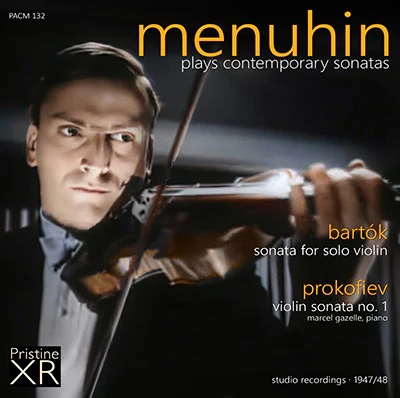
MENUHIN plays Contemporary Sonatas = BARTOK: Sonata for Solo Violin, Sz. 117; PROKOFIEV: Violin Sonata No. 1 in F Minor, Op. 80 – Yehudi Menuhin, violin/ Marcel Gazelle, piano – Pristine Audio PACM 132 (53:04) [www.pristineclassical.com] *****:
I met violinist Yehudi Menuhin (1916-1999) for the first time in Atlanta, Georgia in 1980, on a Saturday, after having heard him perform the previous evening the Elgar Violin Concerto, one of many of his personal, prized specialties. He greeted me in his suite at the Fairmont Hotel, glad that I bore many of his vinyl LPs. Early in our conversation he beamed, “I am so touched to find someone so familiar with my work!” I must state that Menuhin’s demeanor, in conversation, totally fixated on his guest, as though my words and presence were all that meant anything at that moment.
I inquired into Menuhin’s decision in 1947 – the same year he committed to recording history his performance of the Bartok Solo Violin Sonata – to return to Germany, only just beginning to recuperate after the destruction of WW II and actively pursuing, under international jurisdiction for retribution, various, guilty parties of the Holocaust:
“Mr. Menuhin, there are fellow Jews who consider you ‘a dirty Jew’ because you opted to participate in German cultural reconstruction.”
“Yes, I am only too aware. But I received an invitation to perform the Beethoven Violin Concerto in Berlin with Wilhelm Furtwaengler – the greatest of concertos with the greatest of orchestra conductors, and I had to make a decision. Obviously, with the recent revelations of the mass destruction of human beings in Germany, many people felt every German ought to be pushed into the sea. Absolutely, a legitimate reaction. I felt, however, deeply, that if the world were to heal, I must be part of the process. My presence would be unique – after all – my name “Yehudi” means quite literally ‘the Jew.’ There would be no ambivalence.”
“Among my many recordings of you, one of my favorites is that of the Nielsen Concerto with Mogens Wöldike.”
“Thank you. You know, we achieved such good harmony together, that some of the musicians asked if I had Danish in my heritage? But more significantly, in my meeting with the composer Sibelius, he asked me directly whom I thought was the greatest living composer! I felt caught between honesty and courtesy. But he saved me any embarrassment: he stated directly that Bartok was the greatest living composer.”
Which brings us to consider Menuhin’s recording 2-3 June 1947, of Bartok’s Solo Sonata, commissioned by Menuhin, dedicated to him, and premiered in New York City – after minor alterations to facilitate the realization – on 26 November 1944. Given Bartok’s intellectual penchant for academic rigor – he read Beethoven string quartets at bedtime – we experience a pungent stridency, a severity of demeanor that dominates the emotional affect of the work, even in spite of the Magyar, rhythmic vitality that infiltrates the last movement. Bartok has synthesized much of the Bach sonata and partita craftsmanship to his own ends for this work in four movements. The opening Tempo di ciaccona alternates between agonized gestures and ardent, plaintive assaults into the harmonic atmosphere. Either in dialogue or in chromatic ariosi, the musical line exudes a rich but dissonantly poised tautness, rife with folk harmonies in counterpoint. Menuhin’s plaintive tone imbues a tragic humanity to the occasion.
The Fuga, curiously, exerts a degree of melodic freedom to the procedure, despite its four-voice, initial motif. The episodes introduce new subjects, each of them clearly articulated whether by the bow of by pizzicato inversions of the material. The rapid shifts in register and bow technique display no mean gymnastics from Menuhin, who often advised Bartok on the technical resources demanded of the solo. Late in the Fuga, a buzzing motif sallies forth to allow a throbbing, rasping contour in harmonics. The Melodia projects something of Bartok’s patented “night-music” affect, proceeding in expanded degrees of the intervals: sixths, octaves, and tenths, settling high on the instrument’s flute tone or descending low into viola regions. Intensely meditative, the music virtually asks for our silence as it luminously proceeds.
The concluding Presto meant to realize true Magyar tonal elements in quarter tones, but Menuhin convinced Bartok to remain in the traditional chromatic system. The muted, buzzing introduction breaks off precipitately into a driving series of agonized scalar passages and quick alternations of register. A degree of humor persists in the juxtaposition of flighty motifs and ardent, even voluptuous, passages of multiple stops. The coda, too, opens with a quiet scalar synthesis of the three main impulses, only to sail upwards into the realm of the gods.
Menuhin and Marcel Gazelle (1907-1969) recorded Prokofiev’s First Violin Sonata (1938-1946) for EMI on 1 October 1948, the 1946 debut having been given by Russian virtuoso David Oistrakh with pianist Lev Oberin. Likely sympathetic in tone to Prokofiev’s “war” pain sonatas, this Violin Sonata opens, Andante assai, with a series of low, hazy, descending chords pregnant with uneasy sentiments, the melodic content anguished and pleading over persistent grumblings from Gazelle. A rising gesture attempts to bring a degree of light into this malevolent darkness, but the (buzzing) gloom persists. The pizzicato riffs offer no relief from the meandering scale, while the piano intones a bass dirge that has left us in die straits.
The ensuing Allegro brusco injects strident, rasping impulses in C major, and arising melody maintains a martial contour. The activity becomes fierce, combative, but just as suddenly obsessive in a demented character. The texture lightens grudgingly, always ready to engage in combat. A lyrical impulse struggles upward but gets swallowed in the heaving, percussive sonorities. The lyrical strain finally gains a kind of nervous ascendancy, but the underlying agitation had become more unforgiving as the violin sweeps upward to the coda. Gazelle has solo entry in the Andante, to which Menuhin has equal access, and the two sing a wavering arioso in F major. A melancholy intimacy takes form, in a three-note pattern that serves as a persistent plea. The texture lightens to allow the orison an aerial space, while Gazelle plays a parlando line that joins Menuhin in the most emotionally rapt occasion experienced thus far. It stutters to a flighty, diminished call that evaporates.
The Allegrissimo finale opens with a furor in the major mode of F that does relent, in its own way, to a series of stuttered phrases over Gazelle’s extended parlando. A pizzicato pattern begins a new section, aggressively impassioned, that bears a kind of gypsy rapture, only manic. The music has modulated back into its minor mode, Andante assai, dark and menacing, as Menuhin weaves a series of hazy scalar patterns. The opening of the sonata proper emerges, sadly plaintive, and the music leaves us lamenting for the fate of our century.
Despite its relative brevity, this album stands as a potent document of the connection between composer and loyal performer, given Menuhin’s singular conviction that music bears a moral purpose.
—Gary Lemco