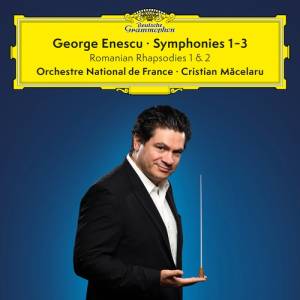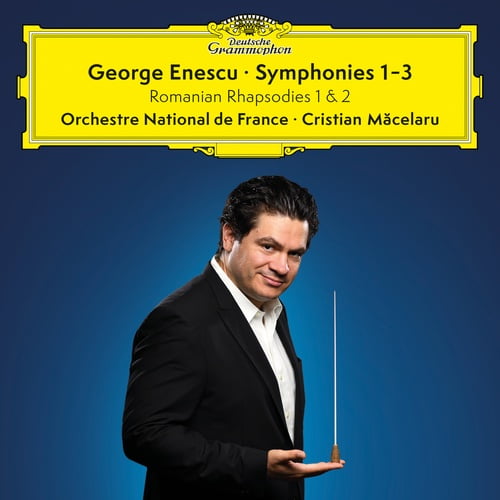
ENESCU: Romanian Rhapsodies, Op. 11; Symphony No. 1 in E-flat Major, Op. 13; Symphony No. 2 in A Major, Op. 17; Symphony No. 3 in C Major, Op. 21 – Orchestre National de France/ Choeur de Radio France/ Cristian Mǎcelaru – DG 486 5505 (3 CDs: 55:41; 56:04; 50:39) (3/9/24) [Distr. by Universal] ****:
Early in my 1980s Atlanta conversation with master cellist Janos Starker (1924-2013), I asked him about his personal favorites, musically speaking. “If you ask me whom I most like to read, then I say Brahms. If you ask me whom I think the most complete musician, I say Enescu.” That Georges Enescu (1881-1955) embodied the gamut of Romanian musical life remains an understatement, given the composer-violinist-conductor’s sheer range of activities, which included having become the artistic godfather of Yehudi Menuhin. From a thorough grounding in national, Romanian style, Enescu the composer spliced elements from Schumann and Wagner, as well a cultural affinity in cosmopolitan, French taste. Add to these diverse impulses the grandiosity of Richard Strauss tone-poems, and the essential Enescu style emerges, resonant and redolent of a refined, post-Romantic allure.
Romanian conductor Cristian Mǎcelaru (b. 1980) obviously feels a kinship with Enescu’s music, having recorded the five works presented in this set (2022-2023) with his own French National Orchestra. He begins with the much-touted 1901 Romanian Rhapsodies, of which the No. 1 in A Major, has become a major virtuoso-color vehicle for any orchestral ensemble. But even here, early, in the survey, Mǎcelaru reveals a tendency to overload the realization with a degree of rhetorical sentiment and sonic gloss that may serve to undercut the more acerbic tendencies in the original scores. While the rhythmic energy survives well, and the orchestral definition of the strings, woodwinds, and brass retain a spirited luster, the slow sections tend to a schmaltz we might ascribe to Eugene Ormandy’s concept of Enescu, as filtered through the CBS enchantment with the Philadelphia Orchestra. Mǎcelaru likewise has a spaciousness available to him in the Paris Auditorium Radio France that intensifies the sense of an aural cocoon. This works well for the more dreamy aspects of the Romanian Rhapsody No. 2 in D Major, whose plaintive, rustic ethos luxuriates in nostalgic sentiment. Only after along series of pedal points and lush musing do we reach a brief folk dance rife with gypsy flavor; and it, too, becomes absorbed into the misty aether.
The initial, splashy impulse that sets off the three-movement Symphony No. 1 in E-flat Major (1905-06) might suggest that Mǎcelaru would avoid the tendency to over-ripe sonorities we heard in the Op.11. What ensues in the Assez vif et rhythmé first movement, however, plays as a series of episodic mood pictures, some of which prove darkly dramatic. I find little of the lean, astringent French nasality of tone that I associate with this orchestra; it’s as if Leopold Stokowski had assumed the reins here. The resultant bloating of the sound imparts a thick molasses on the texture, acceptable, if one has been accustomed to the veneer we recall from the Karajan experience. The first music glides along to a creamy, shimmering coda marked by brass punctuations, a victory hymn of sorts.
The second movement, marked Lent, tends to echo effects from Franck and D’Indy, ominous but arioso, until pizzicato strings and harp support a melancholic, martial tune. Exotic sounds arise, a combination of the woods and aerial vistas. Enescu’s equivalent to Wagner’s Forest Murmurs? Hints of the high, pantheistic romance in Gliere’s Ilya Maurometz? The tone darkens just prior to the coda, where tremolos and horn cede to a pulsing string serenade that reluctantly fades away. The last movement, Vif et vigoureux, imitates an energy easily reminiscent of Richard Strauss, especially his Don Juan. Meandering but pretty kernels of sound proceed in modal colors, seeming to await some melodic revelation. Instead, we get moments of syncopation and polyphony, splashes of color that include a snare drum to heighten the militant effects. The episodes remind us a balletic entr’acte, prolonged. If the urge to heroism may be said to emerge at the last, so be it. Set in episodic arches and lusty periods, the music hovers in suspended pedal points while scalar motions in the strings, brass, and battery sail to a potent conclusion.
Enescu protégé Yehudi Menuhin expressed his admiration for the 1912 Symphony No. 2 in A of Enescu, originally intended as an homage to conductor Édouard Colonne. The manuscript of the work became lost in transit in 1917, as part of a gold shipment meant for Moscow; having arrived along with sketches for the opera Oedipe, the music promptly disappeared. Bruno Walter effected a rescue in 1924, returning the music to Paris. Enescu meant to revise the score but never did, and Menuhin led a performance late in his own career. In four movements, athletic and colorfully knotty, this symphony borrows deliberate “exotic” elements from Richard Strauss, perhaps cross-fertilized by the French school that includes Roussel and D’Indy.
The opening of the expansive Vivace, ma non troppo asserts itself like the Mendelssohn Italian Symphony; and, despite the brash contours a la Richard Strauss, it tends to relax into orientally tinged harmonies and chromatic tone colors that favor the violin and selected woodwinds. A kind of light gavotte emerges and then an insistent and martial passion, perhaps emotionally linked to the Strauss Seven Veils. Rhapsodic in feeling, loosely sympathetic to Mahler, the music lingers modally in color clusters, the melodic content subdued in shades of string and woodwind dialogue, accompanied by a harp and French horn. That the music, in sonata form, derives from the opening materials, prefers to remain a labyrinthine secret. As a virtuoso color tour de force, the movement works quite well, much as the Strauss Ein Heldenleben convinces us of an ensemble’s unanimity of purpose. Violin and harp initiate a dreamy coda that lingers in color limbo, like an Impressionist painting exposed to a heat that has melted the colors together.
The second movement, Andante giusto, finds Enescu in a lyric, singing vein, and the opening clarinet melody which extends outward may remind some auditors of the exotic colors Balakirev claims in his Symphony No. 1 in C’s third movement. More exotic harmonies, instigated by a timpani roll, enter the mix as the lied accumulates horn and wind accoutrements. A pastoral improvisation, the music sometimes assumes the character of a rich, woodwind ensemble piece with string support. Again, to balance the meandering emotive content, Enescu imposes sonata form on his materials without overtly claiming any neo-Classic sensibility. If sonorous opulence appeals to your taste, then this realization, via Radio France technical teams, will gratify your exploration.
The last movement, Un poco lente, marziale – Allegro vivace, marziale, exploits militant sensibilities dominated by gradations of initially dark color. Combined, the two sections balance the girth of the first movement, moving to a solemn proclamation of light to emerge from the opening, even convulsive, menace. Almost an anticipation of the Shostakovich penchant for dramatic marches, the scoring involves a decisive role for the piano. Again, percussive and exotic instrumentation finds its way into the competing impulses, altering in texture and dynamics, often asking more of the color battery that includes harp, brass, cymbals, castanets, harmonium, celesta, and tam-tam. Virtuoso slides and soaring lyricism combine – or collide – as per one’s perceptions, in a mélange of rhapsodic color effects. The elongated coda proffers an entity unto itself. If anyone wished to volunteer the unspoken influence of Scriabin upon this thick, ungainly, and imaginatively compelling score, I would not dissent.
Enescu’s Third Symphony, with its huge orchestration, had a gestation period between 1916-1918, but the composer wrestled with its cyclical form until 1951; and, even then, the final score only appeared in 1965. Although not specifically programmatic in content, the three movements – a brooding then heroic Moderato, un poco maestoso in sonata form; a fiery, apocalyptic Vivace, ma non troppo; and a Lento, ma non troppo with wordless chorus – have been construed as a Dantesque odyssey into Earth (Purgatory), Inferno, and Paradiso. The whole work evolves from common materials, true to a cyclic procedure that has Frank and Liszt as models. Thick in texture, the first movement alternates moody reflection and sudden outbursts of energetic, agitated emotion. Fanfare impulses confront moments of chamber music quietude, once more scored to suggest exotically distant locales.
Mǎcelaru keeps the diverse, even balletic (a la Ravel), textures moving, attempting to impose on their meandering shape has a sense of organic unity. The development section involves long periods of conflict and grudging resolution, abrupt in moving from fanfares to relative calm, virtually groping toward some long-awaited idyll set in post-Romantic and Impressionist harmonic language. The coda, an eerie concoction of competing modalities, seems to ascend by color streaks, urging forward and then retreating, and finally rising to a bright flourish.
The second movement serves as a demonic scherzo, likely a response to the grim politics of the period, 1916, prior to Romania’s entry into The Great War. A fusion of both eerie and brutal sensibilities, the music assumes a quick-march sensibility, the asymmetrical rhythms easily reminiscent of lurid Holst or uneasy Mahler. Six players realize the demands of the enraged percussion section, that includes celesta and piano, all ablaze in an amalgam of snide, snarling sound that blends Richard Strauss, Mahler, Scriabin, and the colossal romantic textures in early Schoenberg.
Enescu’s means to resolve the visceral conflict appears as an extended Lento in the manner of Debussy’s veiled and erotic third Nocturne, Sirènes; here, a wordless, mixed chorus complements a kaleidoscope of refined, modal colors. Whatever bleak context the second movement established yields to a paradisal, waltz-like invocation, the now hopeful music more in keeping with tonal aspects of Delius. Despite occasional, passionate eruptions, the sense of restored faith manages to endure, a vision of some glorious enlightenment after a plunge into an appalling darkness. The singular, transparent wind textures and scalar strings include a bell tone (in F#) which sounds “the Elevation of the Host” in the human spirit.
For some auditors, this grand, Technicolor triptych of Enescu performances may be de trop, but for others a revelation.
—Gary Lemco
More information through Amazon