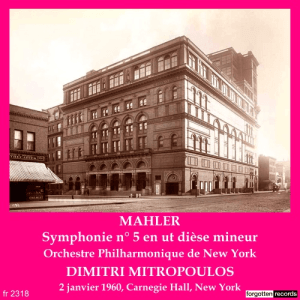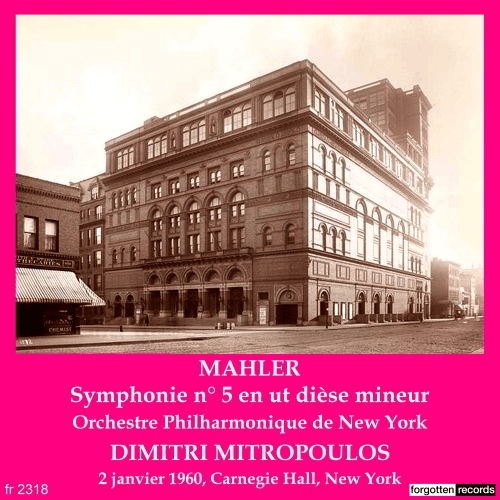
MAHLER: Symphony No. 5 in C# Minor – New York Philharmonic Orchestra/ Dimitri Mitropoulos – Forgotten Records FR 2318 (70:34) [www.forgottenrecords.com] *****:
By now, critical assessments of the contributions made by Greek conductor Dimitri Mitropoulos (1896-1960) to the Gustav Mahler tradition and legacy appreciate his colossal energy and devotion. In early 1960, the New York Philharmonic mounted an impressive, though incomplete, commemorative cycle for the composer’s centenary. This Mitropoulos performance of the Fifth Symphony (2 January 1960) has appeared in prior collections, namely that from Music&Arts (CD-1021) from 1998. Generally, the sound quality remains alert and well balanced, and Mitropoulos clearly exerts a thorough command of his forces and the architecture he fashions, although not every Mahler aficionado will agree with his decisions. Speed and emotional ferocity appear to define the Mitropoulos ethos, although he can generate intimacy and reflective passion just as naturally.
The first movement, Trauermarsch, with its fateful trumpet summons, enters a world abstract and far removed from the first four symphonies’ allusions to the composer’s song cycles. The new emphases on polyphony and continuous harmonic evolution mark a revolution for both the composer and the symphony tradition. Mitropoulos sets a searing, agonized funeral march, answered by a plaintive and elegiac melody, the pattern and its evolution a preparation for the second movement “Stormily active. With great vehemence.” Ferocity and a palpable intimation of mortality pervade these two maovements, which constitute for Mahler Part I of his spiritual journey.
The crux of the symphony, Part II, occurs at the third movement Scherzo, which Mahler dreaded conductors would perform too quickly, as a result of the preceding momentum. For the most part, Mitropoulos fails to obey the nicht zu schnell directive, and he extends the virile mania onward, with only momentary episodes of decreased edginess to the occasion. There are moments of rushed, inexact ensemble, yet the sincerity and humanity of the moments endure, especially when the music expansively resides in natural, bucolic musings. The second part of the movement, an ungainly Viennese waltz, becomes roughly interrupted by the clamorous, polyphonic forces of life’s chaos, a fervent example of Mitropoulos’ handling of competing agogics. The swirling motions become quite overwhelming, breathless, a spirit seething with dire agitation. A kind of parlando in the brass finds some degree of respite, supported by ironic filigree in the woodwinds and low strings. Another rhythmic pulse suddenly takes over, catapulting the music in bold, brassy figures to a convulsive coda, that all but has the audience upright.
Mitropoulos immediately imposes the famous Adagietto fourth movement, virtuoso strings alone, in broad strokes, tender as a child’s cheek and heartbroken as the loneliest man on earth. The harp part resonates against the drooping sighs of the strings, a haunted specter of longing and lost love. The sustained pathos proceeds in a tautly flowing line, nuanced at every turn by the conductor’s sense of noble stoicism. The tugs forward and emotive retreats remind us the composer’s preferred walking tempo, which varied at almost every step. For an example of homogeneity of orchestral tone and unanimity of emotional tenor, you need not seek beyond this pinnacle of Mahler execution.
The Mitropoulos patented intensity extends into the last movement Rondo-Finale: Allegro giocoso, a humorous, even sarcastic, homage to much of the emotionally eclectic moods and torments of prior movements, at first set in strict counterpoint. Within the manifold layers of expression lies a chorale, hints of both the First and the Fourth Symphony, and it will assert itself blatantly in the major mode scarcely a minute prior to the coda. In the meantime, the throes of the Adagietto undergo a series of martial and elegiac transformations. The insistence of contrapuntal development may well be Mahler’s reply to Wagner’s Meistersinger exertions to prove his mastery of Bach’s procedures. Never does Mitropoulos relent in his tragic urgency of expression, as though he were plunging through the Slough of Despair to a higher, saving, metaphysical resolution. The coda does not come easily, but in a headlong sweep, the aerial suicide eager for the pavement. The audience well appreciates the total virtuosity of the performance.
–Gary Lemco