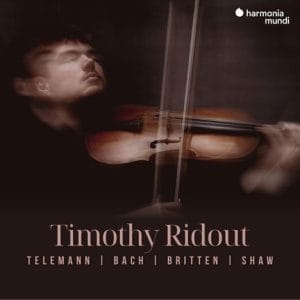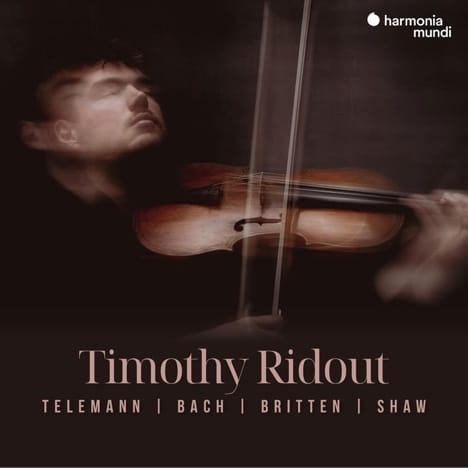
Timothy Ridout (viola) plays: BACH: partita no 2. BRITTEN; Elegy. SHAW: in manus tuas, TELEMANN: Fantasias – Harmonia Mundi HMM 902 750 (61.08) 2/2025 [Distr. PIAS] ****
Timothy Ridout’s new issue has no title, unusual for Harmonia Mundi productions. It is his first solo performance on disc after a couple of award winning chamber recitals and a concerto recording of Bloch and Elgar. Four composers are featured on the cover along with striking blurred photo of the performer. We are invited to figure out without any thematic hints what each has to do with the viola as a solo instrument and perhaps how they fit together as a whole.
Telemann and Bach both wrote a select number of works for solo string instruments, whether they are called partitas or Sonatas or fantasias doesn’t seem very important. They are all based on dance suites and pared down to fit over no more than four strings. In Telemann’s case, he allows the violin (or viola) to stay pretty close to its graceful baroque idiom. Cantabile singing, modest additions of a second voice to steer the way through an implicit but not overly complex harmonic support. They are pieces of great charm. They could be played on any number of instruments, but I think they are ideally suited for the register of the alto.
 I enjoy hearing Telemann next to Bach. Of course, the fact they were friends rather than rivals is part of that. They should not be rivals today either; Bach’s music comes from a very different altitude, a different mountain altogether, while Telmann’s worldly and flattering high baroque style is from no mountain at all; rather the French Court, the the exquisite science of the Italian sonata at its height, and various other folk and North German influences. Nothing jars, and virtuosic note-spinning never outstays its welcome as it does with his rival Handel.
The two fantasias make for an ideal entry point to the sound of Ridout’s rare and magnificent instrument, an Italian 1575 Peregrino di Zanetto instrument on loan from a generous Beare’s International Violin Society. The instrument shines on the dolce and the largo with an amber warmth that would not be easy to duplicate on a violin. The higher notes are pearly clear with just a touch of bite to moderate the sweetness. At around 8 minutes each they are perfect for absorbing as a whole, and memorable in a not-ear-worm sort of way.
Between the fantasias we have a contemporary piece by Caroline Shaw (b, 1982) called in manus tuas (in your hands) that suggests a liturgical connection that we (probably guess) belongs to a secular sort of devotional practice. It was originally written for the cello and I watched a couple of persuasive performances on youtube but I think this adaptation for viola is superior. The Peregrino can do a fine cello imitation in its bottom range and the eerie ectoplasmic harmonics come off better on the viola which can ventriloquize a theremin at its upper register. After some searching arpeggios it settles into a rhapsodic cadence punctuated by an inquiring pizzicato melody that is surprisingly gentle and utterly arresting. The ending is perfectly delivered in a whisper that is both invocation and prayer. I can only imagine that the performer has spent quite a while comprehending this piece for he communicates its beauty and its enigma very well. While it must be technically demanding, it is not demonstrative in the least. Perhaps in its egoless feel it best compares to some late Shostakovich.
A Benjamin Britten piece of almost exactly the same length is the third offering. Entitled Elegy, it was not published in his own lifetime. It is also sombre, but while the Shaw piece was outward looking, this work of the composer’s troubled late teenage years is introspective. Its expressive language is so clear and dare I say adolescent in its mood(s) that it tempts Mr. Ridout to the facile explanation that it represents “a lonely boy struggling with his sexuality.” Well, that is one way to box up a piece of music. In any case, I think that Brittens own assessment of the piece ‘ a not too nice sonata for solo viola’ is a little harsh but not by much. Still if I ever listen to this piece again it will be this version which shows tremendous concentration and care in shaping every phrase. Still one wonders about an opportunity missed had our performer chosen one of the Britten cello suites.
Finally we get to the central work on this disc, indeed the largest work ever written for a solo string instrument, the partita no 2 in dimon by J.S. Bach. Much ink has been spilled in the source of responding to a couple hundred recordings of this masterpiece. Suffice it to say that it puts insuperable demands on the performer and instrument. To say it fits or doesn’t fit on a specific instrument makes no sense. It is way hard for any instrument and way better than any one performance can realize. However there are a few common problems with violin performances which are nimbly evaded on this performance. The high register sawing in the chaconne can easily veer into dentist drill territory. Even the best have to worry about sonic overload on the ears. The 1575 viola takes these down from the danger zone. Somehow he manages the double stops too without any asperity or sense of strain.
Again it is in the slow movements that this artist really stands out and also the superb engineering. The spaces between notes, the fading echo of an overtone, and the pianissimo are extremely well-achieved. It is altogether fitting that they are credited in the notes: Andrew Keener (producer) and Dave Rowell (sound engineering). It is this level of acoustic finesse that guarantees the enduring high quality of this labels recent issues.
In any case, this is an artist and a disc very much worth checking out.
—Fritz Balwit