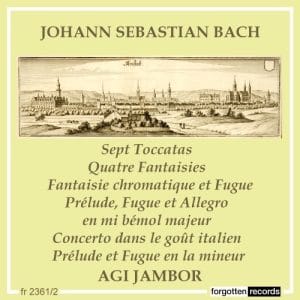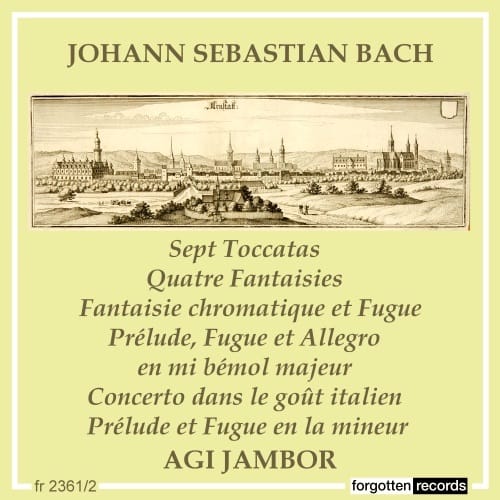
J.S. BACH: Toccatas & Fantasias – Agi Jambor, piano – Forgotten Records FR 2361/2 (complete contents listed below; 2 CDs = 67:04; 71:55) [www.forgottenrecords.com] *****:
Hungarian pianist Agi Jambor (1909-1997) led a remarkable life, of which her distinguished concert and pedagogical careers were only a part. Her personal credo: “I do not play for success; I play to bring life to the composer” persisted throughout a life defined by music and a sense of the best of Austro-Hungarian culture. The daughter of a pianist mother who embraced her Jewish, humanist tradition, Jambor became a musical child prodigy, and she would study with such prominent teachers as Edwin Fischer, Zoltán Kodály and Alfred Cortot. They would infuse her music-making with a particular sensibility, which in turn made her into one of the most distinct interpreters of Bach, Mozart and Chopin of her generation. Jambor was a favorite soloist for Willem Mengelberg, Bruno Walter, and Eugene Ormandy.
With the emergence of Nazism and systematic, racial oppression, Jambor and her husband, the scientist Imre Patai and their child, embarked on a fantastical, grotesque pilgrimage to escape liquidation, under the auspices of “forged papers that identified her as a prostitute and Patai as her pimp. Once, the Nazis mistook her pocket metronome for a bomb.” While husband Imre Patai created a twenty-six volume memoir recounting the final twelve years of his life – he died in 1949 – Jambor herself composed a powerful testament, Escaping Extermination, which chronicles her recollections of horrors but also serves as a means of survival and reconstruction of the Central European and Hungarian-Judaic values that Stefan Zweig had immortalized in his The World of Yesterday.
The power of memory and artistic vision preserves exactly those values the deniers and falsifiers of life seek to obliterate, the nobility and creative potential of the individual human soul. Thus, we may better appreciate the Bach recital Jambor set down for Capitol Records in 1956 – and here restored by Forgotten Records – in New York City, the center of what for Jambor became “the Promised Land.” Jambor assumed a professorship of classical piano at Bryn Mawr College, where she pioneered the field of ethnomusicology, insisting that a younger generation of musicians had to “live in the mu, recreate the music of non-Western peoples, even if they have no spoken words, no ideas to help them.” Ernst seems to have enjoyed greatly Bach’s playing, so it is likely that Bach himself performed his manualiter (i.e., pedal-free) toccatas for his employer. Literally “touch pieces” designed to display the virtues of both the instrumentalist and the keyboard itself, the toccatas meander through mercurial, capricious shifts of emotion and temperament, often provocative in their imitation of what Bach experienced when he beheld his admired contemporary Buxtehude at the organ. Of the set of six, BWV 910-916, only one, that in G Major, does not open with a prelude in the form of an improvisation, while they each evolve into an ornate, often three-voice fugue meant to dazzle the mind whose sensibilities find passion in the play of numbers, what Leonardo da Vinci called “the figuration of the invisible.”
Jambor opens with the 1714 Toccata in D Minor, BWV 913, setting the tone for her complete odyssey. Emphasizing tonal and textural clarity, she proceeds to tie the whimsical sections together, interrupted by a dreamy adagio. Periods of recitative and parlando segue into the fluidly adept fugue, which retains a dancing character. The Toccata in E Minor, BWV 914, with its darker contours, remained a staple piece for Clara Haskil and Robert Casadesus, and Jambor invests a refined but speedy grace to its figures. The G Major Toccata, BWV 916 opens with a bold Presto, a study in perpetual motor-power in scales and staccatos. Jambor imbues the Adagio with lyrical introspection. The syncopated Allegro (Fuga) has wit and rhythmic incisiveness. The joyful Toccata in D Major, BWV 912 at first resembles the organ Prelude in D, BWV 532, but soon embarking on a martial antiphon that becomes playfully complex. Jambor passes through its six sections with firm deliberation, savoring the passing dissonances in modulation that immediately disappear upon the entry of the Fugue, a happy gigue in spirit.
Jambor assembles three minor-key toccatas as a finale-triptych: G Minor, F# Minor, C Minor. The first, BWV 915, installs a seriously meditative aura, both lyrical and chromatic. At moments, the style of the piece resembles a brisk invention intended to instruct the clear narration of contrapuntal entries. As martial as the Fugue sounds, Jambor controls its percussive aspects, which thrust forward without clamor. The work concludes with an ornamental epilogue in which Jambor’s trill asserts itself elegantly. The expansive F# Minor, BWV 910 reveals its organ sources immediately, resounding with resonant bass tones. Those movements lacking any tempo indication receive a marcato, arioso, studied approach. Jambor’s capacity for maintaining structural continuity meets the test with fluent grace. Perhaps the most popular of the genre, the Toccata in C minor, BWV 911 enjoys an ornamental introduction, the ensuing Adagio suggestive of a sad plaint. Occasional recitatives interrupt the large yet singing attention to rhythmic inflection. Jambor then realizes an epic adagio prior to the work’s conclusion.
Bach favored the fantasia genre – of which he composed seventeen – a Renaissance-borne, rhetorical strategy that allowed him creative freedom and learned discipline, at once. His most potent contribution to the form, his Chromatic Fantasy and Fugue in D Minor, BWV 903, receives from Jambor a swiftly focused performance of the exordium’s 32nd notes, and often lavish in its sonority in the slower, meditative passages. As an example of the so-called “fantastic style,” the work illustrates much of Jambor’s searching, oracular temper, her application of keyboard colors to create a tapestry dramatic and fiercely propulsive. Her investment into Bach’s silences proves as pungent as her crystalline attacks and contrapuntal voicings.
Jambor includes two apocryphal compositions in the genre: the Fantasia in C Minor now attributed to Johann Gottlieb Goldberg, and the Fantasia in G Major, likely written by a Bach student. The former enjoys something of the stile antico, a galant and expressive, tenderly arioso, piece that delights in anaphora, poetic repetition of arpeggiated and rolled phrases. No less evident is the application of anabasis, an ascending phrase that gains emphasis as it proceeds. The latter piece proves the more chromatic, much in the spirit of the luxuries in Bach’s BWV 903, only quicker to enter the fugal procedure, and more repetitive without the rhetorical elegance of Bach’s narratio elements. Its high registration points to a work specifically conceived for the two-manual harpsichord that permits crossed hand technique in an arioso temper. Its final section, a bouncing, staccato fugue, manages some pungent energy, almost martial in the percussive ffs before its subdued coda.
We return to the Master for the Fantasia in A Minor BWV 922, a study in deliberately repeated phrases and rhetorical polyptoten, a form of incremental variation of a word to alter its inflection. A simple rhythmic gesture undergoes any number of tinys transformations to assume a grandeur (via Jambor) one would not have attributed to it, a lesson well learned by another German master, Beethoven. The most stentorian of the fantasy group in its impetuous triplets, Fantasia in C Minor, BWV 906, as given by Jambor seems to point immediately to a later admirer and imitator, Johannes Brahms of the G Minor Rhapsody, Op. 79/2. In its brevity, the drama of intricate repetitions, singing bass line, and subtle counterpoints deeply impresses our respect for Bach’s economy of means.
Jambor turns to the richly elaborate 1735 Prelude, Fugue and Allegro in E-flat Major, BWV 998, rich in arpeggios and passing ornaments. At moments harmonically audacious, the piece illustrates Jambor’s legato and homogeneity of tone. The ternary-form Fugue moves with clear precision, a sense of what Rachmaninoff termed “the point,” this being the exact duplication of the opening materials in the da capo. Jambor attaches to this polyphonic feast her rendition of the popular Italian Concerto in F Major, played at first in a moderately shaped and dance-like Allegro that does not try, a la Glenn Gould, to imitate harpsichord sonorities. The Andante from Jambor basks in a precious atmosphere of D minor, pealing an extended, flowing melody over an ostinato bass. The challenge of maintaining the concerto grosso opposition of tutti and concertino in the vigorous, joyful last movement finds an able executor in Jambor, who allows flights of fancy and intellect to inform her moto perpetuo.
At last, the 1709 Prelude and Fugue in A Minor, BWV 989, an ambitious setting of a theme and ten variations in the Italian manner, played with rhetorical emphases by Jambor, whose trills and turns appear in rare from. Each of the variants is bisected, repeated, but with subtle alterations from Jambor to keep us alert. The graduated dynamics that inform her runs and scalar episodes might have influenced Brahms his own transformations of the Handel theme for his own Op. 24. After the big fermata, Jambor drives the Fugue with a motor regularity that manages to accommodate her plastic colorations. When we consider that for fifteen years, Jamor career had suffered a forced medical hiatus, what we have here in these restored Capitol documents embodies a testament to human will and its powers of recovery, physical and spiritual.
—Gary Lemco
J.S. BACH: Toccatas & Fantasias
Toccata in D Minor, BWV 913;
Toccata in E Minor, BWV 914;
Toccata in G Major, BWV 916;
Toccata in D Major, BWV 912;
Toccata in G Minor, BWV 915;
Toccata in F# Minor, BWV 910;
Toccata in C Minor, BWV 911;
Fantasia in C Minor;
Fantasia in G Minor;
Fantasia in A Minor, BWV 922
Fantasia in C Minor, BWV 906;
Chromatic Fantasy and Fugue in D Minor, BWV 903;
Prelude, Fugue & Allegro, BWV 998;
“Italian” Concerto in F Major, BWV 971;
Prelude and Fugue in A Minor, BWV 989