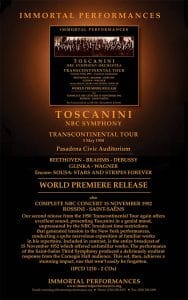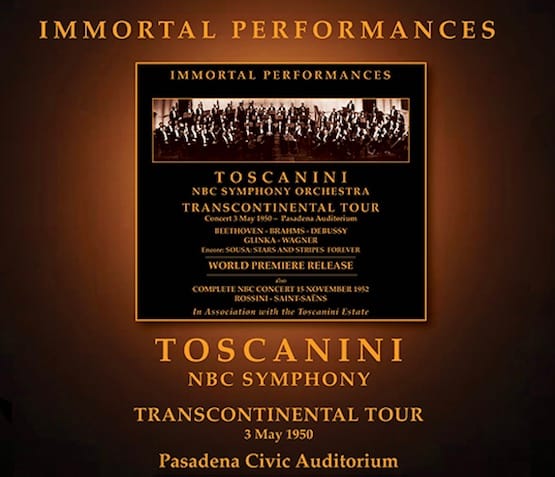
TOSCANINI NBC SYMPHONY 1950 TRANSCONTINENTAL TOUR = ROSSINI: La Cenerentola Overture; BEETHOVEN: Symphony No 3; SMETANA: The Moldau; WAGNER: Parsifal: Good Friday Spell; TCHAIKOVSKY: Romeo and Juliet Overture; MEYERBEER: North Star Overture– Immortal Performances IPCD 1208-2 (2 CDs = 72:16; 60:17) [www.immortalperformances.org] *****:
The passionate discipline characteristic of conductor Arturo Toscanini (1867-1957) finds excellent expression in this “World Premiere Release” from Immortal Performances, documenting the 5 May 1950 concert by the Maestro and the NBC Symphony Orchestra at the Pasadena, California Civic Auditorium. Even having programmed a generally populist range of compositions, at every measure the Maestro’s constant, shouted demands for subito, cantabile, and espressivo, in the midst of the composer’s arsenal of percussive effects from brass, tympani, and cymbals. Only the fact that Toscanini, despite his scrupulous exertions, felt the orchestra insufficiently prepared, removed the Meyerbeer rarity from his public performances, replacing it with Prokofiev’s Classical Symphony.
The concert opens with an astonishingly clear rendition of Rossini’s 1817 Overture to La Centerentola, a dynamic piece that forever justifies Rossini’s nickname as “Monsieur Crescendo.” The acoustical resonance of the Pasadena venue pales the many recordings that exist from Studio 8H in Radio City, New York – witness the sterling pizzicatos from the NBC strings – and we could wish the site had been available from the orchestra’s earliest days. Those generations raised on the Toscanini performance of the Beethoven Eroica Symphony know how the sense of inevitability permeates every bar, the ferocity of will that drives its opening Allegro con brio to a resolution of its many conflicting, polyphonic impulses and the overcoming of self-imposed limitations. The interior vibrancy of the inner string lines and brass interjections throb with an elastic energy we feel long overdue Toscanini’s musical genius. A much-warranted applause erupts from the audience.
The heart of the Symphony, its ternary second movement, Marcia funebre: Adagio assai, C minor, Beethoven’s farewell to an ill-conceived idealism, projects from the outset a grim, firm gravitas, both fraught with anguish yet subdued in economical, musical means. The dance-like episode curls into yet another martial explosion of emotion in G major whose cadences feel curtailed, suppressed, so that the funeral mood in all its contrapuntal glory may proceed. The remainder of the movement seems valedictory, accepting of the universality of tragedy, from which heroism may emerge.
Without delay, the swiftly moving impulses of the Scherzo: Allegro vivace: Trio scramble by on light feet immanence of transcendence. and then detonate into Beethoven’s idiosyncratic kernels of atomic energy. At the winds’ chromatic coda, yet another brief utterance of audience applause. Beethoven employs his patented, bare ground-bass rhythmic motive as the basis for the “Prometheus” theme and variations of his finale: Allegro molto: Poco andante: Presto: a fantasia-form that will employ two fugues in the course of its majestic, alternately militant and pastoral, evolution. Rarely have the NBC brass and battery enjoyed their punctuated utterances such full resonance of expression, and the resounding intensities simply cast the Pasadena audience into throes of exultation.
The familiar strains of Bedrich Smetana’s The Moldau ensue, a pastoral certainly, but rife with nationalistic pageantry and heroic ambitions. The NBC strings and brass once more invest a warm passion into the progress of the river and its scenic episodes, culminating with the confluence of its stately, native theme with the High Castle’s motif based on the invocations of the bard Lumir.
Toscanini proceeds to the 1879 orchestral episode from Act III of Wagner’s opera Parsifal, the Good Friday Music, arranged as an independent concert piece. The opening depicts the anointment of Parsifal, deemed King of the Holy Grail Knights. The ineffable beauty of Nature once more prevails in this music as it had in Smetana, as the brilliance of a meadow illuminates Kundy’s baptism and repentance. The vision of Gurnemanz prevails, that Good Friday waters Nature’s fields with the tears of penitents, and Heaven rejoices in the Savior’s redeeming sacrifice upon the cross. Toscanini creates an intimately transparent tapestry that utilizes the “Dresden Amen” adopted from the Saxon church and Mendelssohn, the whole a stunning invocation of the immanence of transcendence.
Toscanini concludes the formal concert with a performance of Tchaikovsky’s 1870 Overture-Fantasia Romeo and Juliet, a one movement, sonata-form, tone-poem that recounts the emotional vitality of Shakespeare’s play without any attempt at a chronological, scenic program. Toscanini’s evolution paces itself in broad strokes, relishing the chromatic elements, F# minor and E minor, that first set forth the narrative of the tragedy before the fateful B minor erupts in conflict. The famous love-theme in D-flat major emerges with tender restraint and luminous string tone, virtues of which the Maestro does not often receive proper credit. Does over four minutes of audience ovation count for something?
Immortal Performances provides a lavish, illustrated booklet, with informative program notes by Robert Matthew-Walker and producer Richard Caniell’s historical context for the Toscanini tour, making an attractive alternative to the competition by rival label Pristine Audio, for the presentation of Toscanini’s Pasadena concerts. Highly recommended.
—Gary Lemco
TOSCANINI NBC SYMPHONY 1950 TRANSCONTINENTAL TOUR
ROSSINI: La Cenerentola Overture;
BEETHOVEN: Symphony No 3 in E-flat Major, Op. 55 “Eroica”;
SMETANA: The Moldau;
WAGNER: Parsifal: Good Friday Spell;
TCHAIKOVSKY: Romeo and Juliet Overture;
MEYERBEER: North Star Overture – Dress Rehearsal (1951)