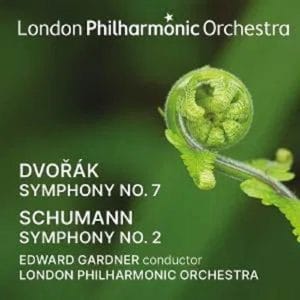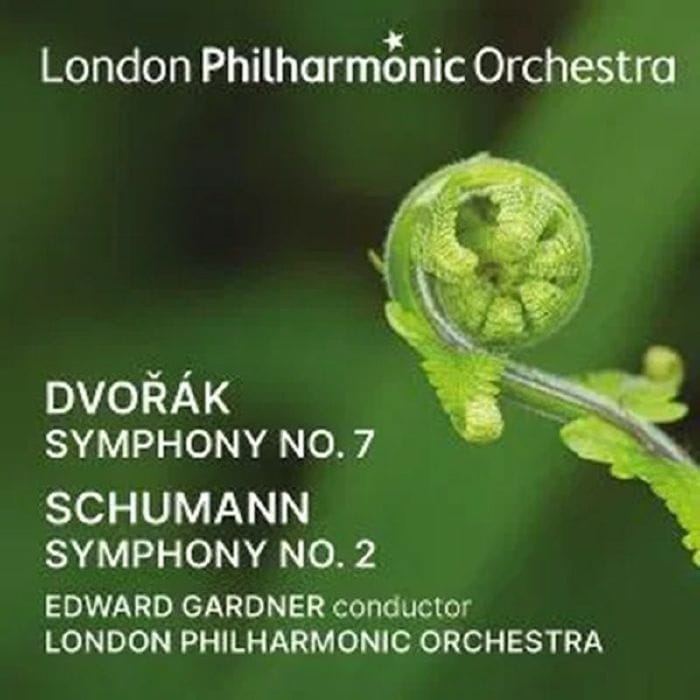
DVORAK: Symphony No. 7 in D Minor, Op. 70; SCHUMANN: Symphony No. 2 in C Major, Op. 61 – London Philharmonic Orchestra/ Edward Gardner – LPO – 0133 (72:36) (6/6/25) [Distr. by PIAS] ****:
Prior to having auditioned this LPO release, recorded 28 September 2022 (Dvorak) and 3 February 2024 (Schumann), I had no knowledge of the work of British conductor Edward Gardner (b. 1974), who has led the London Philharmonic since 2021. The 1885 Dvorak Seventh Symphony, coincidentally, owes its genealogy to a commission from the London Philharmonic Society. The resultant symphony offers a profound blend of darkly dramatic musical impulses, offset by inspired melodic periods, creating a symphonic structure emblematic of The Great German Tradition.
The first movement, Allegro maestoso, resonates with a dark motif that owes its sonata-form evolution to the model provided by Brahms in his own Third Symphony, equally ambiguous in its modal identity. The LPO strings and brass prove especially pungent in this performance, even the woodwinds provide some bucolic respite from the anxieties of the main theme. The plastic, seamless flow of materials proceeds at a driven pace reminiscent of what George Szell achieved in Cleveland in terms of orchestral discipline, along with a warmth of tone we associate with Vaclav Talich, Carlo Maria Giulini, and Wolfgang Sawallisch.
The F major Poco adagio opens in the manner of a summer’s wind serenade, but it, too, darkens in tone to reveal capacities for tragic, expressive lyricism. The transparency of sound Garnder gleans from his forces urges us to admire Dvorak’s mastery of symphonic content within the Classical structures advocated by his idol, Brahms. The execution of Dvorak’s open-work textures proves ravishing, especially poignant given the richness of his melodic tissue.
Always demonically exciting, Dvorak’s Scherzo third movement, a 6/4 Furiant rife in cross-rhythms of duple and triple meter, has Gardner’s holding back at first, until the essential pulsation accelerates of its own accord. The innate energies of Bohemian folk dances take possession and hurry us to the Trio in G major. Once more, the bucolic impulse virtually saturates the texture, bird calls and forest whispers in aggressive colloquy. Flute and French horn seem intent to lull us into pantheistic ecstasy, until the dark ferocity of the da capo thunders forth once more.
The last movement, Finale: Allegro, proffers a true culmination of orchestral effects, once more in this composer’s symphonic output having a theme of hymnal breadth and sensibility. Gardner slows down the secondary, cello and violin theme to a swaggering gait, only to unleash the songful momentum for immediate contrast. The fertile momentum – a la Brahms – proceeds in tussling, energized counterpoint, leading to the movement’s recapitulation. But there is nothing academic in Dvorak’s structural arsenal, and so we have a potent working out of Dvorak’s true masterpiece in his symphony oeuvre, brilliantly realized with the stamp of Gardner’s personality.
Gardner couples the Dvorak work with a true archetype of the Romantic symphony, Robert Schumann’s 1845 Symphony No. 2 in C Major, created in a time of Schumann’s 1844 personal crisis. Schumann himself confessed that mental instability had its effect in the obsessive repetitions in the thematic tissue of the first movement; and that, only at the last movement did he feel a sense of liberation. George Szell used to address this work as an extended march, while Dimitri Mitropoulos and interpretive acolyte Leonard Bernstein, allowed the music’s more lyrical impulses their rich expanse. The third movement, Adagio espressivo, particularly, in form and concentrated anguish, anticipates much in the Mahler sensibility.
Gardner captures the polyphonic, ceremonial atmosphere of the opening movement, Sostenuto assai – Allegro ma non troppo, a rather martial treatment of motives indebted both to Bach and Beethoven. The double-dotted rhythmic flow becomes layered by various instrumental voices, sometimes proceeding in competing, nervously scalar motives. A degree of repetition sets in sequentially, set in antiphonal choirs in shifting registers. As the intensity mounts, we hear a galloping sonority derived from Beethoven, whose song cycle, An die ferne Geliebte, Op. 98, Schumann will quote in movement four. Trumpets announce the solid peroration, a set of fanfares based on the original materials.
Schumann conforms to his idiosyncratic Scherzo format: a 2/4 hybrid rondo pattern utilizing two trio sections. The nervous flux of the music owes much of its intense fervor to diminished seventh chords. For my part, I find the realization of the first of the trios a mite glib, the tempo too fast to accommodate the harmonic subtleties. The second trio assumes a chorale mien, even employing the BACH motif that has inhabited many a formal, contrapuntal exercise. Some orchestral wizardry marks the coda, a tour de force for the LPO strings, brass, and tympani. The gorgeous C minor third movement features fine oboe, bassoon, and string playing, the melody stretched out in meditative periods. In achieving an emotional apotheosis, Schumann modulates to the major mode, which ironically feels even more tragic. Here, I must confess that Giuseppe Sinopoli had an especial sense of Romantic Agony for this movement; and, like Gardner, Bernstein, and Mitropoulos, luxuriating in the contrapuntal development.
The last movement, 4/4 Allegro molto vivace, displays great originality of form, given Schumann’s cyclical penchant for presenting prior materials. Opening with a robust fanfare, the music immediately plays games with the Adagio theme in inversion, moving to what appears a sudden halt. Then, a new theme arises via the solo oboe, rapt with optimistic, modal energy, ushering in more allusions to Beethoven. Schumann breaks off once more, invoking his slow movement in contrapuntal guise, while distant brass fanfares from the past suggest that a glorious revelation is at hand. Gardner conveys at once the sincere urgency and glamor of the last chords, and the audience, utterly silent until then, declares its own rapture.
—Gary Lemco