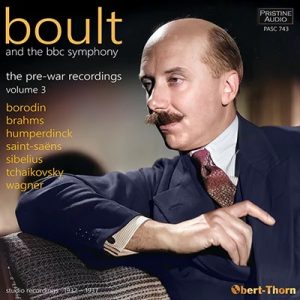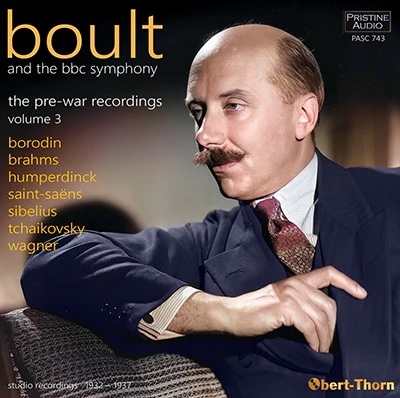
BOULT and the BBC Symphony: the Pre-War Recordings, Vol. 3 = Orchestral Works by WAGNER; HUMPERDINCK; BRAHMS; BORODIN; TCHAIKOVSKY; SAINT-SAENS; SIBELIUS (complete content listing below) – BBC Symphony Orchestra/ Sir Adrian Boult – Pristine Audio PASC 743 (2 CDs= 61:37; 63:08) [www.pristineclassical.com] *****:
Producer and Audio Restoration Engineer Mark Obert-Thorn here addresses the third in a series of four volumes from Pristine Audio devoted to the pre-War 78 shellacs by Sir Adrian Boult (1889-1993), including several recordings that have not had re-issue since their original appearance, 1932-1937. Among other effects, this set helps belie the notion of Boult as an “English music specialist,” granting him the catholicity of taste we associate with the other benefactor of the Fritz Steinbach influence, Arturo Toscanini.
The program first offers three staples of composer Richard Wagner: the Overture to Die Meistersinger von Nürnberg (1862-67) from the recording of 6 April 1933; the concert version of the Prelude to Act I of Tristan und Isolde from 25 July 1932; and the Good Friday Spell (1882) from Parsifal, recorded 6 April 1933. Given Wagner’s desire to prove his capacities at orchestral counterpoint, the Meistersinger Overture enjoys both muscular girth and textural transparency, the upper-voice singing line nobly taut. The pace, quick but unhurried, compares in lyric and dramatic power with the best of Wagner from Albert Coates. As Mark Obert-Thorn points out in his accompanying notes, Boult remained among a select group of conductors of the 78 era – including Karl Muck, Richard Strauss, and Otto Klemperer – to perform the Tristan Prelude using Wagner’s own concert ending. The erotic tension of the music unfolds briskly, lacking for this reviewer the immense virility that Knappertsbusch imparts, but nonetheless forcefully driven by the sense of fateful tragedy. A pungent sense of anticipation marks Boult’s rendering of The Good Friday Music from Parsifal, though Boult is careful to delineate the five-note phrases meticulously, blending the bucolic and spiritual aspects of Nature in a poised, glowingly rich texture.
The two excerpts from Humperdinck’s 1892 opera Hansel und Gretel (Overture, 25 July 1932; Dream Pantomime, 2 November 1934) represent Boult’s last thoughts about this music on disc. The Overture enjoys an aggressively sweeping approach, lithe and rhythmically flexible, with great handling of the subito shifts in dynamics the composer demands. True to context, the woodwind and harp playing of the BBC captures the spirit of unspoiled, childhood innocence in Humperdinck’s visionary score for the Dream Pantomime. The music rises to a chorale status, an apotheosis of unwavering faith in Divine protection.
A furious drive opens Boult’s version of the Brahms Tragic Overture in D minor (1880), wrought much in the Toscanini mold, as dictated by their mutual advisor Fritz Steinbach. Brahms himself seems to have imitated Beethoven – especially his C minor Coriolan Overture – as a structural model, although Brahms injects his own ideas about the inversion of sonata form. The three sections of the piece later evolve contemplatively and judiciously, with emphasis on transparent textural clarity. The last section, marked Tempo primo ma tranquillo, allows the BBC ensemble to sing a melancholy song that urges its way, somewhat stolidly, to a trumpet climax.
The selected Hungarian Dances: Nos 19-21, in B minor, and two in E minor (rec. 7 October 1932), enjoy the color touches from Bohemian master orchestrator Antonin Dvorak. Boult never addressed these on record again, and so we are left with rather unbuttoned readings, alert, whimsical, and dynamically deft, as required. The last proffers a csardas that takes the starch from your collar.
Disc 2 opens with music by Borodin, his Polovtsian March from Prince Igor (rec. 28 January 1937), moodily aggressive and colored by wind, brass, tambourine, and string sonorities instilled by the composer’s association with the Mighty Five. From the same recording session, we have the celebratory Polonaise from Act III from Tchaikovsky’s Eugene Onegin, whose gestures often border on the heroically aristocratic comfort of the landed class. Boult achieves the grand sonority I first heard when Stokowski performed this piece in concert.
The last of the Russian selections culminates with Tchaikovsky’s brilliant 1880 String Serenade in C, recorded 25 June 1937, which Obert-Thorn concedes pressured Boult into a rushed performance. We can, however, appreciate the fine discipline exhibited by the BBC strings, their refined delicacy of articulation and tonal precision. The second movement Valse: Moderato becomes, in the word of Obert-Thorn, the “casualty” of the 78 shellac medium that compels Boult to speed the tempo to accommodate the beginning of the succeeding Elégie. Unfortunately, Boult never approached this score in modern sound circumstances. Boult does manage a touching, dramatic pace to the scalar passages of the Elégie, luminously presenting its haunted power. The transparency of effect carries over to the Finale before the engaging, breathless, Russian dance explodes in two distinct impulses, eventually to be merged into the wizardry of the coda.
Obert-Thorn characterizes Boult’s singular confrontation with Saint-Saens’ Act III Bacchanale from his 1876 opera Samson et Dalila, with its ecstatic complement of winds, strings, and percussion as “bravura playing.” The exotic scalar patterns and their orgiastic implications resound with an energy we ordinarily attribute to Thomas Beecham and Hamilton Harty, which represents no mean acknowledgment.
The set concludes with two Sibelius tone poems which remain underplayed so far as their popularity is concerned: The Oceanides and Night Ride and Sunrise, both recorded 23 January1936 for the Sibelius Society Series. Boult would address this repertory once more, with exuberant fervor, for the Pye label in 1956. The 1914 Oceanides presents Sibelius’ rendering of “the nymphs of the waves,” the daughters of the mighty, river god Oceanus, in Greek mythology. The piece pulsates with feral energy throughout, having begun sostenuto assai, and cumulatively acquiring more and intensified coloration by way of a pair of harps, timpani, diviso strings, and sounding brass. Night Rise and Sunrise had a long etiology, having been first conceived in 1901, completed in 1908, and performed (by Siloti) in St. Petersburg in 1909 to a disappointing premiere. In two sections, the first an evocation of a lone traveler in the gloom of the forest, both compelled with and fearful of, Nature. His former anxieties – in an obsessive, trochaic rhythm – find glorious succor in the resultant daybreak, here embodied in Sibelius’ ardent coloration and melodic breadth that we likewise experience in the Fifth Symphony. Ever an able conductor of Sibelius’ oeuvre, the performances shine in clear, seamless restoration, an album to be treasured.
—Gary Lemco
BOULT and the BBC Symphony: the Pre-War Recordings, Vol. 3
WAGNER: Die Meistersinger – Overture; Tristan und Isolde – Prelude, Act I; Parsifal – Good Friday Spell;
HUMPERDINCK: Hansel und Gretel –Overture and Dream Pantomime;
BRAHMS: Tragic Overture, Op. 81; 3 Hungarian Dances (orch. Dvorak);
BORODIN: Prince Igor – Polovtsian March;
TCHAIKOVSKY: Eugene Onegin – Polonaise; Serenade in C Major for Strings, Op. 48;
SAINT-SAENS: Samson et Dalila – Bacchanale;
SIBELIUS: The Oceanides, Op. 73; Night Ride and Sunrise, Op. 55