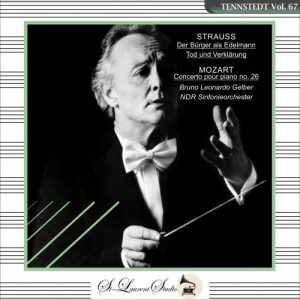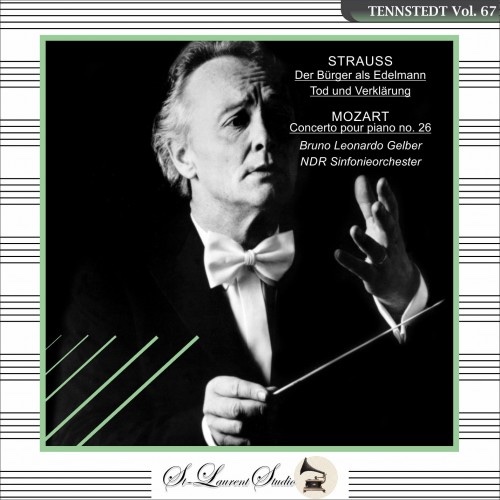
TENNSTEDT VOLUME 67 = R. STRAUSS: Der Bürger als Edelmann, Op. 60; Tod und Verklärung, Op. 24; MOZART: Piano Concerto No. 26 in D Major, K. 537 “Coronation” – Bruno Leonardo Gelber, piano/ Symphony Orchestra of the North German Radio/ Klaus Tennstedt – Yves St-Laurent YSL T-1464
(2 CDs = 65:45; 28:06) [78experience.com] *****:
Yves St-Laurent provides us the concert of 23 April 1976, featuring the renowned German conductor Klaus Tennstedt (1926-1998), who gleaned an impressive reputation in the interpretation of the Austro-German music tradition. Joining Tennstedt for Mozart’s 1788 Piano Concerto No. 26 is Argentine virtuoso Bruno Leonardo Gelber (b. 1941), who never fails to combine precision and grace in his often voluptuous renditions of the classics.
Tennstedt opens the concert with the Strauss 1917 arrangement of incidental music retrieved from his ambitious, though aborted, Stuttgart project of 1912 in collaboration with Hugo von Hofmannsthal to stage Molière‘s 1670 play Le bourgeois gentilhomme in tandem with the one-act opera Ariadne auf Naxos. Strauss assembled nine numbers as an orchestral suite in a distinctly Baroque style, of which two pieces overtly claim to be in the manner of Lully.
Tennsttedt applies the light hand to introduce the suite, the Overture’s tripping in sparkling textures that include a piano obbligato, until a fateful modal scale insinuates itself with the aid of the trumpet. The latter half suggestions the possibility of romance, A wistful flute intones the Minuet, followed by the pompous brass and percussive piano fanfare and glissando for the Fencing Master. The Entry and Dance of the Tailors proves immediately engaging, especially for its solo, concertante violin part, as accompanied by selected woodwinds and brass. The Lully Minuet moves in poised, intimate measures, rife with solo violin sentiment. The flighty Courante enjoys a serenade’s texture, gently polyphonic, before proffering a more passionate persona. The Entry of Cléonte asserts another allegiance to Lully, at times an extended string meditation, intimate and delicately nuanced. Woodwinds chirp the arrival, led by the flute. The stately mood returns, now more formally and dynamically processional. Another wistful moment, the galant-style Intermezzo (Vorspiel) arrives, allowing Strauss to indulge his violin solo with harp, string, and wind accompaniment. The music culminates in The Dinner, a parody piece of some length, peppered with Tennstedt’s swaggering, satiric references to the commedia dell’arte, the bleating sheep of Strauss’s own symphonic poem Don Quixote, some Rhine salmon to mock Wagner’s Das Rhinegold, and birds’ songs to allude to his own Der Rosenkavalier.
The Mozart concerto presents its own, idiomatic challenges, given that the opening, orchestral ritornello avoids harmonic modulations in favor of extended melodic fabric, a device that frees Gelber’s role as celebrant, ostensibly at the coronation of Emperor Leopold II at 1790 Frankfurt. Gelber’s tonal palette, as silken as it is sumptuously rounded and varied, delivers a performance of aristocratic luster, as Mozart well intended. The orchestra at times merely serves as a background scrim for Gelber’s inventive figurations that indulge his virtuosity for cosmetic effect. Mozart likely felt slighted at not having been invited to the regal festivities and decided to supply his own pageant. Gelber literally provides his own Mannheim rocket figures and any number of legato and staccato transitions that flow seamlessly into the next melodic group.
The solo piano introduces the affecting A major (Larghetto) movement, the tempo parenthetical due its presence by another’s hand, not Mozart’s. The same is true for the last movement in D major (Allegretto), 2/4. Another striking fact lies in the absence of any left-hand part for much of the first movement and the entirety of the second, given Mozart’s natural, improvisational musicianship. Often characterized as “brilliant and amiable,” the concerto enjoys a thoroughly engaged soloist and conductor, whose mutual affection for this brisk and innately dazzling composition suffuses every measure. Despite some missing bars at 3:40-3:44, the performance glides to a sonorously lavish conclusion, enthusiastically received.
The concert “concludes,” in a most literal sense, with the 1889 Richard Strauss tone-poem after Alexander Ritter, Death and Transfiguration, a sick, bedridden man’s psychical journey from past to the tormented present, as his body succumbs to his final illness. Upon his death, his liberated soul finds an illumination of his youthful ideals, which has remained elusive in life. The thematic, transformative elements of the various themes – in four distinct episodes – follows a pattern well instituted by Smetana and Liszt, while the harmonic evolution pays debts to Wagner.
Tennstedt gives the opening Largo a broad canvas, a beating heart in a fevered room, invaded by the two harps that invoke an inexorable fate. The first encounter with Death, a contorted struggle, Allegro molto agitato – terrifyingly realized by Tennstedt – dispels whatever youthful, idyllic visions had consoled him. The time of bitter-sweet recollection, Meno mosso, sets a panorama of past ambitions, passionate loves, and thwarted dreams. A trio of ascending, stepwise notes, immediately leaping by an octave, define the progress of the Moderato last section, which gradually rises to its apotheosis in C major, the two NDR brass, string and timpani have been consistently complicit in this towering, urgent expression of one’s last moments, a musical eschatology of resonant power, whose slow evolution warrants comparison to the Romanian Sergiu Celibidache for elongated intensity. Almost two full minutes of unabashed audience delirium follows, a rousing tribute to a remarkable performance.
—Gary Lemco