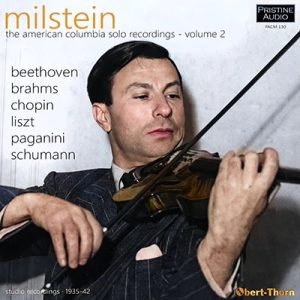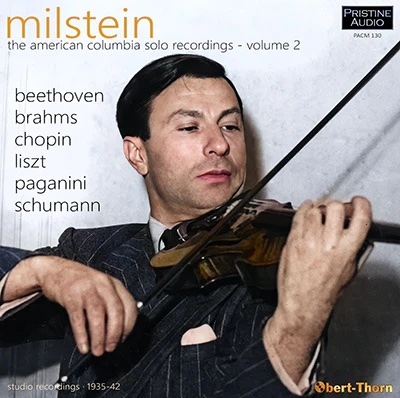
NATHAN MILSTEIN: The American Columbia Solo Recordings, Vol. 2 = Works by Gluck, Stamitz, Mozart, Beethoven, Paganini, Schumann, Chopin, Smetana, Liszt, Brahms – Pristine Audio PACM 130 (62:04, complete content and credits listed below) [www.pristineclassical.com] ****:
Producer and Audio Restoration Engineer Mark Obert-Thorn provides the second installment of his 3-CD project to reissue all of the American Columbia label, solo 78 rpm recordings by Odessa-born, violin master Nathan Milstein (1904-1992), 1935-1942. The combination of tonal elegance and intensity of expression marked the Milstein sound for the gamut of his illustrious career, which came to its formal end in 1986 Stockholm. This reviewer had the distinct good fortune to hear and to meet Milstein in , Atlanta, after a performance of the Beethoven Violin Concerto and one encore, the E Major Prelude from Bach’s Third Partita. Obert-Thorn includes a compendium of classical and romantic pieces, several in arrangements from Milstein himself.
This recital opens with a transcription of Gluck’s Orfeo’s Lament (21 May 1942), an intimately vivid, pathos-laden account that has us recall the significance this piece added to William Styron’s tragic tale, Sophie’s Choice. From 14 October 1940 we have a rarity in the Milstein discography, the two latter movements of the Violin Concerto in B-flat Major of Johann Stamitz (1717-1757), whose school of composition influenced Mozart. In galant gestures, the piece, especially the Rondo, demonstrates the level of virtuosity in quick shifts in registration that help define the composer’s Mannheim style.
The Mozart 1781 Sonata No. 17 in C Major, K. 296 (rec 3 May 1939) effects a lovely balance between violin and piano, especially apparent in the serene melody of the Andante sostenuto movement. When Milstein applies more bow pressure or double-stops, the immediate voluptuousness of his tone approaches something “symphonic.” The coda, too, assumes an emotive force that, in retrospect, anticipates Beethoven. The last movement, Allegro, remains a busy affair, both nimbly dainty and playfully whimsical, at once.
Ironically, for this reviewer, it was the same Milstein/Balsam duo on Capitol Records who introduced him to the sunny graciousness of Beethoven’s 1802 Sonata in G Major, Op. 30, No. 3. Their performance here, 4 May 1939, opens with a frisky, impulsive statement of the Allegro assai, urged in scalar and buzzing steps that evoke lyricism and alert charm. Balsam provides a consistent, nervous tension to Milstein’s flights of accented fancy. The second movement, Tempo di minuetto, proves more of an operatic aria than a courtly dance, in which the recurrent, main theme undergoes slight (martial) variation as it assumes something of a loose rondo form. Reminiscences of Haydn infiltrate the last movement rondo, marked Allegro vivace, whose bristling, swirling figures earned the work the sobriquet “Champagne Sonata.” Milstein and Balsam pour a concoction of dazzling colors, focused in sterling tones on a preconceived, resolute, grand finale.
From 4 January 1936 come two of the six “encore” selections Obert-Thorn reinstates into the Milstein active discography. Paganini’s “La Campanella” remains unique in its one appearance, showing off the Milstein bravura in an easy series of brilliant flourishes that alternately dazzle and purr in a manner to challenge the best of Ruggiero Ricci. Smetana’s Andantino “From my Homeland” projects a high-strung sentiment rife with poetic nostalgia. Pianist Leopold Mittmann (1904-1976) accompanies Milstein in its sudden, flaming mood swings, from ardent recollections to unbridled, gypsy flair.
Milstein the arranger-violin transcriber appears in two brief works: from 31 December 1935, he intones Chopin’s posthumous Nocturne in C# Minor, whose upper line conveys the tesknota, or pained nostalgia that soon passionately embraces figures from the F Minor Piano Concerto. Liszt’s poignant Consolation No. 3 in E Major (20 February 1936) unfolds as written, Lento, quasi recitativo, as an intimate song that offers emotional, if not religious, succor from worldly ills.
Finally, from late April 1942 comes two familiar salon staples: Schumann’s “Träumerei” (April 27) from Kinderszenen served as the eternal encore for Milstein’s former colleague, Vladimir Horowitz. The dreams Milstein invokes seem to come true, given the ardent, etched phrasing he applies to its meditative strains. The D Minor Hungarian Dance No. 2 by Brahms (April 30), a Milstein perennial encore, always catapults forward, Allegro non assai, moody and fiery, a syncopated cherry bomb. The central part must refer to the composer’s days as accompanist to violinist Ede Reményi, who introduced young Brahms to Hungarian gypsy music.
–Gary Lemco
NATHAN MILSTEIN: The American Columbia Solo Recordings, Vol. 2 =
GLUCK (arr. Kreisler): 1Melodie from Orfeo e Euridice;
2STAMITZ: Violin Concerto in B-flat Major: Andante and Rondo;
1MOZART: Violin Sonata in C Major, K. 296;
1BEETHOVEN: Violin Sonata No. 8 in G Major, Op. 30/3;
2PAGANINI (arr. Kreisler): La Campanella from Violin Concerto No. 2 in B Minor, Op. 7;
1SCHUMANN (arr. Huellweck): Traumerei;
2CHOPIN (arr. Milstein): Nocturne N0. 20 in C# Minor;
2LISZT (arr. Milstein): Consolation No. 3;
2SMETANA: Aus der Heimat: No. 2 Andantino;
1BRAHMS: Hungarian Dance No. 2 in D Minor –
Nathan Milstein, violin/
1Artur Balsam, piano/
2Leopold Mittmann, piano