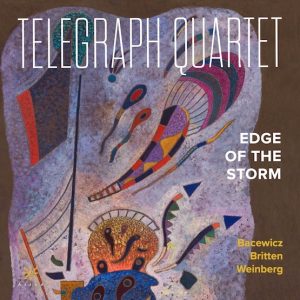
EDGE of the STORM = BACEWICZ: String Quartet No. 4 (1951); BRITTEN: String Quartet No. 1 in D Major, Op. 25 (1941); WEINBERG: String Quartet No. 6 in E Minor, Op. 35 (1946) – Telegraph String Quartet – Azica ACD-71381 (8/25/25) (76:43) [www.azica.com] *****:
The Telegraph Quartet (estab. 2013) – Erin Chin and Joseph Malle, violins; Pei-Ling Lin, viola; Jeremiah Shaw, cello – explores the period 1941-1951, a turbulent decade in which the three composers featured in this album faced the challenges, respectively, of political exile, mass genocide, and post-war rehabilitation. In the words of annotator Kai Christiansen, “Each composer featured on the album lived a unique wartime life that unmistakably influenced their equally unique mastererworks of the period.”
The String Quartet No. 4 of Grazyna Baceicz (1909-1969) celebrates the career and personality of Poland’s pre-eminent female composer of the 20th Century. Bacewicz and her family survived the Nazi occupation of her country, fleeing the Warsaw uprising and joining the Underground Union of Musicians. This music projects a feeling of having risen from the ashes and seeking cause for hope. From a dark, lugubrious opening figure the Andante quickly gathers significant energy, Allegro moderato, only to return to its somber musings. The harmonies become shrill and aggressive, even vibrant with hopeful militance. The viola part becomes expressive but cedes its optimism to a haunted figure played over pizzicato strings. The second theme, lyrical, is marked “sweet” and “melancholy.” The colloquy once more assumes a feverish intensity, underscored by passing dissonances and active counterpoint. Another extended moment of haunted lyricism emerges, just prior to a mad rush of a coda.
The second movement, Andante, also opens with unearthly harmonies in a syntax close to that of Bartok. The weaving, chromatic harmonies often coalesce into melodic fragments that take on effects from the cello the viola, including brief bits of polyphony. The music remains a kind of phantasma, dreamy but disturbed, ending quietly. The last movement, Allegro giocoso, posits a rondo, a Polish oberek in neo-classical form, similar to a work by Haydn, except touched by modern irony. A touch of humor occurs when the plays intone a rural hornpipe figure. Hints of former oppression notwithstanding, the music cavorts and sails with a renewed sense of spiritual direction, the coda “symphonic” in scope.
Benjamin Britten (1913-1976) composed his String Quartet No. 1 in D Major in 1941, for a commission from Elizabeth Sprague Coolidge. Britten was living in exile in America, having left England just prior to the outbreak of WW II, since he and tenor Peter Pears had declared themselves pacifists. Though intended for the British ensemble Griller Quartet, the premiere of Quartet No. 1 was given by the Collidge Quartet 21 September 1941 at Occidental College. The work has a curious structure, with the first and third movements brief, and the second and fourth movements more than twice their length.
Movement one begins, Tempo primo, Andante sostenuto, with a sound almost outside human experience, the upper string in vibration while the cello comments down below with pizzicato and arpeggios. The Tempo secondo, Allegro vivo, suddenly propels us forward, the first violin almost dizzy with bristling, syncopated accents. The two impulses alternate and trade fragments, reaching for a heaving synthesis dominated by the cello’s somber plaints. The tessitura extends into the high, virtually cosmic registers, lingering above the cello pizzicatos, until the aether evaporates the entire complex. The compressed second movement, Allegro con slancio, thrusts us into a scherzo-march interrupted by disturbing triplet figures, music of acerbic wit and irony, which has much in common with such episodes in Beethoven and Shostakovich.
The third movement, Andante calmo, conceived in 5/4, has been characterized as “a requiem for a lost world.” Stratospheric violins compete with the lower range of the viola and cello, the music predictive of the darkly meditative sonorities in Britten’s contemporaneous opera Peter Grimes, based on the poem by George Crabbe. At moments, the sonority of the quartet becomes organ-like, with anguished cries from individual instruments. The music, when it slows down, seems to stagger in a delirium, groping for harmonic, upwardly-directed, resting places. The organ texture returns, casting the cello into its pizzicato motion while the upper strings sing the coda to an extended lament.
The last movement displays Britten’s mastery of intricate and robust counterpoint, Molto vivace, the cello’s taking a solo position against his fellow strings. The pesante tune will return two octaves above its original position, the entire tissue having become symphonic and sonically daring as it sails into a final cadence.
The tumultuous life of Polish-born Mieczyslaw Weinberg (1919-1996) finds ample documentation in his music, a potent opera of diverse works conceived by “a powerful spirit enclosed in a frail body,” as one admirer described Weinberg. Having fled Poland to the Soviet Union, Weinberg found few consolations after 1948, when Soviet propaganda and biased antisemitism reigned as official, cultural policies. Despite consistent support from Dmitri Shostakovich, Weinberg was arrested and remained a prisoner until Stalin’s death in 1953. The 1946 Quartet No. 6 had been proscribed by Soviet authorities and would not receive publication until 2006, the premiere given by Quatour Danel, whose second violinist, Gilles Millet, coached the Telegraph Quartet on tis work in 2019.
Quartet No. 6 in E Minor unabashedly refers to the trauma of war, its first movement, Allegro semplice, deliberately set in the unusual Locrian mode, which flattens degrees of the scale, involving diminished fifths and minor seconds to establish an unsettling, anxious mood. The agitated, melancholy theme opening the first movement evolves in sonata form, often interrupted by sobbing or wistful gestures – especially from the viola – soon developed more aggressively. In the manner of Weinberg’s idols, Shostakovich and Miaskovsky. Both viola and first violin engage in mournful dialogue with the cello. A four-note motto or “fate” that arose earlier concludes the movement.
The second movement, Presto agitato – attacca, explodes into violent martial figures, almost vicious in its dire defiance, rife with glissandos and swift, jabbing, relentless attacks. The music suddenly breaks off, Allegro con fuoco, in the manner of a tuning for a feral square-dance, a Klezmer, solo-violin invocation to lamentation. The fourth movement, Adagio takes its cue from J.S. Bach and Shostakovich, a sad fugue made up of individual voices who will fade away, much as the ghosts of Holocaust victims.aa The morbid atmosphere intensifies at movement five, Moderato commodo, an eerie totentanz in the form of a theme and variations. With an occasional nod at gallows-humor via muted instruments, the music might invoke an agonized, cello-driven homage to a common musical idol for Weinberg and Shostakovich, Gustav Mahler. The final movement, Andante maestoso, marks a culmination of sorts, embracing both majesty and tragedy. Again, the flattened modality of this music adds a peculiar, ethnic fever to the gestures, marked by violent pizzicatos and melodic tissue harmonized in thirds. A whirling violin dance, interrupted by dark cello exhortations, moves to the viola’s lament, easily reminiscent of a Shostakovich symphony’s farewell vista. Emotionally taut and expressive in extremis, the music becomes a fanfare for cosmic weltschmerz.
An impressive series of performances, these, and not for the faint-of-heart.
—Gary Lemco (this review dedicated to the political writings of Professor Judith Lichtenberg)