Covering all the bases- The Complete Pharoah Sanders Theresa Recordings..
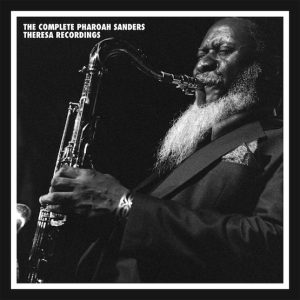
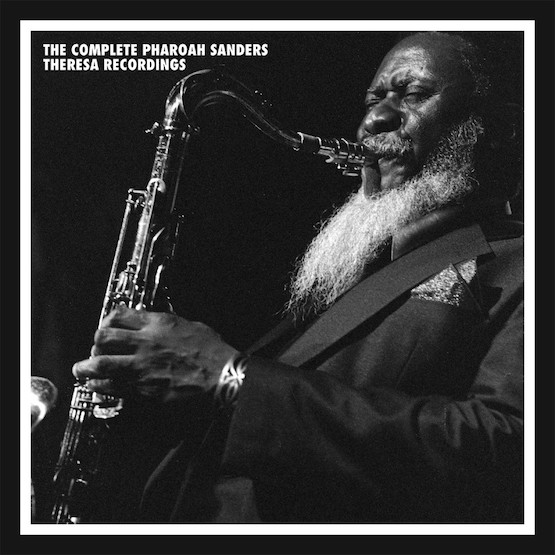
Pharoah Sanders – The Complete Pharoah Sanders Theresa Recordings – Mosaic Records #MD7-282 – 7 CDS – 1978-1987 – ****1/2
(Pharoah Sanders – tenor sax, soprano sax, tambura, vocals ; John Hicks, Joe Bonner, Ed Kelly – piano; William Henderson – piano, Kurzweil synthesizer; Ray Drummond, Joy Julks, Jorge Pomar, Art Davis, Walter Booker, John Heard, Peter Barshay – bass; Idris Muhammad, Randy Merritt, Billy Higgins, Elvin Jones, Alvin Queen, Eddie Marshall – drums; Leon Thomas – lead vocal
The iconic jazz tenor saxophonist, Pharoah Sanders, (1940- 2022), (born Ferrel Lee Sanders, but inspired by Sun Ra to be referred as “Pharoah”), covered a lot of ground throughout his lengthy career. He recorded more than 30 albums as a leader, and came up strongly influenced by John Coltrane, with whom he recorded in the mid-60s. Noted for his altissimo high register tone, with use of overtones and multiphonics, his playing covered a wide range of musical styles from the avant garde with squeals, honks, and screams, to the most moving ballads. The constant throughout was a devotion to spiritual, passionate themes.
On the marvelous new Mosaic Records box set, The Complete Pharoah Sanders Theresa Recordings, we find Sanders (from 1978-1987) transitioning from the avant garde to a period of re-exploring standards (and especially ballads) without turning his back on free expression. Recording for the small Bay Area based, Theresa Records, Pharoah’s six LPs (and two as co-leaders) gave him the opportunity to honor the past, but always with an eye towards future endeavors, leading to a period of mentorship and inspiration for young musicians. Present day young lion saxophonists like Kamasi Washington and Isaiah Collier, have been influenced by Sanders as they have worked to widen traditional jazz idioms by including poetry and electronics in their music.
Along with Yusef Lateef, Pharoah brought Middle and Far Eastern influences into his compositions with Japanese and Indian instruments, using chants, as well as vocalizations thru his horn. His breath control, tonguing, and reed pressure contributed to his ability to reach levels that few could match.
During the period that Sanders recorded for Theresa Records, his LPs showed a mature, reflective side, as to the more cutting edge playing found on his prior Impulse! catalog. Still heavily inspired by Coltrane, he retained his “sheets of sound” blowing for his new label, retaining his passion, but allowing more approachable compositions to emerge. His spiritual side remained, but a choice of standards and ballads helped balance his repertoire.
Pianists, John Hicks and William Henderson, as well as drummer, Idris Muhammad, are featured through a majority of the seven CDs. Bass stalwarts, Ray Drummond, and Walter Booker are also prominent. In addition, there are special appearances from future super stars like Bobby Hutcherson, Steve Turre, and Eddie Henderson, and a one-off with George Coleman. We hear Sanders, both off in the stratosphere, and on gorgeous warm ballads. As the set progresses the labels owners, Allen Pittman and Kazuko Ishida, encouraged Pharoah to emphasize his ballad prowess, and the result is so pleasing, as there is something for everyone here. All the bases are covered.
Each CD covers a specific LP, with the final seventh CD, featuring both Sanders as a session as co-leader with Bay Area pianist, Ed Kelly, and finally, as a partner for Idris Muhammad, on his Theresa issue, Kabsha.
This set opens with Journey to the One, from December, 1979.” Greetings to Idris” is inviting, building in intensity as the melody is repeated several times. Sanders goes on a tear with high register “screams,” while John Hicks provides a sparkling solo. “Doctor Pitt” brings in guest, Eddie Henderson, on flugelhorn, and the choruses swing. Bringing in international influences, there is “Kazuko, (Peace Child).” Gears are switched here with koto, harmonium, and wind chimes having a calm and serene mood set. “After the Rain,” with Joe Bonner on piano, written by John Coltrane, is a blues of such sweet tenderness. “Soledad,” has sitar and tambura swirls, with Indian vibes, wrapping you like a warm blanket. We also have the first version of “You’ve Got to Have Freedom,” and Eddie Henderson is back, as well as vocalists, including an early Bobby McFerrin, who repeat the incantation of the song title throughout. The sublime remastered acoustics from the original masters by Andreas Meyer and Shane Carroll at Swan Studios, is well represented on the standard, “It’s Easy to Remember,” as Pharoah wrings the emotion from this chestnut, while Ray Drummond’s bass pulses, and Idris’ drums pop.
Disc 2 is the two LP set, Rejoice. Recorded in New York City and San Francisco, it has special guests (with limited involvement), Bobby Hutcherson, Elvin Jones, and Billy Higgins. It’s a mixture of spiritual themes, African beats, and standards, made well known by John Coltrane. The title track is an offering to God (A Tribute to Peace and Beauty), with Elvin Jones’ polyrhythms standing out. “High Life-African Dance Party” with Big Black on congas, and lots of background vocals, has Sanders “singing” thru his horn, while edging into total abandon. There is a visit to Calypso on “Nigerian Juju High Life,” and some straight ahead, largely ballad magic, on Benny Carter’s “When Lights are Low,” and Coltrane’s “Central Park West.”
Disc 3 is the Live album from 1981 recordings on a West Coast tour with John Hicks, Walter Booker, and Idris Muhammad. “You’ve Got to Have Freedom” is revisited with a very wild ride, as John Hicks’ piano keeps the group from going off the rails. “Pharoma,” and “Blues to Santa Cruz” bring down the temperature. The latter has Walter Booker with a “greasy” bass solo, that would have been right at home with his former employer, Cannonball Adderley. “Doctor Pitt,” at 21 minutes, with more multiphonic wildness from Pharoah, is like a pressure cooker ready to pop its cork.
Heart is a Melody LP is Disc 4, recorded at The Keystone Korner in San Francisco in January, 1982. William Henderson is the new pianist aboard, and John Heard is the bassist. “Ole” is a 22-minute ride to the stratosphere. “Heart is a Melody of Time,” has an overdubbed choir. With a feel similar to Sanders’ opus, “The Creator Has a Master Plan,” the repetitive melody will elicit some serious head nodding to its groove. One of the extra CD tracks is Coltrane’s “Naima.” It’s lovely and warm, and William Henderson’s piano solo is special.
The next two CDs, Shukuru, and A Prayer Before Dawn are quite mellow, and likely both suggested and approved by the label owners in order to elicit more commercial appeal to draw in a wider audience. They both use the Kurzweil synthesizer which has the ability to add both “strings” and “vocals/choir effects” to greatly expand the soundscape. The unique vocalist, Leon Thomas, is added for his rich baritone vocals and inimitable yodeling (which can be an acquired taste). “Sun Song” features his talents. “Body and Soul” is given a languid reading, while the sheer beauty of “Shukuru” would be great for a movie soundtrack. The romantic “Too Young to Go Steady” is an interesting addition. It has a high register Sanders’ solo, while the choir effects can be a bit saccharine. “For Big George” closes Disc 5, with a version of an African American slave spiritual, with the refrain of “I’m Goin’ Home” sung by Leon Thomas that is deeply moving.
Disc 6 is the last Sanders led release, titled A Prayer Before Dawn. It’s a mostly duo album with Henderson’s piano and synthesizer. Recorded in 1986 (Theresa Records folded in 1990), its ballads are beyond beautiful. “The Light at the End of the World” adds orchestral choruses from the synthesizer, and Pharoah’s tenor drips with emotion. Henderson’s solo, “Softly for Shyla” has classical piano lines, while “The Greatest Love of All” fits into the “Easy Listening” category, but of course, Sanders gives it a full soulful treatment.
Bonus tracks include Dave Brubeck’s “In Your Own Sweet Way,” and Mel Torme’s “Christmas Song,” which likely received some holiday air play.
The final CD in this set is made up of two sessions that were “led” by other musicians, but featured Pharoah as un-official partner, probably for contractual reasons, since Sanders was involved with Arista Records at the time. Ed Kelly and Friend was led by Bay Area pianist, Ed Kelly, a close friend of Sanders. The sidemen were local, and included Eddie Marshall on drums, who was first call in the area for traveling jazz stars. There is a fair amount of electric bass (Peter Barshay), and electric piano, in vogue at the time (1978).
“Pippin” has the welcome addition of a full front line horn section, the only instance on this entire set. “You’ve Got to Have Freedom” from Sanders is given its first run here, well before Pharoah recorded it as leader for Theresa.
The real standout track on this session is Sam Cooke’s classic, “You Send Me.” It’s a dynamic version with Sanders digging in with urgency, and Ed Kelly having a long bluesy piano solo.
The other half of the final CD is Pharoah playing on Idris Muhammad’s release, Kabsha. On five tracks, it boasts of a meeting with tenor saxist, George Coleman on “GCCG Blues,” where the two heavyweights blow be-bop, blues, and Coleman attempts to match Pharoah on upper register altissimo. “Soulful Drums” is largely Idris, and Idris and Pharoah go to battle on “St. M.”
I would be remiss if I did not mention, again, the superb acoustics on the entire set, as well as honoring the erudite liner notes by Detroit based jazz writer, Mark Stryker. As always, Mosaic has archival photos from the sessions from San Francisco photographer, Tom Copi.
This is a set to treasure, both for fans of Mr. Sanders, as well as those who have categorized him based on his early discography, neglecting his ability to go in so many directions in his career. The one constant is his ability of being fully “open” to bare his soul with so much emotion.
—Jeff Krow
The Complete Pharoah Sanders Theresa Recordings
Discography:
CD 1: Journey to the One- 1979 72:51
CD 2: Rejoice- 1981 63:34
CD 3: Live – 1981 64:37
CD 4: Heart is a Melody – 1982 63:14
CD 5: Shukuru – 1984/1985 – 42:22
CD 6: A Prayer Before Dawn – 1986/1987 56:12
CD 7: Ed Kelly and Friend/ Idris Muhammad: Kabsha – 1978/ 1980 -62:34
Special Guest Artists
Yoko Ito Gates – koto; Chris Hayes – guitar; Paul Arslanian – harmonium, wind chimes; Bedria Sanders – harmonium; Carl Lockett – guitar; Babatunde – congas, agogo bells, shekere; James Pomerantz – sitar; Phil Ford – tablas; Peter Fujii – guitar; Big Black – congas; Danny Moore – trumpet; Steve Turre – trombone; Bobby Hutcherson – vibes; Lois Colon – harp; Lynn Taussig – sarod, chandrasarang; Brian McLaughlin – tabla; Junius Simmons – guitar; Larry Blackshere – vibes; Larry Jones, Anthony Sidney, Don Ramsey, Harley White – horns; Eddie Henderson – flugelhorn; George Coleman – tenor sax; Mark Isham – synthesizer; Joanne Nichol, Cecile Twain, Marsha Gonick, Joseph Herbert – strings; Vicki Randle, Claudette Allen, Ngoh Spencer, Donna Dickerson, Bobby McFerrin, Andy Bey, B. Kazuko Ishida, George V. Johnson, Jr., Flame Braithwaite, Sakinah Muhammad, Bobby London, Caroll Wilson Scott, Janie Cook, Debra McGriffe, Cort Cheek, Kris Wyn, Jes Muir, Mira Hadar, Faye, Kerillynn and Terrance Kelly – background vocals)