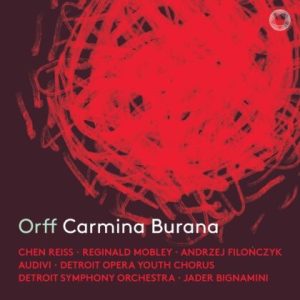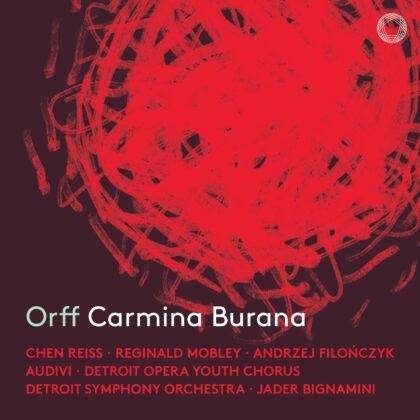
ORFF: Carmina Burana (Scenic Cantata) – Chen Reiss, soprano/ Reginald Mobley, countertenor/ Andrzej Filonczyk, baritone/ Audivi, chorus/ Detroit Opera Youth Chorus/ Detroit Symphony Orchestra/ Jader Bignamini – Pentatone PTC 5187 519 (6/26/26) (61:06) [distributed by the San Francisco Conservatory of Music] ****:
Some years ago, I aired (on “The Music Treasury”) the 1956 recording of Carl Orff’s scenic cantata Carmina Burana with Wolfgang Sawallisch leading the Cologne Raio-Symphony Orchestra, soloists and chorus, the whole enterprise supervised by the composer, who made a laudatory, short speech at the end of the Angel LP. Although a later (1960) performance on CBS with Eugene Ormandy appeared, it did not supplant the effect of the Sawallisch version. The work, especially through its rhythmic vitality and the lusty nature of its texts, continues to compel attention, exploring the mercurial nature of fate, love, and worldly gratifications. Orff selected 24 poems from a collection of secular, Eleventh and Twelfth Century songs found in a Bavarian monastery, the products of Goliards and disillusioned clerics and ecclesiastics. The large orchestral ensemble and the diversity of choral elements assure a feast of color and often provocative perspectives on the human condition. Within the diversity of texts lies a degree of satire and pensive reflection on social convention and hypocrisy, realized in acerbic musical accents and witty orchestral textures, eschewing contemporary, chromatic harmony for a chaste simplicity in diatonic harmony and adjacent triads.
The present performance, recorded 7-9 November 2025, captured by Pentatone producer Blanton Alspaugh and mastering engineer Mark Donahue projects the exuberance and lusty frictions of the score, the famed “O Fortuna” that frames entire concept and the individual, dramatic and lyrical declarations of pleasure and pain, amorous meditations and drinking songs. In three major sections: Springtime, In the Tavern, and the Court of Love, the “Fortune” motif provides a ritornello saturating the procession, while the immense orchestral hues owe debts to Igor Stravinsky’s Les noces. The bright panorama given us in the last of the Spring sequences, “Ecca gratum,” for instance, revels the diction of the chorus and the blazing battery of the DSO. The Bavarian dance that follows has seductive, rustic energies to initiate the “On the Green/In the Meadow” phase of the cycle, whose last two episodes, “Reie, Swaz hie gat umbe. . .” and “Were diu werlt alle min” enjoy a ravishing peroration.
For many auditors, after the opening energy of “O Fortuna,” the real excitement enters with the “In Taberna” quartet of pieces, wherein intoxication has induced a new layer of cruel truth. Baritone Andrzej Filonczyk invites us to the mixture of pleasure and mortality with a weird tango filtered by the Dies Irae. Countertenor Mobley renders the anguish of a roasting swan on a spit, the melody line divided between whole and half steps. The chorus of drunken revelers sardonically toast the Pope and the King, all the while imputing sheer hedonism to their motives. The abbot of Cockaigne literally flails humanity in the combustible mix of DCO percussion. Orff indicates the musical dynamic as scastenato, unfettered, listing every possible human condition as being susceptible to the power of drink.
A children’s chorus initiates “Th Court of Love,” no less a world of anguished contradictions. Soprano Reiss has oboe and flute to accompany her lyric response to the call of Amor. The baritone laments his uncertain, erotic fate, outlining the “O Fortuna” motif. A woman in red, sighing in a tango rhythm, muses on her own possibility for bliss. A baritone solo rife with flustered ambition and misery, sings a direct quotation from Stravinsky once more, his Symphony of Psalms, leading to the a cappella annunciation of scatological amorousness: “Veni, Veni, veritas” rings with erotic clamor, piano and percussion. The soprano invests a note of spiritual calm, “In trutina,” a moment of indecision between chastity and experience.
The near-full complement of singers thus conspire in the momentous “Tempus est iocundum” to culminate the occasion, citing “totus floreo” as more than enough justification for carnal union. With “Dulcissime,” the soprano cedes her body to the call of Amor, culminating with a high D. In “Blanziflor et Helena” the eternal consummation of the sexes has been certified by Venus and the Virgin Mary, at once. If Love does present an eternal paradox, the fact finds immanence in “O Fortuna,” the ouroboros, the full, mysterious, ostinato-laden circle that circumscribes our lives.
—Gary Lemco