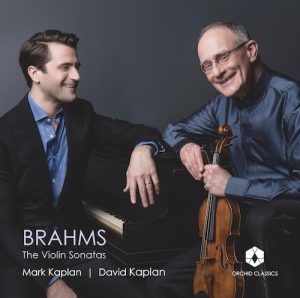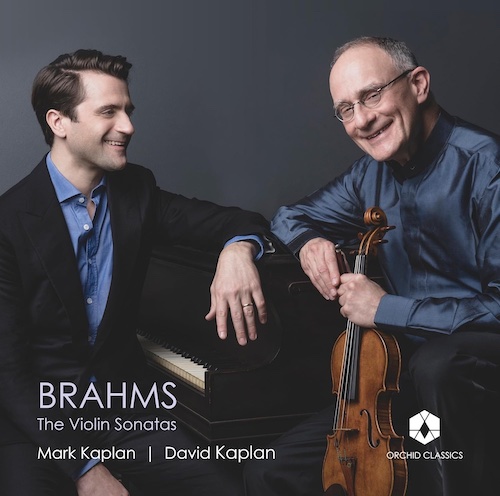
BRAHMS: Violin Sonata Nos. 1, 2, & 3 – Mark Kaplan, violin/ David Kapla, piano – Orchid Classics ORC 100454 (69:01) (6/19/26) [www.orchidclassics.com] ****:
Father and son duo Mark and David Kaplan recorded the three Brahms violin sonatas 14-16 June 2014, the fine sound of Mark Kaplan’s 1685 Stradivarius (“the Marquis”) and David Kaplan’s Yamaha piano captured by Producer Eric Silberger. From the outset of the 1879 “Rain” Sonata in G Major, the gentle nostalgia of the opening Vivace ma non troppo projects a thin, direct nasal tone that often reminds me of the sound from Joseph Szigeti’s instrument. Both through-composed and cyclical in construction, the sonata ranks among the composer’s most rarified, lyrical compositions, always tender in affect, the passion subdued but intensely wrought. Balances remain the focus of the procession of themes, the violin’s leading but the keyboard in fine symmetry in its realization of the dotted rhythm and the ubiquitous, three-note melodic contour.
Pianist David Kaplan takes a pregnant ritard in addressing the Adagio, and Mark Kaplan intones the main vocal theme with ardent introspection. Its aching expressivity will reappear at bar 84 in the last movement. The initial, martial rhythm assumes a processional quality, soon asserting itself with vivid earnestness. Solemn and intimate at once, the music soon adopts that “rainy day” filigree that often defines Brahms in his valedictory sensibility. He had paid homage both to composer Robert Schumann and his lamented son Felix, a violinist of future promise who died at age twenty-five. The last movement, Allegro molto moderato, alludes openly to songs from Brahms’s Op. 59, Nos 3-4, Regenlied and Nachklang, plangently reminiscent and expressively nuanced by painful memories. The Kaplans shape this music with tender care, the collaborators’ sympathy as palpable as the refined musicianship that realizes the composer’s bittersweet intentions.
The so-called “Thun” Sonata in A Major (1886), like many of the works of young Mahler, relies on songs and lieder for much of its inspiration. The singer Hermine Spies, a talented alto, received creative attention from Brahms, and the lyricism of Wie Melodien zieht es, Op. 105/1 and Kommt bald, Op. 97/5 infiltrates the opening movement, Allegro amabile. Commentors have well noted the resemblance of the opening to Walther’s “Prize Song” from Die Meistersinger. The keyboard part enjoys a plastic and persuasive series of gestures; and while David Kaplan intones his part affectionately, few have ever realized the keyboard contribution with the same magic as Mieczyslaw Horszowski. A series of declamations closes the movement, a sturdy resolution.
The second movement, Andante tranquillo – Vivace blends a slow section and a scherzo into one concept. Much of the violin and piano texture cross and reflect upon each other, in the same register or serving as doubles. One is reminded of Edgar Allan Poe’s insistence on “unity of effect” for a successful narrative. Some fine pizzicato and broken chord gestures glide by before the variation of the opening refrain that sails with casual elegance to the striking coda. Both metric ambiguity and intervallic repetition (A-C#, A-C) dominate the last movement, Allegretto grazioso (quasi andante), a thoroughly integrated lyrico-dramatic concept. Whatever undercurrents of doubt or conflict exist in this piece, the merger of the two instruments guarantees a hearty, impassioned conclusion.
The Violin Sonata No. 3 in D Minor (1888) likely meant to serve – as had the Double Concerto, Op. 102 – as a “reconciliation” piece, not for violinist Joseph Joachim but for conductor Hans von Bülow (1830-1894), whose advocacy for the music of Richard Wagner had alienated the two musicians. In four movements, this sonata offers a greater range of emotion than the more lyrically minded first two sonatas, with metric ambiguity and sudden dynamic shifts more aggressive than previously. Despite the violin’s sotto voce opening, the music soon explodes with emotion, a subito forte from David Kaplan asserting a sturm und drang dimension to this piece. So, too, the bariolage effect from the violin and sustained pedal point from the piano in the development maintain a distinct tension. The “circuitous route” through F # minor has had a disconcerting effect, until we pass, sostenuto, through modulations (including the major mode of D) leading back to a fragmentary hint of the music’s origin.
A serene cavatina, the second movement Adagio proceeds in D major, a 3/8 quasi-nocturne n waltz mode, in which the keyboard remains subservient to the violin. Mark Kaplan establishes a leisurely nostalgia that soon achieves its own, poignant rapture, capped by a potent passage in double stops. The expressive modulation, especially those in C, adds to the hesitant groping for emotional certainty. A kind of mischievous scherzo ensues, in F# minor, Un poco presto e con sentimento. The dalliance suddenly becomes ardent and serious, moving briefly to D minor. The da capo has the piano in sotto voce expression of the main impulse, while Mark Kaplan plucks the strings in thirds, and the movement ends.
The last movement, Presto agitato, offers a 6/8 tarantella of muscular power and momentum. I well recall how the collaboration of Jascha Heifetz and William Kapell struck me for their sheer emotive vehemence. The Kaplans prove not a whit less agile and insistent in their interpretation, which does not lack for the Brahms poetry. Syncopation appears to be the means of the day, with modulations into the modes of F. When the musicians combine for the coda, the result proves compelling, a just closure to a work that had considerable significance for the original musicians, and as a farewell to the violin sonata medium of which Brahms remains a master.
–Gary Lemco
Mark Kaplan, David Kaplan — Brahms Violin Sonatas
Violin Sonata No. 1 in G Major, Op. 78
Violin Sonata No. 2 in A Major, Op. 100
Violin Sonata No. 3 in D Minor, Op 108