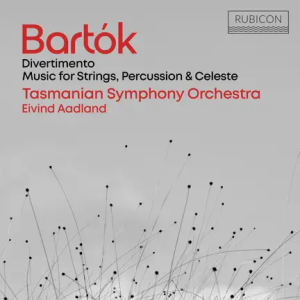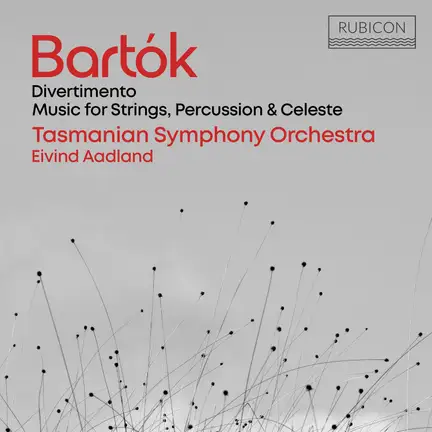
BARTOK: Divertimento; Music for Strings, Percussion & Celesta – Tasmanian Symphony Orchestra/ Elvind Aadland – Rubicon RCD1205 (54:35) (11/21/25) [Distr. by Integral] ****:
Recorded in April and August 2023 at the Federation Concert Hall, Nipoluna, Hobart, Tasmania, this splendid-sounding recital features two Bartok compositions commissioned by the visionary conductor Paul Sacher (1906-1999), whose progressive sense of programing made his Basel Chamber Orchestra world famous. The 1939 Divertimento, conceived in a miraculous two weeks, though written at a time of impending world crisis, maintains an academically vigorous tenor, combining Bartok’s sense of Baroque concerto-grosso style with his Magyar, modal temperament. The piece savors the contrast between the ripieno, solo string instruments against the concertino, the full tutti of the larger mass of players. While cast in three traditional movements of fast-slow-fast, the work diverges from tonal and metric convention, jarring us with fierce accents and askew harmonies rife with the folk inflections of his native Hungary.
Pungently aggressive, the first movement Allegro non troppo sets forth two opposed motifs, alternately visceral and driven, and sweetly calm and bucolically suggestive. Bartok’s use of E-flat as a “blue note” colors his sonic effect, which often resists a clear tonality. When the full body strikes out in brazen, chromatic slashes of sound, the concertino offers a calming patina of diatonic harmony. The progressive development proves both playful and learned, at once. Bartok employs selective moments of stretto to increase the wavering tensions. As we approach the coda, a truly romantic sonority emerges, closing in a disarming peace.
Bartok’s eerie second movements retain a repute for their misty, nocturnal ethos, and this Molto adagio conforms to the pattern. Moving in slow, chromatic gestures, sotto voce, the music urges shadows and hints of personality, something akin to the humanoid figures in the paintings Giorgio de Chirico. Various outcries, haunted trills, plummeting descents, and mounted crescendos define an uneasy universe, Gothic and threatening. The Tasmanian Symphony, eloquent and articulate, illuminates Bartok’s eldritch textures.
In duple meter, the rondo last movement, Allegro assai, asymmetrical and potently syncopated, dissolves the former gloom, offering crisp counterpoint as an anodyne for existential insecurity. Ethnically dependent on Magyar rhythmic life, the music breaks into a solo violin, village meditation, again assumed by the darker strings. Suddenly, a joyful, spirited dance erupts, weaving various modal harmonies into the vivacious mix, as if the old masters Haydn and Mozart were compelled to engage in high-mountain rustic gymnastics. A plucked-string episode interrupts the spectacular momentum, which rather mocks us as it gambols to its conclusion.
In my early concert-attendance career, Bartok’s 1936-1937 Music for Strings, Percussion and Celesta – the four-movement work commissioned for the tenth anniversary of the Basel Chamber Orchestra – became the most often performed work by the several conductors who followed Leonard Bernstein’s lead. Bartok divides his musical forces into two groups of opposed strings, between which he assembles his percussion: timpani, bass drum, snare drum, piano, cymbals, tam-tam, xylophone, harp and celesta, with its metal-plated sonority, first used by Tchaikovsky in his The Nutcracker ballet. The antiphonal effects become “intruded upon” by a host of color effects, constituting a quasi-Baroque ensemble of startling range and colors.
The opening movement, Andante tranquillo, may prove the most audacious: a polyphonic palindrome, it presents a slow fugue by muted strings in graduated crescendo, until the assertive bass drum announces a regression, both backwards and inverted, of the assembled materials. The dominant pitch is A, which begins and closes the movement. The influence of Beethoven’s late quartets seems palpable, given the strictness of the feverish textures and the rigor of the layered voices. Even though the mutes for the violins have been removed, the dynamic becomes subdued while the celesta intones arpeggios.
The second movement, Allegro, utilizes antiphonal effects between strings, while the piano, timpani, and harp contribute to the vivacious activity. The shifting metrics, 2/4 and 3/8, sustain a syncopated drive that delights in changes of timbre and color effects. Conductor Aadland has his Tasmanians in brisk attention, the accents, especially in plucked sequences, sonically alert. The third movement, Adagio, illustrates the “night music” sensibility in Bartok, featuring interplay by xylophone and celesta to inflect another palindrome from the composer, eager to demonstrate his take on Classical architecture in music. Of particular note emerges Bartok’s use of slide effects, glissandi, in both strings and timpani, to heighten the unearthly mood of the occasion. The cascading percussive sounds, especially from the xylophone and various, grumbling drums, assign a feral, primitive energy to an otherwise hazy atmosphere.
An energetic folk dance concludes the work, Allegro molto, announced by the timpani and strummed strings, a revel in true Magyar style. Between the stretti and the rapid syncopations, we become totally immersed in the uncanny momentum Bartok achieves, while he still manages to toss in the interspersed comments from the piano, whose significant, dissonant part now resembles that of the first two piano concertos. Patterns from the opening fugue intrude once again, setting a dark hue on the dance, which has slowed to an almost static halt, until trilled string work renews the vigorous assault, and the celesta makes a scalar comment. The last pages become almost dizzy with alternate tempos, finally mounting to a last gasp of Magyar assertion, deftly and stylistically executed here from Tasmania.
—Gary Lemco