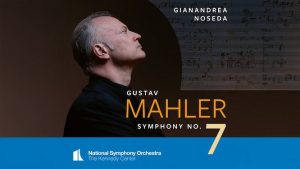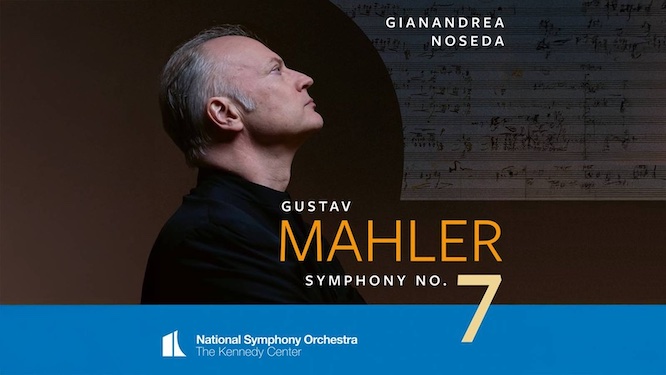
MAHLER: Symphony No. 7 in E Minor “Song of the Night” – National Symphony Orchestra/ Gianandrea Noseda – National Symphony Orchestra NSO0022 (75:12) (12/5/25) [Distr. by PIAS] ****:
My first real encounter with Mahler’s “enigmatic” Symphony No. 7 of 1908 occurred at my inaugural 1984 appearance on WQXR’s “First Hearing,” where my colleagues Richard Kapp and Robert Jacobson commented on the “anonymous” performance, which we soon learned had been led by Bernard Haitink, in a singularly pristine and academically clinical interpretation. I asked, “When is it an appropriate time to listen to such contorted, emotionally shifting, and Classically contrived grotesquerie?” Conductor Richard Kapp replied, “When you’re in sick bed, sporting a temperature of about 104, and contemplating the vagaries of life.”
The “hothouse” effect results from the work’s enormous, even bloated, emotional range. Rather in the spirit of E.T.A. Hoffmann, the universe feels compressed into a world of contraries, grandly grim marches, mischievous asides, meditatively lyrical and poetical musings, constant shifts of temper and timbre, all in a concession to the power of Change, yet set in a palindromic progression that suggests Blake’s “fearful symmetry.” The true master of this work, conductor Leonard Bernstein, maintained a thorough grasp of the music’s expansive ironies and dazzling originality, unafraid to seize its contentious, irascibly mercurial figurations with a passion worthy of Mahler’s tormented soul. Some pundits label this music “existential,” as though Mahler’s affective kaleidoscope has a greater claim on experience than his worthy, kindred spirits. I rather conceive that Mahler felt the tearing, brutal paradoxes of the oncoming century, what he called “the century of death.” Those contradictions proved no more trying than his own, personal demons, many of which literally exult in their grand expression.

Gustav Mahler,
by Moritz Nähr
That Mahler designated several movements as “night pieces” has selected commentators’ posing Rembrandt – especially his The Night Watch – as a possible source for Mahler’s orchestral chiaroscuro. While Novalis, Lord Byron, Eichendorff, and Nietzsche lay poetic aspirations on the subject of night, Mahler’s progression no less seizes daylight and major keys as a spiritual objective. The C major second movement Nachtmusik has Noseda, like Bernstein, providing jarring, lusty, and playful accents to an otherwise pensive context. Horrible morbidity of mind collides with thoughts of glorious transcendence for the honor of a final Truth. In the second of the Nachtmusik intervals, a mandolin appears, perhaps a concession to Nietzsche’s call for a soothing, Mediterranean spirit he found in Bizet’s Carmen. True, Mahler’s last movement, a Rondo-Finale that insists on its main theme seven times, also concludes in C major, but what a knotty, circuitous ride Man and Nature it has been, to the point of invoking cowbells! We remind ourselves of the opening sequence of the film, Last Year at Marienbad, whose meandering hallways indicate a journey through the infinite maze of the human mind and imagination. Perhaps those miles of meandering caves in Coleridge’s “Kubla Khan” serves as the better analogy.
Conductor Noseda and the National Symphony – which added this massive work to its repertory as recently as 1979 – perform this gargantuan piece with ardor and loving attention to details, the demands of articulation, timing, and emotional balances deftly maneuvered. I found the interpretation much in the middle ground between literalist homage and expansive, romantic indulgence. Noseda, in his brief accompanying note to the booklet, admits “a special bond” with this music, and his affection, clearly shared by his able collaborators, shines forth in this interpretation. Recommended.
I mention, in closing, that the French Radio possessed a copy of an ORTF Bruno Walter reading of Mahler’s Seventh – a work he and CBS did not record for posterity – and the radio people decided to erase it, in favor of maintaining his performance of Eine Kleine Nachtmusik!
—Gary Lemco