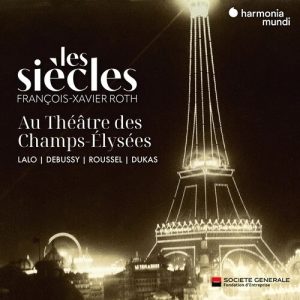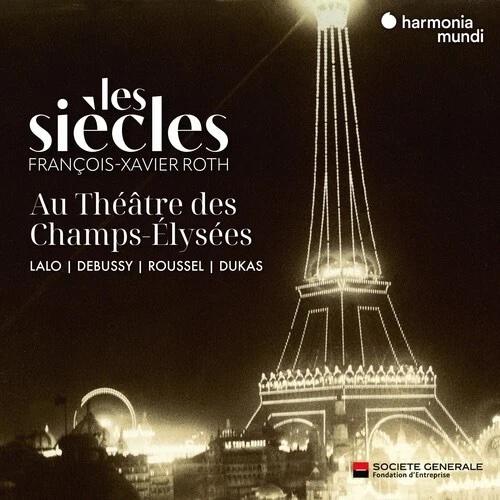
Les Siècles au Théâtre des Champs-Elysées = LALO: Namouna Suite; DEBUSSY: Prélude a l’Après-midi d’un faune; ROUSSEL: Bacchus et Ariane Suite; DUKAS: L’Apprenti sorcier – Les Siècles/ François-Xavier Roth – Harmonia mundi HMM 902736 98 (61:14, complete listing below) (9/19/25) [Distr. by PIAS] ****:
The period instrument ensemble Les Siècles, led by its founder François-Xavier Roth (b. 1971), has, since its inception in 2003, distinguished itself for clarity and precision in 19th and 20th Century repertory. The present live concert, recorded 10 January 2023, focuses on French music of rather virtuosic caliber, allowing several of the orchestra musicians opportunities for solos that combine fluency and intensity.
The program opens with five excerpts from Edouard Lalo’s 1882 ballet Namouna, set in Spanish style on the island of Corfu, featuring a devoted slave whose love for her master protects him from various intrigues. Proffering both audacious harmonies and rhythms, the music anticipates moments in later Ravel and Stravinsky, but remains notable for its own color schemes and instrumental blends. The cello line of the Prélude – Andante enjoys a rich, hefty sonority, while the supporting tissue seems infused with Wagnerian motifs from Das Rheingold.
Sterling string pizzicati mark the ensuing Sérénade while selected woodwinds illuminate the punctuated, declamatory melodic line. For haunted transparency of effect, the tender Theme and Variations elicit a sensuous contour. Parades de foire relish a militant hustle and muscular arioso reminiscent of the best in Bizet. The ensemble woodwinds, brass, and battery declare their own virtuosity in the final number, Fête foraine, a whirlwind only a step away from Petrushka.
The virtues of Claude Debussy’s 1894 Prélude a l’Après-midi d’un faune have often been lauded, given the remarkable fluidity of the color scheme, having high instruments descend into nether regions while low instruments savor the arial regions to which the flute (Marion Ralincourt) invites them. Briskly paced (under nine minutes), the urgent Symbolist effects do not achieve the haze that Svetlanov attained in London by lingering in amorous space for thirteen minutes. Still, Ralincourt’s period flute, from 1892, proves enough of a siren to lure us into ecstasies, supported by some dazzling hap effects.
Conductor Roth cherishes composer Albert Roussel as a local, creative resource, given that Roussel (1869-1937) had been born in Tourcoing, the local base for Les Siècles. The Suite No. 2 from the 1930 ballet Bacchus et Ariane presents nine movements, all relatively brief, that depict the abduction of Ariadne by Dionysus, as told by Ovid. Once more, Ms. Ralincourt’s flute – a Louis Lot instrument – compels our attention.
Contrapuntal technique vies with angular rhythmic and melodic contours that imbue the score with a neo-Classical sensibility close to Stravinsky’s work around the same time period. The pounding fervor of Danse d’Ariane invests the music with a motor power quite reminiscent of Prokofiev. The final scene, a glorious apotheosis set Allegro molto, has a bacchanal conclude with Bacchus’ having crowned the head of Ariane with stars, true Cecil B. DeMille.
Roth and spirited company conclude with the 1897 concentrated masterpiece by Paul Dukas, his The Sorcerer’s Apprentice, after a ballad by Goethe. Set as a one-movement symphonic poem in C minor, the scherzo evolves two themes to capture the hubris of the magical upstart, one of them a direct utterance of the Beethoven “fate” motif.
Rather than repeat all of the testimonials to Mickey Mouse in Disney’s 1940 animation Fantasia, let me suggest a few literary companions: read Nathaniel Hawthorrne’s “Dr. Heidegger’s Experiment” for a parallel moment of supernatural prowess. In Ralph Ellison’s novel Invisible Man, the narrator has a similar “bucket scene” that ultimately explodes out of control, only in fire instead of water. Dukas’ compelling bassoon part comes to us via Michaël Rolland, who plays a Buffet Crampon instrument from around 1900. The appropriately ferocious performance conjures up rousing audience appreciation for an evening of consistent musical witchery.
—Gary Lemco
Les Siècles au Théâtre des Champs-Elysées
LALO: Namouna – Suite No. 1;
DEBUSSY: Prélude a l’Après-midi d’un faune;
ROUSSEL: Bacchus et Ariane – Suite No. 2, Op. 43;
DUKAS: L’Apprenti sorcier
Les Siècles/ François-Xavier Roth