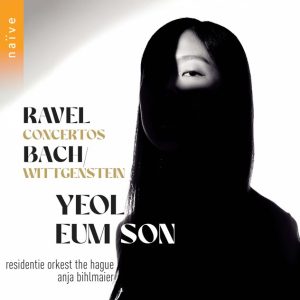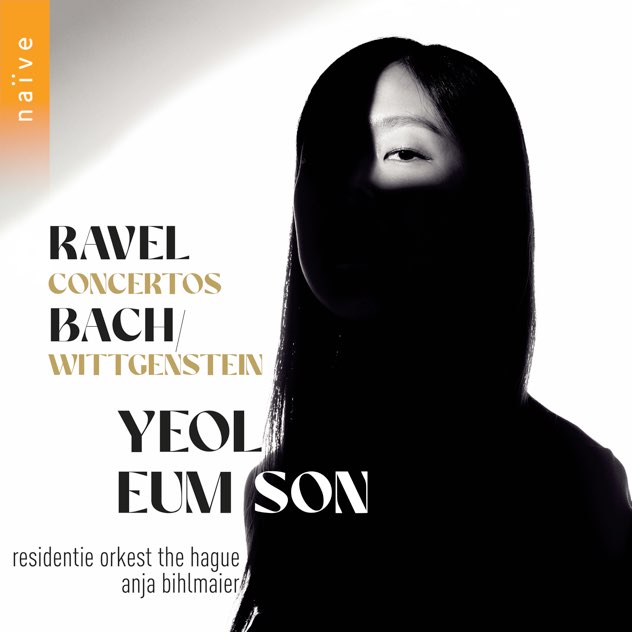
RAVEL: Piano Concerto in G Major; Piano Concerto in D Major for the Left Hand; BACH Prelude and Fugue in C; Prelude in C Minor; Gigue; Siciliana – Yeol Eum Son, piano/ Residentie Orkest the Hague/ Anja Bihilmaier – Naïve V8447 (52:00 (complete details below) (5/12/25) [Distr. by Naxos] ****:
Korean pianist Yeol Eum Son (b. 1986) first came to my attention via the 2009 Van Cliburn Competition; then on its heels, the 2011 Tchaikovsky Competition, both of which illustrated her glistening, clear technical prowess. This album conceived over the period 2022-2024, combining concertante works by Ravel with solo Bach pieces arranged for the left hand – by Paul Wittgenstein (1887-1961), who commissioned the Left Hand Concerto – bears a valedictory character, a signing lament for the World War that preceded the works, coupled with the triumph over adversity that marks the transcriptions, so that a one-armed performer may realize the gift of melody inscribed in the Baroque works.

Maurice Ravel, 1925
From the opening Allegramente whip crack and high piccolo, the 1932 Concerto in G crackles with humor and transparent aplomb, buoyant and mischievous. Basque harmonies collide with jazz rhythms, not to create bad Gershwin but to romp in Spanish sensibilities that no less convey the textural freedom and youthful verve in Mozart and Saint-Saens. Ravel literally tormented himself in creating the operatic Adagio assai, whose lyric tracery, a waltz-sarabande whose purity of line suggests an antique, aristocratic gesture. Such graceful innocence the world may no longer be capable of supporting in our time.
In this second movement, as she has in the cadenza of movement one, Son exerts a lithely fluid line, sustained by a firm sense of pulse. The English horn, who had set the Basque tone of the first movement, restores the main melody, ceded temporarily to clarinet, oboe, and flute. By the last movement Presto, Ravel has yielded to his notion of the piano as primarily a percussive instrument, antagonistic to the gentler persuasions, and so joining trumpet and trombone for a dazzling series of runs over an eddying and mounting tension that threatens to become some martial call-to-arms. The sly glissandi of the various instruments ameliorate the wild aggression, so even the final thump of the bass drum feels more like a smirk than an existential demise.
Ravel’s 1930 Concerto in D for the Left Hand, conceived in one movement subdivided into three parts, suggests a Lisztian symphonic poem with piano obbligato, arising from the somber depths of keyboard and orchestra to proclaim a rebirth of its commissioner’s musical vitality. A grinding sarabande merges from a musical, bass morass dominated by contrabassoon and horn, evolving to an assertion of will by the piano and its liberated cadenza. The improvisation becomes bold and manic, somberly virtuosic, as Ravel stretches the intervals between thumb and index finger, maintaining consistently the illusion of fluid motion. The middle, fast section, in a deliberate jazz style, arises from impulses stated earlier, only slower.
Conductor Bihlmaier delivers crisp attacks, earthy punctuations and stealthy thumps to underline the piano’s dervish romp into a world simultaneously complicated and folk-like. Harp and snare drum effects bristle and clomp, moving us into a musical phantasmagoria, one step away from one Gatsby’s celebrated summer parties. The cadenza from Son utters pure poetry and the love of life and its compensations. Cyclical, symmetrical, and fearfully demanding, the final movement declares a moral, if not a physical, victory of staggering proportions.
To complement the Ravel concertos, Son drew upon Paul Wittgenstein’s third volume of Transcriptions (Bearbeitungen) from his School for the Left Hand. The adaptability and flexibility demanded to sustain Bach’s arioso for the C Major Prelude reveals registration art that conceals art. The brief C Minor Prelude requires quick staccato and repeated note adjustments that sound like Scarlatti. The familiar Gigue from the first of the piano partitas moves a bit more marcato than, say, Lipatti or Gould, but it evinces good, fluid pulse and motor inevitability. At last, we have the tender Siciliano that sounds like a music-box in the style of the French clavecinistes. The final trill is magic.
—Gary Lemco
Yeol Eum Son plays Ravel, Bach
RAVEL:
Piano Concerto in G Major;
Piano Concerto in D Major for the Left Hand;
BACH BWV 846 (arr. Wittgenstein for he left hand):
Prelude and Fugue in C Major,
Prelude in C Minor, BWV 999; Gigue from Partita No. 1 in B-flat Major, BWV 825;
Siciliana from Sonata for Flute and Harpsichord in E-flat Major,
Residentie Orkest the Hague/ Anja Bihilmaier