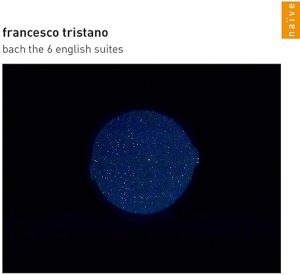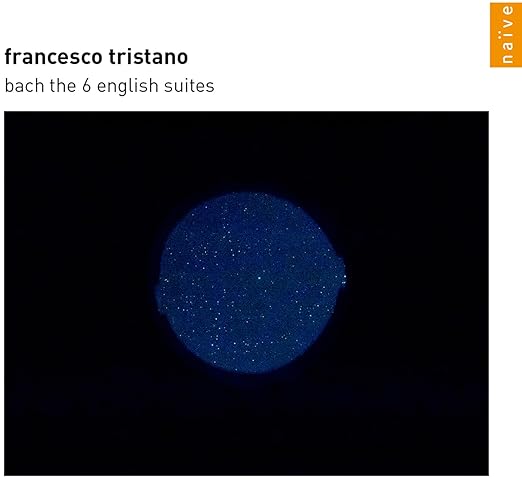
BACH: The 6 English Suites, BWV 806-811 – Francesco Tristano, piano – NAÏVE V8828 (2 CDs = 53:38; 50:49) (2/27/25) [Distr. by Naxos] *****
Recorded in December 2022, this survey of Bach’s 1715 set of six English Suites by Francesco Tristano (b. 1981) has us consistently captivated by the fiery, vigorous approach requisite to their successful realization. While not so concerned to have his Yamaha CFX instrument sound like a harpsichord, a la Glenn Gould, Tristano enjoys an equally lucid, crystalline articulation that maintains the essential dance impulses that Bach refines with deft, contrapuntal audacity. Tristano’s sonic allure in the Bach sarabandes proves as infectious as his visceral delight in the faster dances, the courantes, bourrées and gigues. Although conceived in Weimar presumably for an English sponsor or audience, Bach’s absorption of the Italian and French models into a brilliantly complex organization dwarfs whatever influences Purcell or Dieupart’s suites may have exerted. Albert Schweitzer concisely sums up Bach’s contribution when he states, “Bach goes still further; he always visualizes the form and gives each of the principal dance forms a definite musical personality. For him the allemande represents vigorous but easy motion; the courante represents a measured haste, in which dignity and elegance go side by side; the sarabande represents a grave and majestic walk; in the gigue, the freest of all forms, the motion is quite fancy-free. He thus raises the suite form to the plane of the highest art, while at the same time he preserves its primitive character as a collection of dance pieces.”
The moments of unbridled energy mount by advanced degrees, given the blazing attacks that mark the “Prelude” from Suite No. 4 in F Major and the two “Bourrées” from Suite No. 2 in A Minor, for me set in stone by Glenn Gould but equally vivid in Tristano’s fluent realization. The “Sarabande” from Suite No. 4 evinces a searching, learned quality, while the two “Menuets” and concluding “Gigue” convey a high, if whimsically buoyant, purpose. The percussive, staccato immediacy of Tristano’s “Prelude’ for the Suite No. 3 in G Minor literally took me by storm, while his unbroken momentum retains the tension of the individual, polyphonic lines, which bear his imprint of added grace notes. The flexible shaping of Bach’s allemandes allows their Italian character to sing, despite their “German” designation. Tristano colors the “Allemande” from Suite No. 1 in A with a music-box sensibility, the close imitation pert and lithe. The pair of “Doubles” testifies to the influence of the French clavecinists on Bach’s keyboard style, and Tristan renders them with refined taste.
Perhaps the most demanding of the series, No. 5 in E Minor urges a colossal conception, its opening “Prelude” laden with 200 measures of fugal exhilaration. The “Courante” is set as a moto perpetuo, an Italian athletic contest well met by Tristano. The French court makes its appearance in two “Passepieds,” a dance more light in tone than a menuet, the first of which Bach shapes as a rondo. Tristano’s natural virtuosity finds a perfect vehicle the concluding, witty “Gigue,” receiving the “play catch” treatment from the hands.
The D Minor Suite No. 6 wastes no time establishing its dramatic profundity and emotional largesse. Much of the tablature of the opening “Prelude” and its richly ornamental fugue seems reminiscent of Bach’s organ studies in the form. Tristano extends the regal expressivity of the piece in the ensuing dances, Tristano’s repeated notes cast a relentless, pulverizing effect, so we simply submit to the monumentality of the moment. The succeeding “Allemande” complements the “German” sensibility of the piece, its contrapuntal density offset by Tristano’s clear lines. Much of what remains of this extraordinary work expresses the French taste, with its explosive “Courante” and galanteries in the form of contrasted “Gavottes.” None can deny the expressive power of the D minor “Sarabande,” the very heart of the whole composition. Its Spartan simplicity finds grand contrast in the “Double,” a flowing line in 16th notes that edify the original line with an effervescent glow. We have been awaiting Tristano’s final “Gigue,” a Force of Nature in itself, the fugal material redolent with the Elixir of Life, brought to thunderous fruition by a musical artist for whom Bach represents a divine mission.
—Gary Lemco